Background Switcher (Hidden)

When the Goldenrod Peaks

Wednesday, September 30, 2020

5 comments

Here's what happens every morning on Indigo Hill.  
Curtis and I head out the meadow. Sometimes there is laundry still hanging from the day before, because the rain seems to have quit. I really like the way the colors of my load work with the meadow. Even the red PJ bottoms. I basically wear the same clothes all the time. I have two closets full of nice clothes that never see the light of day, because I don't go anywhere but the grocery store every 7-10 days!


Up close to the house is the prairie bit, visible to the left of the clothesline. There are Maximilian and gray sunflowers growing rampant in there. I was given one Maximilian sunflower many years ago. Not knowing what it really was, other than native, I planted it by the back door. It made clear its plans to grow ten feet high and take over the entire flower bed. Out it went to the prairie meadow, where the bees and butterflies and goldfinches adore it.  When the meadow was disced early this spring, it divided like Medusa's head and now it's everywhere out there. 


The meadow is at absolute peak right now at the end of September. Tall goldenrod is everywhere and it is ablaze with color. 
If you click on the photo below you can see Curtis looking for me out in the meadow. He lost track of me while following a scent. 


It is like a sea of gold out there, the house topping a cresting wave like a red ocean liner.


Leaving the path to wade out into it gets you pantslegs full of beggarticks (Desmodium), those little triangular  green pita pockets full of exasperation.
So I wear shorts, even when it's cold, until those durn things die down, because life's too short and sweet to sit around picking Desmodium off my pants.


My mown paths make green rivers through the gold. I love this time of year because I can finally stop thinking about what needs mowing. Man, I mowed a lot this year! Time for the grass to go to sleep. Time for me and the John Deere to catch a break. That said, I'm headed out now to do a thorough weedwhack of the grounds near the house. No rest for the one-woman band. After that, I've got two dozen Asclepias plants to set out--mostly baby butterfly weeds, plus four big common milkweeds.


I adore the combination of heath aster and goldenrod. Starry night and fireworks!


And when it's fully out, there's nothing like heath aster. I always think what a beautiful bridal bouquet it would make. 


The long view from near the end of the meadow. That clump of red sumac in the middle of the field is where Bill had somebody with a dozer dig a test pit to see if they could hit water. They did, and there's a little imitation pothole there, and winged sumac sprang up because then he couldn't mow there without breaking an axle. He wanted to dig a pond on this dry ridgetop, and I have to say I fought him hard on that one. I knew it would only dry up every summer, probably every spring, and what kind of dang pond would that have been?


The sumac clump lives on, and Bill sleeps near the big pine. Not sure I won that round.


I wasn't quite ready for bright red of winged sumac this morning, but whoomp! there it is.


And the deer thud lightly down the paths. 

When we're done in the meadow, Curtis and I head to the orchard to walk the four parallel mown paths out there. Lately there have been lots of migrants, and Curtis tells me the coyotes are using the paths. His bark is rarely heard, and this is the first time I've heard his Darthy growl. This went on for two minutes. Four barks and rough inhaling growls. HEY YOU GET LOST! hhhhhhhhrrrrr HEY YOU GET LOST!!


I need to set up our second game camera out there and catch some of that action! I keep picking up a lone coyote on the Meadow Cam at all hours of the day. 

Curtis sits beside the Dogwood God, watching and waiting for me. He doesn't stray far when there are coyotes around. 


Good dog, Curtis.



I'm Gonna Make You Love 'Em

Saturday, September 26, 2020

10 comments


Everybody loves a big dew-covered spiderweb, right? But does everyone love the artist who makes those? Here's Neoscona crucifera, the Arboreal or Spotted Orbweaver. I'd say they're one of my favorite spiders, but I have so many.  Right now is a wonderful time to go out and find Neosconas. They hang like little plums from eaves and, in this case, sumac fruit clusters. This one cleverly hides in the sumac when she's not working in her web, which she does at night. By morning, she may eat the entire web and recycle the silk proteins to make another one this evening. 


Those of you who follow me on Instagram and Facebook know that I'm mad for the sit and wait predators, the ones who hide in flowers waiting to ambush pollinators. Spiders have to eat, too! This white-banded crab spider Misumenoides formosipes has caught herself a nice fly.


I visited a pair of these crab spiders (well, both were females) on a tall thistle plant in the orchard this fall, for day after blissful day, and I loved to see where they were and what they were up to each morning. These patient predators wait hour after hour for pollinators to visit their flowers. When a flower would fade they'd move to a fresh one. 
Look at those arms held wide to give a bee a big hug! Aww! 


They also come in French vanilla. Not sure what this spider thought she was gonna catch on a spent thistle. Maybe a goldfinch?
If you look really closely at these (as in, click on the photo), you can see a ridge just below the eyes that looks like a Snidely Whiplash mustache. That's the white band that differentiates it from the goldenrod crab spider.


Who doesn't love a black and yellow argiope, or garden spider? Argiope aurantia is just a spectacular spider. I love the zigzag landing strip they weave in the web just below where they rest all day. 
I don't see near enough of these spiders for all the habitat that's here. 


Side view, very fetching as well. When you see a big spider like this, you can bet it's a female. Male garden spiders are minuscule by comparison. That's true of almost all spiders. The females are the ones who get your attention. 


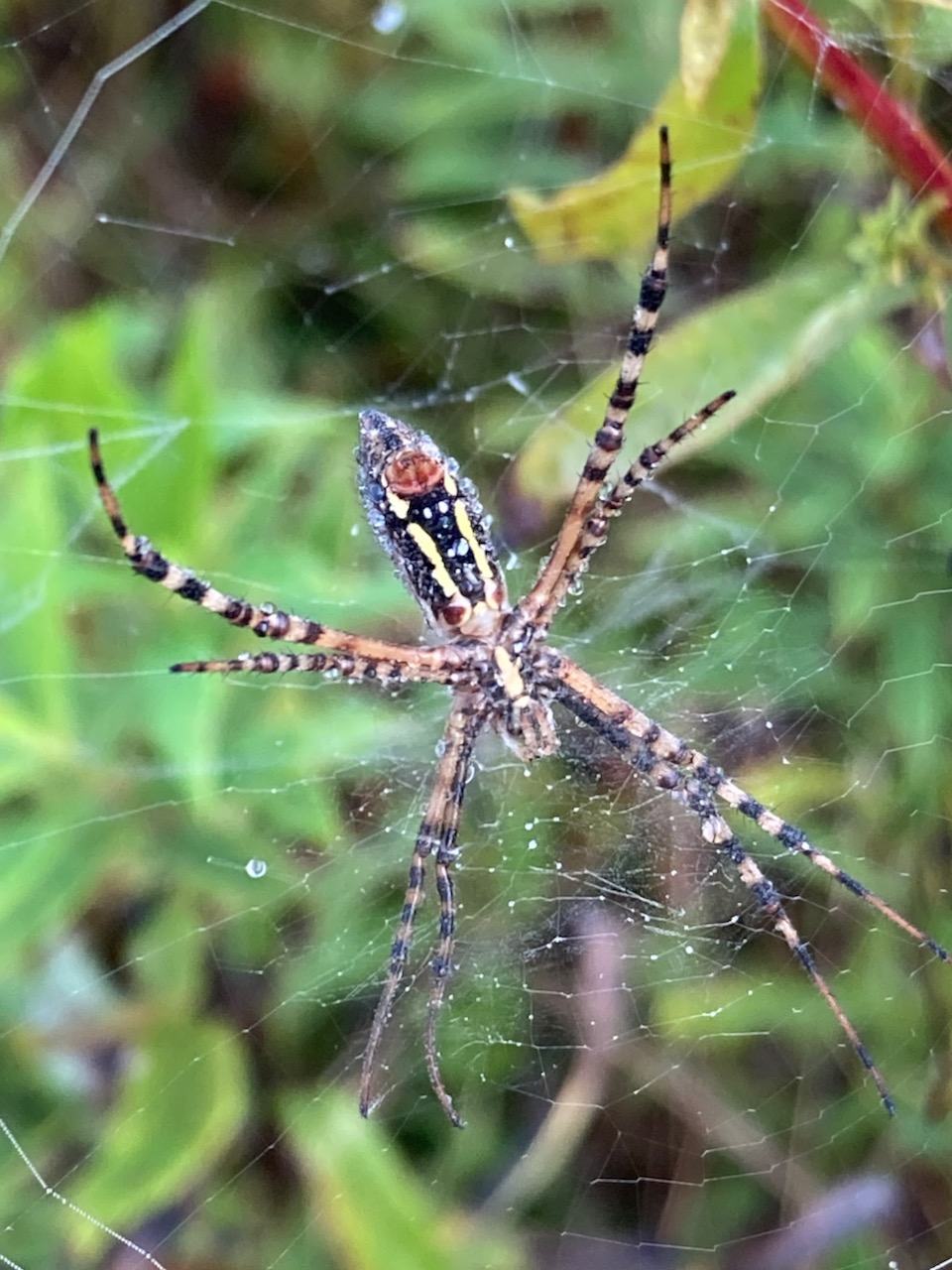
This was a lifer for me this year: the Banded Garden Spider, Argiope trifasciata. 


It weaves a beautiful web, and is smaller, thinner and more silvery than the more common black and yellow argiope.


It has a very fancy reverse.


I was delighted to add this creature to my sanctuary list, and to my rapidly growing iNaturalist sightings board. Ooooh I love that app. It really encourages me to learn my spiders and insects. And having the list of them with their Latin names at the touch of a finger on my iPhone helps me learn those lovely names, too. 

Of course, iNaturalist will crunch away at your photo and identify the subject, which seems too darned easy to me! I like my books! and still refer to them. But man, it's handy and such a thrill to look back over your sightings and have the date, your notes, and the exact location where you saw them. This app, geared as it is to iPhone photography, suits me to a T. And because so many people are feeding in their photos now, the identification algorithms have become infinitely more robust than they were when I first became a user three years ago. Durn thing can tell a fall bay-breasted warbler from a fall blackpoll! My first post was a road-killed porcupine I found, out of range, in extreme western Maryland. That was October 2, 2017. Three years and 226 posts later, I'm learning my bugs and spiders, and about to celebrate my third iNat anniversary. I believe this app could change the world, empowering everyone to identify and learn about the natural world around them.


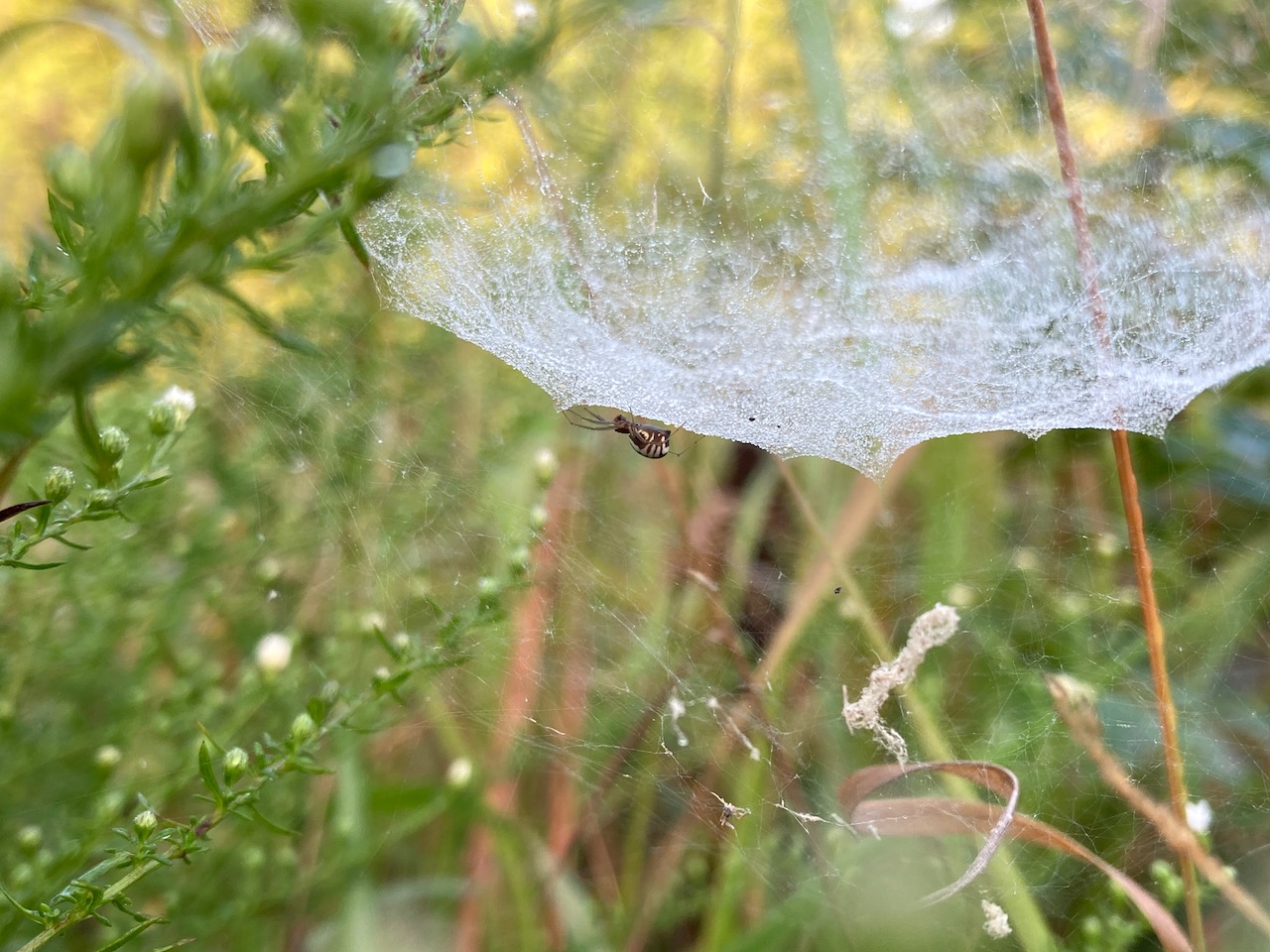
As delighted as I was to get those big orbweavers, this one eluded me for a long time. This is the work of the bowl-and-doily spider, Frontinella pyramitela. Isn't that the most gorgeous Latin name? You see these webs by the thousands in a good backlit morning field, frosted with dew, in mid-September. Usually there are two tiers, the bowl, and the diaphanous doily beneath it. 


The spider is in this photo, just really hard to see. That's because it hides under the top bowl (above the doily), and BITES insects THROUGH THE WEB when they fall into the bowl! Isn't that cool? If you click on this photo and blow it up, you can see her clinging to the bottom of the bowl, left of center. 

Here's one that's more easily visible, above the web, crawling up. Look at the sucked-out husks of little moths, caught in the doily! This spider is a bloodthirsty (well, hemolymph thirsty) killer! 


I tried for days to get a better photo of the bowl and doily spider. It's just so tiny and so hard to shoot, because it hides under the gauzy web and swiftly climbs to a hiding place if you disturb it.

Finally, persistance was rewarded. I found a beautiful big female amidst the budding heath aster. Oh yes!


And with the fabulous telephoto option on the SE, I finally got an acceptable shot of the beautiful bowl-and-doily spider. 

Death to tiny moths, and huzzah! This fierce little warrior leaves carcasses strewn in her wake. 


Another new spider for me was the White Micrathena, Micrathena mitrata. I found this lovely female in my garage, so I moved her outdoors for a better life. Many spiders prefer to be in buildings; my sense was that this isn't one of them. 

What a looker, what a little jewel. As I have learned more about and come to admire spiders so much, my fear of them has vanished. They are by and large harmless. I mean, I don't pick up black widows, and I'm glad I live (mostly) out of range of the brown recluse, but I'm not afraid to let a little thing like this hitch a ride on my finger to a better spot. 

This is another one for which it's tough to get a decent photo. The Pennsylvania Grass Spider, Agelenopsis pennsylvanica,  is a hulking beast that spreads a web of unsticky silk a foot or more across a meadow floor. It waits in a neat tunnel for the vibrations of an insect walking across the silk, then dashes out with lightning speed to snag it. For this species, iNaturalist got me to the grass spider genus, Agelenopsis, and I hit my beautiful Common Spiders of North America book by Rich Bradley to narrow in on the species. The plates in that book are to die for. Highly recommended.


I'll save one of the coolest looking spiders for last. I'm really happy with these photos of a Spined Micrathena Micrathena gracilis, which is a very common spider which is very hard to photograph. The problem is it hangs in the middle of paths, waiting to festoon me with a faceful of silk, and there is nothing for the iPhone SE to focus on!  So I'm forced to put my finger there so the camera can see to focus, like this...


and then I move my finger out of the frame and praaaay it doesn't choose to refocus on the goldenrod behind...and once in a blue moon the focus holds and I get something like THIS which makes my heart swell, with the blue and gold bokeh bits behind


and then if I'm super lucky I can zoom the SE up and get an actual photo of the coolest lookin' little spidey in the hood. Big ol' silk factory in that spiny abdomen, the better to drape Zick with!


I hope you've enjoyed this foray down the webby paths of Indigo Hill, and I hope you'll seek out some spiders of your own, and try your hand at spidertography, and check out iNaturalist, which will teach you so much. And maybe then you can identify your own bugs and beasties! Yes! That was a hint! ha ha !!

Happy buggin'!


28 Minutes of September

Tuesday, September 15, 2020

12 comments

 The morning started beautifully, at 8:17 AM with this spring's rose-breasted grosbeak, trying to sing. He'd gotten strawberry jam all down his front. Just kidding--he's coming into his first adult plumage, but it's gonna take a couple years. I love seeing them when they're just showing the first hints of their sex.


I went inside reluctantly, but I was due to be on a public radio fundraiser for WOSU with my dear friend Ann Fisher,  and I wasn't about to miss that! I am deeply honored to be asked to help with a fundraiser. Ann asks such wonderful, unexpected questions, and I adore her and hold her in highest regard. I feel like this narrow sort of nature savant, where she's a brilliant generalist who knows something about everything. I know I'm kind of a break from the news, and I like serving in that capacity.

Well, I'd no sooner hooked up the Zoom audio connection with the Columbus OH radio station than a little wave of fall migrants came sweeping into my yard. I'm inside sitting at my drawing table, all tethered by headphones plugged into my laptop, and all this is happening outside! 

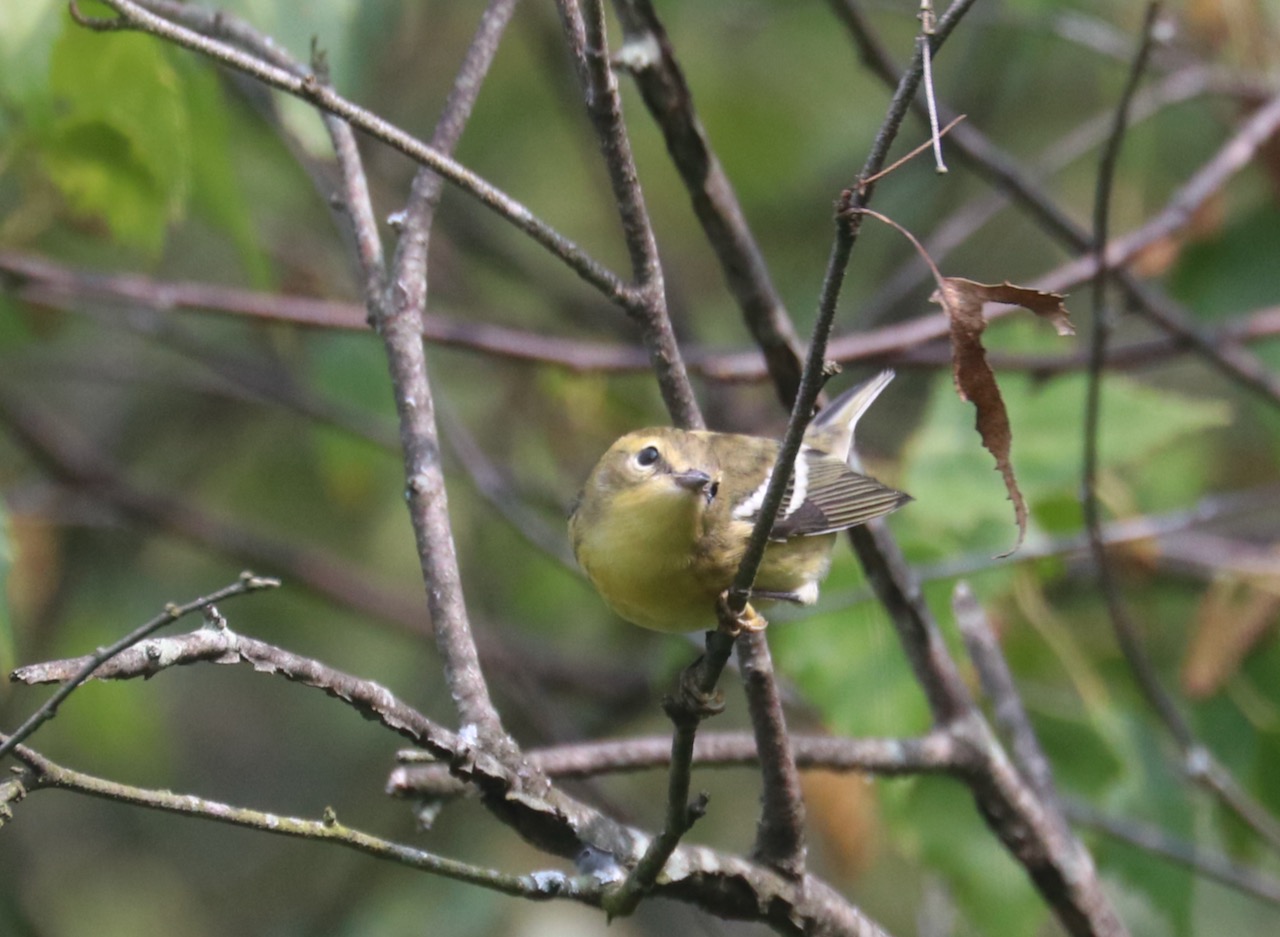
11:09 am: A young female Blackburnian warbler peers quizzically through the birch twigs. 


There's warbler action everywhere. I see a little magnolia go flitting through, but I don't get my lens on another bird until 11:14 when a young bay-breasted warbler lands on the feeder post.


You can see the traces of bay on his flanks, which tells us it's a male. How beautiful!


Bay-breast is sometimes hard to tell from blackpoll in fall, but you can almost always see a bit of bay on the flanks. The bay-breast has lead-gray feet and legs, while a blackpoll has yellow-orange feet. And baybreasts have sweeter, plainer faces and cleaner striping on the back than do blackpolls, which always look a tetch mean to me. Blackpolls have a stern line through the eye, bay-breasts less so.

At 11:19, the bay-breast fluttered over to a birch, where it made a lovely sight.


At 11:27, a beautiful young Blackburnian warbler appeared. I got a bunch of blurry photos, but this one was at least acceptable. It's a classic Audubon pose, showing every field mark--the very wide white wingbars, the pale backpack straps, and the strong, long eyeline. This is probably a young female, as it has no hint of orange in its yellow face. It's a girls' club today!


At 11:28, an eastern wood-peewee caught a little moth. How do I know it's a peewee and not an eastern phoebe? It's showing strong cinnamon wingbars, which a hatch-year phoebe would display as well. I know by the steepness of its forehead, and the slenderness of its body. Weird, but true. An eastern phoebe would look more flat-headed, with a larger head proportionate to its body.


Keep in mind that as I'm taking all these photos, I'm trying to sound cogent and informed about whatever Ann asks about. Ha ha! By now, Ann knows to ignore the sound of my shutter clicking as we talk. Science Chimp's gotta do what she's gotta do.
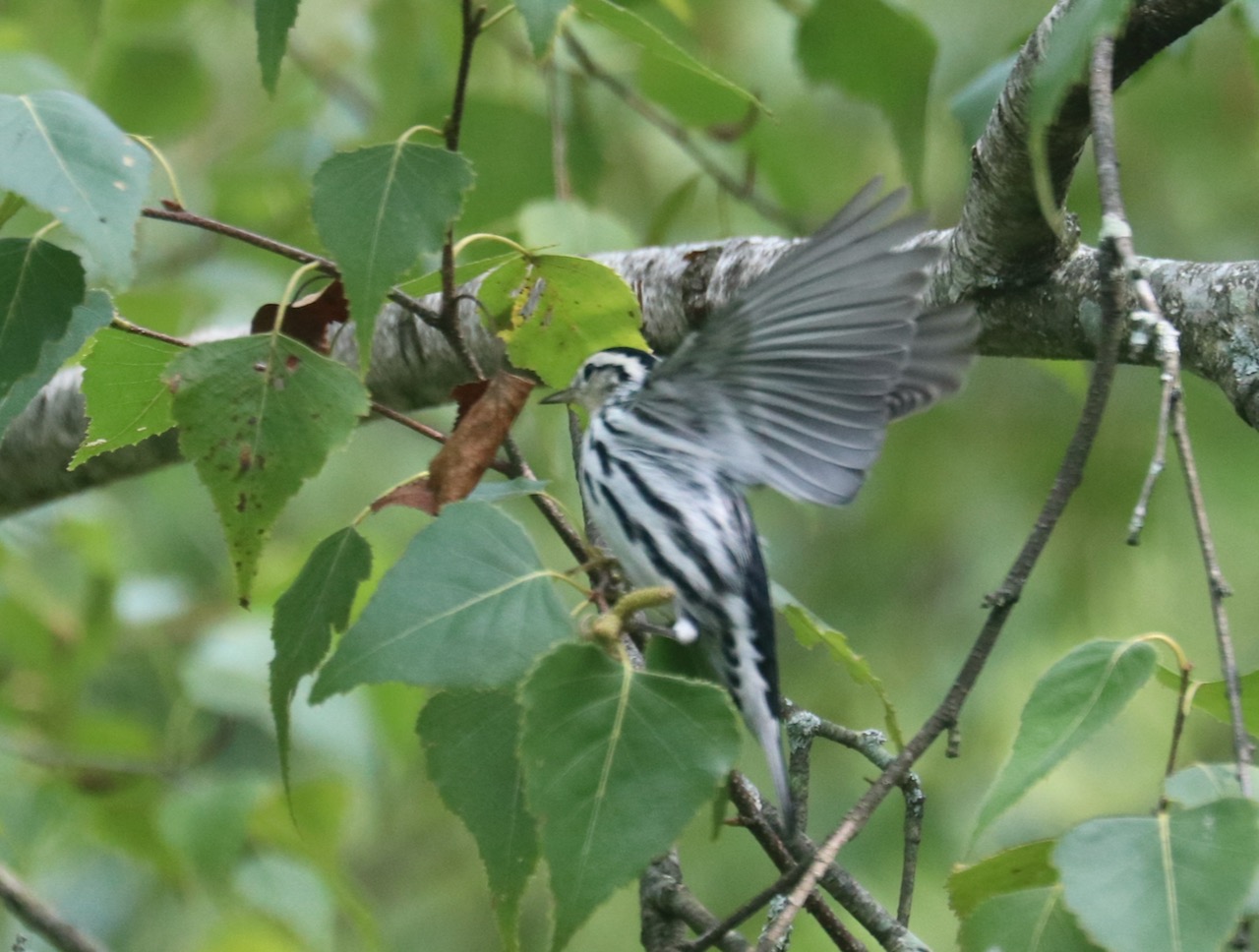
And it only got better! Here comes a  female black and white warbler, at 11:30! One of my very favorites!


Black and white warblers creep all over trunks and limbs, like a nuthatch does. They're looking for spiders, crickets, moths, larvae; anything that hides in bark crevices.


Here are the wings that will take her to a Costa Rican shade coffee plantation. And look, please, at the beautiful undertail and rump feathers, herringbone black and white. I always try to get a look at those perfect chevrons. 


We know this is a female by the clear white throat. A male would have black striping there. See that long, long bill, for probing in the bark? Black and whites also have a very long and strong hallux, or hind toe, for hanging head-down! Just like a nuthatch.


Only two minutes later, at 10:32, along comes a Cape May warbler. You're going to have to trust me on this ID. There are so many things that factor in here, but one of them is that we get floods of Cape Mays in the fall, and I just know them.   But how, you ask?


Well, there is no other fall warbler except perhaps a young female Pine, that has this precise shade of olive-drab. A young female Cape May and a young female Pine are the drabbest fall warblers there are. 

The strong but blurry streaking on the chest and flanks is another good field mark for Setophaga tigrina, the Cape May, the little striped tiger.


And finally it displays for the camera its best field mark in any plumage--the lime green rump.


This photo was taken at 10:32, and the warbler wave was over. 

Almost. A young bay-breasted warbler came right up to the studio window to say hello


and ask if I'd seen its most beautiful wings? Look at those long, tapered jobs--the wings of a long-distance migrant, who is headed to Central America. This bird is built to fly, and fly he will. 


Even I am agog at all that happened in my Ohio yard in those 28 minutes, and I'm grateful to be able to share it with you just a couple of hours after it happened.

It is a comfort, as America lies sick and burning, battered by discord as it is by hurricanes and thick smoke, to know that beautiful birds are still hatching, fledging, and now on the move, headed for the tropics, still living out their small but important lives. The smoke from California and Oregon has finally made its way to Ohio, to steal September's blue, and turn the sun into a smudgy thumbprint. Ann Fisher invited me on the show to give her listeners a nature break, and I'm here to tell you that the fall warbler migration is in full swing, today, right now. Get out there and take it in! It'll save you.

If you'd like to listen, the show is archived at https://tinyurl.com/zickonWOSU
If you'd like to give to WOSU, a $20 monthly sustaining donation will get you a subscription to Bird Watcher's Digest AND a fleece neck gaiter, too! 

Get out there and watch some warblers, will ya?

[Back to Top]