Showing posts with label Fall warblers. Show all posts
Meet the Mint Humbug
Pssst. Fall migration is in full swing. While you're asleep, warblers by the hundreds and thousands are slipping through the treetops, silently making their way toward Central America. Getting out before the frost comes, giving themselves plenty of time to travel in night skies, dropping down to forage in insect-laden leaves at daybreak. It's Fat City out there, the best time to travel, when caterpillars and crickets and spiders and aphids are everywhere.
When there are redstarts on the roof, the move is on. You hear their lisping calls in the sky each morning. Watch the trees, see them cartwheeling through.
This little immature female black and white warbler has eaten her share of spiders, I am certain. She's clinging to the trunk of a golden Chamaecyparis right outside my studio window. If she recalls a nuthatch in her stance, that's no accident. This is the warbler who lives like a nuthatch.
Black and white warblers spend a lot of time hanging head-down and hitching around on the bark and limbs. As such, they have strong legs and large feet.
Mniotilta is treated as monotypic because of morphological adaptations for vertical (tree trunk) foraging (Parkes 1978), adaptations that include an elongated hallux, roughly as long as the tarsus (Ridgway 1902).
Translated, that means that the hind toe of this bird is nearly as long as its leg! Check out that feature on this white-breasted nuthatch, also shot from my studio window:
Isn't it neat to see the congruencies of behavior, coloration and structure in these two unrelated species, based on the similarity in how they make their living? Convergent evolution, y'all. It makes the world go around.
Disruptive coloration, black and white striations resembling tree bark, help break up the bird's form as it works the bark. Even the undertail coverts are spotted. I noticed that this young female's nails are a fetching golden color. Now I want to check every black and white warbler to see if that color stays into adulthood. Look at those golden grappling hooks!
From my friend John Kricher's account in Birds of the World (formerly Birds of North America), I learned that the "distal toepads (are) usually notched, a possible adaptation for bark foraging (Clark 1973b)" Blowing up my photo, I see a teeny weeny notch just anterior to the fattest part of the big toe pad. Do you?
Nice to have a black-and-white warbler so close that you can grab a photo of the notches in its distal toepads!
The black-and-white warbler is famous as a vagrant, showing up somewhat regularly in fall in Britain and Ireland. You can imagine how that thrills European birders, who are accustomed to waxing poetic about the drabbest of their hopelessly drab warblers. When you've been rhapsodizing about birds that look like this...
Great Reed Warbler, Wikipedia Commons. A lovely bird, but no Mint Humbug.
...imagine THIS striped beauty showing up, knocking everyone's damp woolen socks off.
Ah, Facebook. Beneath one photo I posted there, I got this comment from Megan Crewe, a bird tour leader for Field Guides, Inc:
"Did you know that the British birders' nickname for these little sprites is "Mint Humbug"? That's a black-and-white peppermint candy here."
Naturally, I had to check and see why...Waah hahaha!!!
Leave it to the British to come up with such a perfectly droll name for our gorgeous warbler. Mint Humbug. I can see them, whispering in code, so the rarity-seeking throng can't hear. "Psst. Mint Humbug, working a large beech, corner of Gloucester and Wembly, still there as of 1400 hours Tuesday." Thank you for that smile, Megan!!
I am delighted to say that these little darlings breed in my southeast Ohio forest. In the spring of 2020, rainy, cold and wet as it was, I watched a pair constructing a nest in the newly-cleared farthest reach, among the black maples. They were tucking wads of bark-fluff and moss at the base of tree trunk. What a weird place for a warbler nest, but then black-and-white warblers are among the weirdest of warblers. Ground nesters--with all these chipmunks and snakes and raccoons...arrrgh. Yet somehow they persist. I never knew if the 2020 nest was successful; I was not about to walk up to it and lead predators there. Plus, I was too busy feeding starving migrants and bluebirds that awful, freezing cold, rainy May. The black-and-whites were back in 2021, voicing their squeaky-wheel song in the tulip grove just off the lower path in the orchard, and though I rarely caught so much as a glimpse of them, that squeaky song made me smile so big. Knowing they were there was everything.
I'd love to think this little gal was hatched here, but in the fall, one never knows. The black-and-whites and all the other warblers are streaming through now. Go out, willya, and catch the show.

|
Widget for blogger by Way2Blogging | Via Spice Up Your Blog Gadgets
|
28 Minutes of September
Tuesday, September 15, 2020
12 commentsThe morning started beautifully, at 8:17 AM with this spring's rose-breasted grosbeak, trying to sing. He'd gotten strawberry jam all down his front. Just kidding--he's coming into his first adult plumage, but it's gonna take a couple years. I love seeing them when they're just showing the first hints of their sex.
I went inside reluctantly, but I was due to be on a public radio fundraiser for WOSU with my dear friend Ann Fisher, and I wasn't about to miss that! I am deeply honored to be asked to help with a fundraiser. Ann asks such wonderful, unexpected questions, and I adore her and hold her in highest regard. I feel like this narrow sort of nature savant, where she's a brilliant generalist who knows something about everything. I know I'm kind of a break from the news, and I like serving in that capacity.
Well, I'd no sooner hooked up the Zoom audio connection with the Columbus OH radio station than a little wave of fall migrants came sweeping into my yard. I'm inside sitting at my drawing table, all tethered by headphones plugged into my laptop, and all this is happening outside!
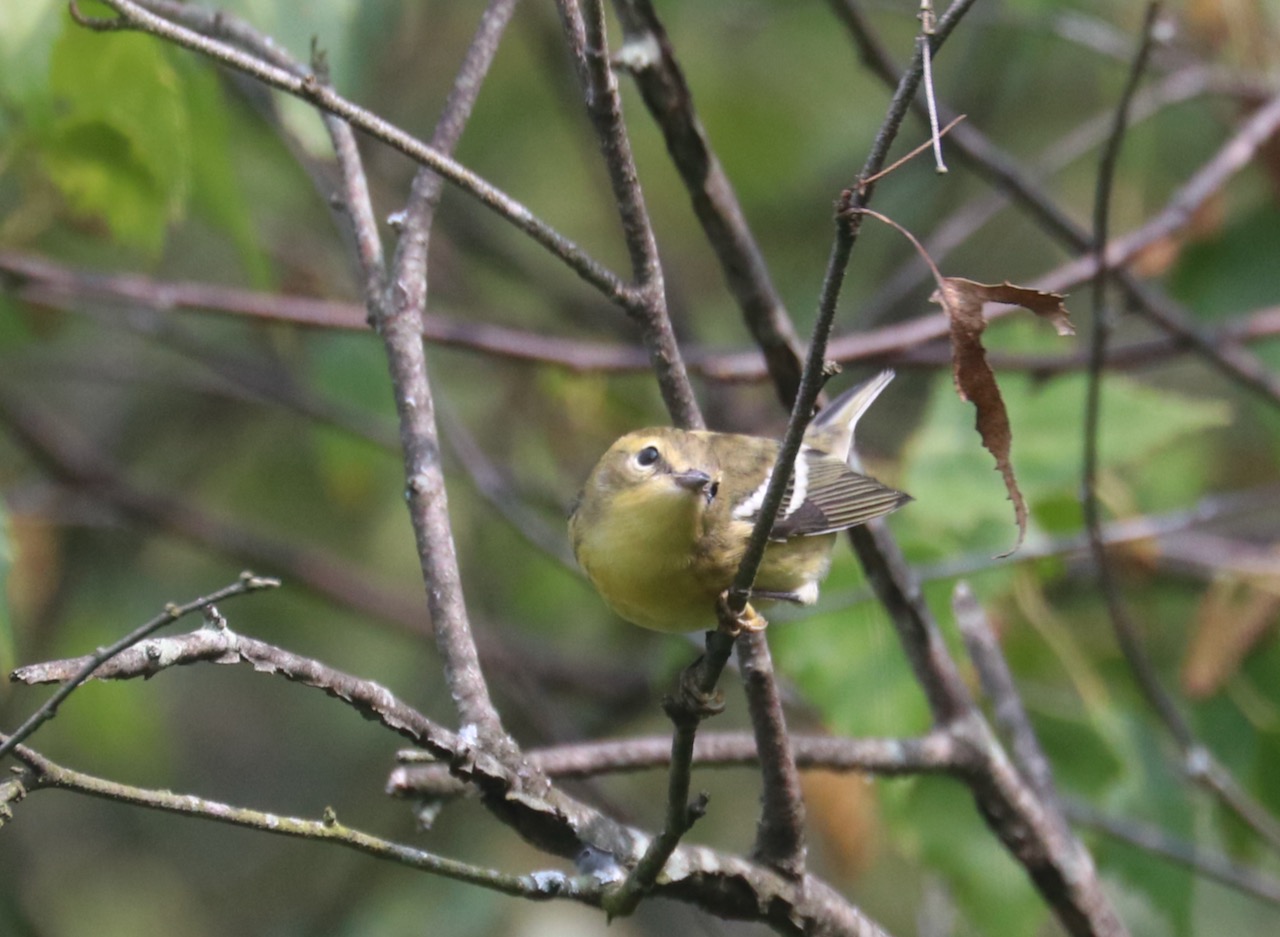
11:09 am: A young female Blackburnian warbler peers quizzically through the birch twigs.
There's warbler action everywhere. I see a little magnolia go flitting through, but I don't get my lens on another bird until 11:14 when a young bay-breasted warbler lands on the feeder post.
You can see the traces of bay on his flanks, which tells us it's a male. How beautiful!
Bay-breast is sometimes hard to tell from blackpoll in fall, but you can almost always see a bit of bay on the flanks. The bay-breast has lead-gray feet and legs, while a blackpoll has yellow-orange feet. And baybreasts have sweeter, plainer faces and cleaner striping on the back than do blackpolls, which always look a tetch mean to me. Blackpolls have a stern line through the eye, bay-breasts less so.
At 11:19, the bay-breast fluttered over to a birch, where it made a lovely sight.
At 11:27, a beautiful young Blackburnian warbler appeared. I got a bunch of blurry photos, but this one was at least acceptable. It's a classic Audubon pose, showing every field mark--the very wide white wingbars, the pale backpack straps, and the strong, long eyeline. This is probably a young female, as it has no hint of orange in its yellow face. It's a girls' club today!
At 11:28, an eastern wood-peewee caught a little moth. How do I know it's a peewee and not an eastern phoebe? It's showing strong cinnamon wingbars, which a hatch-year phoebe would display as well. I know by the steepness of its forehead, and the slenderness of its body. Weird, but true. An eastern phoebe would look more flat-headed, with a larger head proportionate to its body.
Keep in mind that as I'm taking all these photos, I'm trying to sound cogent and informed about whatever Ann asks about. Ha ha! By now, Ann knows to ignore the sound of my shutter clicking as we talk. Science Chimp's gotta do what she's gotta do.
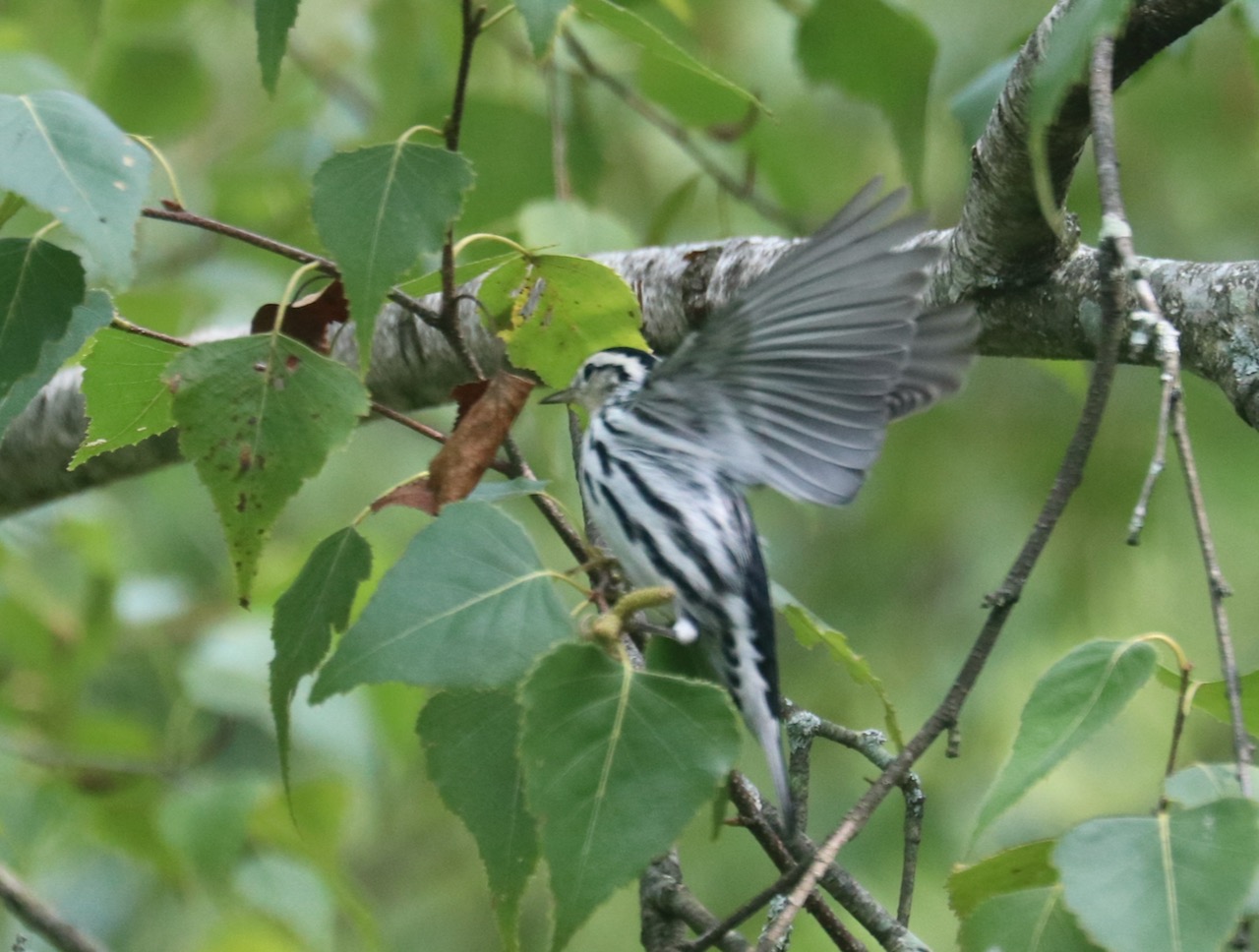
And it only got better! Here comes a female black and white warbler, at 11:30! One of my very favorites!
Black and white warblers creep all over trunks and limbs, like a nuthatch does. They're looking for spiders, crickets, moths, larvae; anything that hides in bark crevices.
Here are the wings that will take her to a Costa Rican shade coffee plantation. And look, please, at the beautiful undertail and rump feathers, herringbone black and white. I always try to get a look at those perfect chevrons.
We know this is a female by the clear white throat. A male would have black striping there. See that long, long bill, for probing in the bark? Black and whites also have a very long and strong hallux, or hind toe, for hanging head-down! Just like a nuthatch.
Only two minutes later, at 10:32, along comes a Cape May warbler. You're going to have to trust me on this ID. There are so many things that factor in here, but one of them is that we get floods of Cape Mays in the fall, and I just know them. But how, you ask?
Well, there is no other fall warbler except perhaps a young female Pine, that has this precise shade of olive-drab. A young female Cape May and a young female Pine are the drabbest fall warblers there are.
The strong but blurry streaking on the chest and flanks is another good field mark for Setophaga tigrina, the Cape May, the little striped tiger.
And finally it displays for the camera its best field mark in any plumage--the lime green rump.
This photo was taken at 10:32, and the warbler wave was over.
Almost. A young bay-breasted warbler came right up to the studio window to say hello
and ask if I'd seen its most beautiful wings? Look at those long, tapered jobs--the wings of a long-distance migrant, who is headed to Central America. This bird is built to fly, and fly he will.
Even I am agog at all that happened in my Ohio yard in those 28 minutes, and I'm grateful to be able to share it with you just a couple of hours after it happened.
It is a comfort, as America lies sick and burning, battered by discord as it is by hurricanes and thick smoke, to know that beautiful birds are still hatching, fledging, and now on the move, headed for the tropics, still living out their small but important lives. The smoke from California and Oregon has finally made its way to Ohio, to steal September's blue, and turn the sun into a smudgy thumbprint. Ann Fisher invited me on the show to give her listeners a nature break, and I'm here to tell you that the fall warbler migration is in full swing, today, right now. Get out there and take it in! It'll save you.
If you'd like to listen, the show is archived at https://tinyurl.com/zickonWOSU
If you'd like to give to WOSU, a $20 monthly sustaining donation will get you a subscription to Bird Watcher's Digest AND a fleece neck gaiter, too!
Get out there and watch some warblers, will ya?
|
Widget for blogger by Way2Blogging | Via Spice Up Your Blog Gadgets
|
September's Silent Parade
Sunday, September 23, 2018
9 commentsMy birches are loaded with little green aphids, candy to migrant warblers and hummingbirds, too. Of course, I'm glued to the windows, my big lens slishing away.
The magnolia warbler has a pretty yellow rump in all plumages.
We're firmly on the fall migration route for Cape May warblers, but they're rare as hen's teeth in spring. Go figure. This is a nice adult male, still showing his golden side neck and strong tiger stripes.
Who's that?
One of my favorite fall migrants (and breeders) is the ovenbird, a warbler that looks like a thrush. That shoe-button eye, with the surprised ring around it; those heavy droozly stripes down the belly--I just love these neat little forest dwellers.
All that would be great, but the burnt orange crown stripe is too much.
And the ovenbird walks. One shell-pink foot is placed daintily in front of the other. They walk along long branches, mincing delicately. The head bobs slightly, like a chicken's. I love everything about ovenbirds, except their tendency to crash into glass windows in fall. For them, and for so many others, I put netting over my windows.
Salvia guaranitica "Black and Blue" is a favorite. As often as not, the dainty flowers will drop when they're probed.
Most of my out-the-studio window photos feature sweet birds on the colorful tomato cages I use to support my taller flowers.
This is a juvenile song sparrow, impersonating a Lincoln's sparrow, with its finely penciled breast streaking.
A young Tennessee warbler briefly got itself trapped behind the netting that keeps my huge studio windows safe for migrant birds. It was a thrill to see it so close. Birds are never trapped for long, since the netting is stretched on a PVC frame that stands almost a foot out from the window, and they have only to go up, down or sideways to get out. To learn more about this miraculous life-saver, go read my article, "A Solution to Window Strikes," here.
I just never know what I'm going to see, so I keep looking. Who's that on the hanging basket hook? I knew right away, because there isn't another species that has yellow (instead of white) tail spots. It's a yellow warbler!
and a very, very beautiful one. An immature yellow warbler in September is such a lovely bird, the bright yellow washed with grass-green. Yellow suffuses everything: its eye ring, tail spots, legs, feet, even its bill. It's like it drank sunshine.
Needless to say, I take cuttings of this miraculous tropical plant and carry it over in the greenhouse all winter. I'm petrified of losing it; it's such a cheery, free blooming soul and it roots from cuttings in water! Hummingbirds love it and they look fabulous prospecting those clusters of pink. I have four-foot tall plants blooming their heads off, planted right in the garden soil, right now. The rabbits leave it mostly alone. Miracle. Anything the nipping, chomping, chewing animals allow to live is a pure miracle to me.
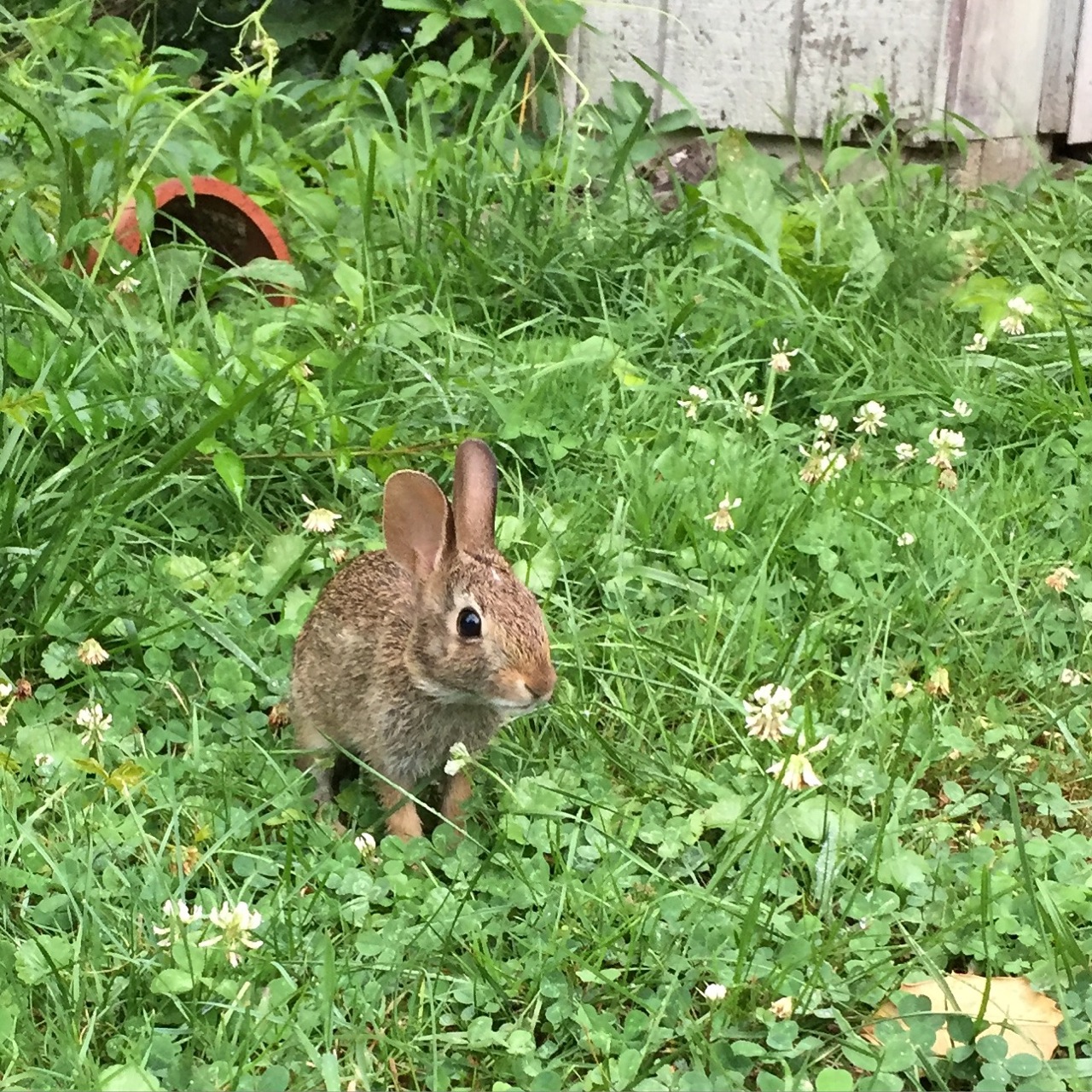
As a bonus, you can see the bird screen with its gray PVC frame over my studio windows. It's nicely unobtrusive, but highly effective. Those windows are doing a great job of pretending to be limitless sky. They need a screen, and they have one.
The warbler was pretty sure there should be something edible in that pretty flower. So it diddled with it for awhile, trying to see if it would produce something nice.
What a breathtakingly beautiful little bird. Every feather is unworn and new, immaculately fringed and bordered, since this bird, who was born this spring, has just molted into a fresh suit of feathers for the long trip south.
The yellow warbler is just a part of the silent parade going on outside, all through September. Get out there! The trees are dripping with warblers. Blackburnians running into bay-breasts; black-throated blues and Cape Mays; yellows and yellowthroats and Tennessees, blackpolls and hoodeds, all coming through now in southeast Ohio. It's the greatest show on earth, and it's perfectly silent.
Keep looking up.
|
Widget for blogger by Way2Blogging | Via Spice Up Your Blog Gadgets
|
Happy Birthday to Me!
Monday, July 25, 2016
26 comments
I usually get a post up on Sundays, but I was working on a new talk and I had to get it done.
It's only supposed to be 20 minutes, and it'll be delivered at the Saturday banquet for the Sedona Hummingbird Festival (Squee!!). I've figured out that I work something like two hours for each minute of the talk. The amount of time and brainpower I expend on these things is ridiculous. If it comes out right, it sounds extemporaneous. Well, it isn't. Snort.
So I was tied to the desk all day, except for an insanely cool evening walk down Dean's Fork, the subject of its own post. Sunday happened to be my birthday, so I decided if I had to sit all day, I would count the blessings that came my way. Each one would be a present.
My first gift was a handful of protoplasm. A couple of days ago, I looked down at a tire rut at a construction site and saw a puddle of tadpole goo where the day before there'd been rainwater. Because it's late July, the only thing they could be is Cope's gray treefrogs. I touched them and sure enough a few wriggled in a SAVE ME!! kind of way. Oh no. More than a mile from home, and it's going to be a blistering hot day, and there is no natural water I can reach in shorts for at least another mile, unless...
I glanced around the site and saw a gallon of drinking water on a folding table, with a stack of plastic cups. Eureka!
I scooped up the taddies and a good bit of silt and plopped them in a cup, pouring life-giving water over them. Imagine how good that feels to a tadpole on its dying day. Jogged that mile home carrying the cup of taddies, laughing to myself about how that must've looked to the neighbors. Poured it in a plastic jar and added beaucoup rainwater. I gave them a couple of days to rehydrate before releasing them, and they needed it. When they started acting like tadpoles instead of crumpled bent fetuses, I knew they were ready to go.
This was my first birthday gift.
For future reference, they love koi sticks. Nomnomnom.
On this morning, I took the jar down to our fishpond, fed the comets to repletion, then installed the jar on a shelf in the pond. One by one, the taddies who had survived their ordeal came up for air, saw the great expanse of water and delicious algae, and swam off into the deep.
This one swam curlicues, dove, wriggled through the algae; its joy on being in proper habitat that wouldn't dry up was palpable. Honestly, I don't know how tadpoles do it, always watching the water levels, praying for rain, facing the imminent prospect of death by baking. Ugh.
There being no puddles left anywhere in the sweltering July heat, our water garden was my best choice. I had to hope the fish would leave them be. Comets aren't very predatory where small swimmers are concerned. As I was monitoring their exodus from the jar, I saw a tiny comet, the first spawn of my four fish, swim by. If he can make it, they can, too.
Second present: BUN.
I have a little family of brown thrashers in the yard! I don't know if any of them are Cletus, Melba or Harper; I think not, because the adults aren't tame at all. But oh, being able to look out and see thrashers doing thrasher things, dust bathing, sunning, hunting bugs or, in the case of one of the parents, grabbing a sunflower seed and pounding the shell off--it's just the best. This is a juvenile. Gift 3.
Seeing the laborious way a thrasher, which doesn't hold seeds in its toes for shelling, has to pound the hull off a seed, I spread sunflower hearts in all their favorite spots. Watching them gobble them down: Gift 4.
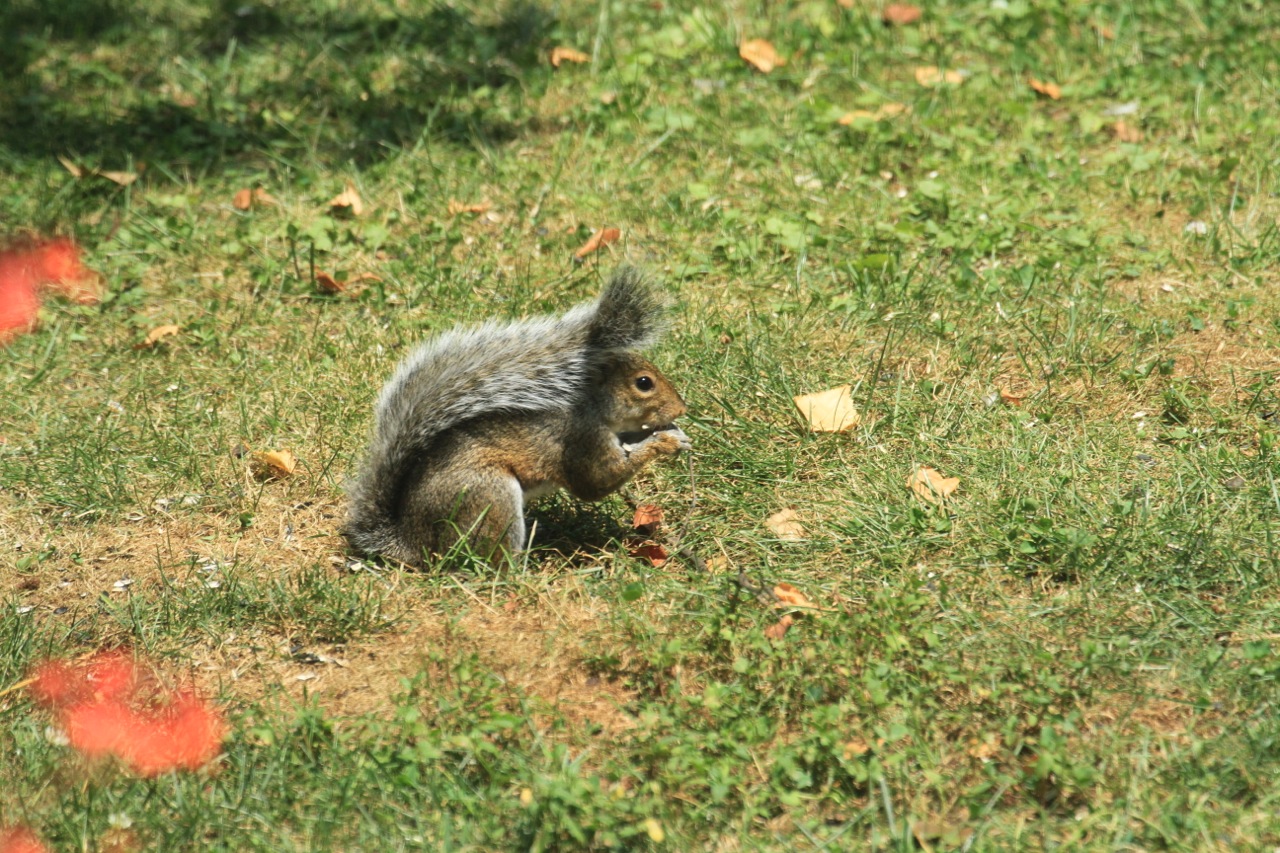
Present # 5: Someone dribbled squirrel! He appreciates the sunflower hearts very much. He ooches around on his belly picking them up one by one. I have to say I love my squirrels. They annoy the hell out of me, but they're such fun to watch! So they're paying their way, at least partly.
The sunflower hearts brought in MamaCoon and her three kits! Gift #6: July 24 was first day she's brought them out at noontime.
It's amazing how long those raccoon babies are dependent. The smarter the animal; the more complex and comprehensive its diet, the longer the juvenile dependency period.
It takes a long time to learn to be a raccoon.
Gift 7: the yard robin resents crowding by a ruffian house sparrow, tells him to back off! Just having a robin in the Spa, ahhh. But this combo was too much.
#8: speaking of Back Off, a mourning dove warns a squirrel it's too close. I am big! I will beat you with my wing! Interestingly, a dove would NEVER let a chipmunk get that close. Chipmunks are far more dangerous than squirrels. They're nastya-s little animals. Chipmunks remind me of the killer rabbit in Monty Python and the Holy Grail.
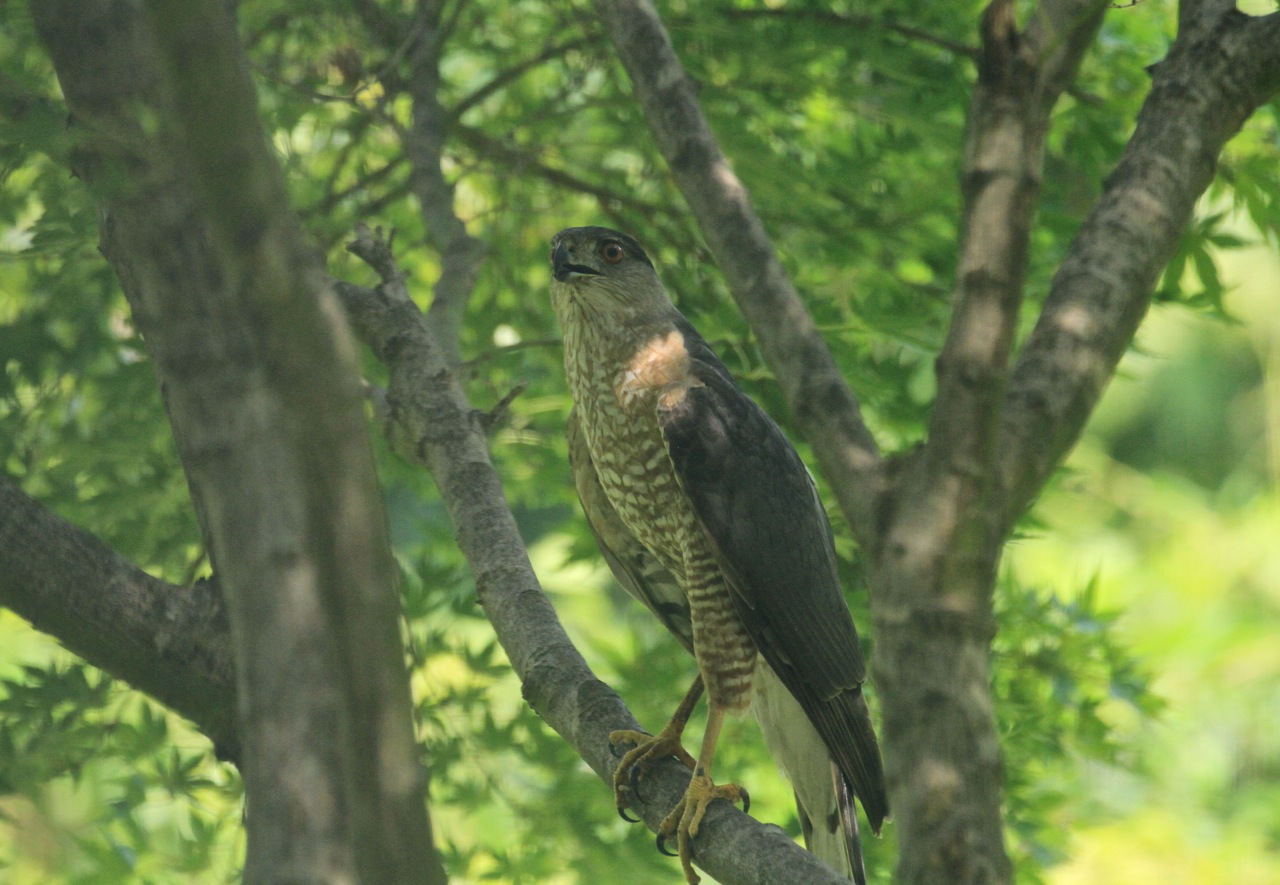
This just in!! July 25: I saw the Coop take a pass at some doves just now and scuttled with camera downstairs to shoot it from the bedroom. This is through two panes of glass, at a terrible angle, but OH MY. Talk about a gift, hurled from the Other Side. Thanks DOD!!
On the first shot, I captured the whole hawk. When it turned toward me, I lost my head and focused on its face. Ah well. Too excited to shoot well.
Please note that this hawk is perched in a retired, or as I love to say, recovering bonsai. DOD, you place your gifts so well. He adored my bonsai.
You beautiful thing!! Please help yourself to mourning doves, and take a house sparrow as a chaser, willya? You're also most welcome to squirrels, but please not the one who sccoches around on his belleh.
#10: Seeing a gray squirrel use its tail as a hat and parasol.
At this point it's 98 in the shade, easily 102 in the sun, and I'm so thankful to be inside mostly (not) working on my talk.
# 11: a rubythroat investigates the coneflower, seeming to find a sip of nectar in the disc. Not something I see every day, but these midsummer juveniles try everything.
There has to be nectar in this big fat bud. Just has to. I'll wait for it to open. This photo: Gift 12.
I have a variety of wire supports for my tall cardinalflower and Fuchsias, and the hummingbirds adore them. Hummies appreciate thin perches. They can watch for Cooper's hawks from them. It must be nice to be too small and fast to bother with. But you still have to stay vigilant.
This photo: Gift 13.
Meanwhile, fall migrants (yes, I said it; fall begins in July for warblers!) are sifting through the yard. A young yellow-throated warbler on its leisurely path southward. Or westward, or eastward...they do a bit of wandering. This has to be one of my favorite warblers, Gift #14. Get the picture? Everything out there is a gift. I had intended to put all my birthday gifts in one blogpost, but it's evolved into at least three. And that is a gift in itself.
Happy birthday to me! Now you can see why it takes me so dang long to put together a talk. Or a blogpost. A giant set of Venetian blinds for the studio window would probably go a long way toward increasing efficiency, but ignoring the show going on just outside those windows in late July? Unthinkable! All but a couple of these photos were taken through my studio window, through the crop netting screens that cover them. Gift #14: having such a big, comfortable blind for a house!
Blessed, that's all!
|
Widget for blogger by Way2Blogging | Via Spice Up Your Blog Gadgets
|


Tuesday, August 31, 2021
5 comments