Background Switcher (Hidden)

Fun With Pine Warblers

Sunday, April 2, 2023

2 comments

One of my gray birches has decided to leaf out on April 2. You go, little tree. The rest are still in tight winter bud. 

This female cardinal looks fine in new leaves.

 I cannot tell you what a thrill it is for me to hear a pine warbler singing incessantly just outside my studio window. I've lived here outside Whipple in the southeast corner of Ohio since November 1992 and I have had pine warblers breed occasionally in the tall Virginia pines that line my oilwell access road.  In the early 2000's I saw a female take the fuzz off a spent dandelion and take it off to line her nest.  And they bred there in 2022.


But this year, I have a male who has claimed the feeders as his, and he commutes several hundred yards out to sing on his territory in the row of pines in between picking at the peanuts at my feeder. I know this is a reasonably common feeder bird in the Deep South and Southeast, but it is a Big Freakin' Deal for me to have a PIWA making hisself at home and helping himself to the food. 


Along with the white-breasted nuthatches, he's a peanut fan. He's like Texas toilet paper too...he don't take s---t off nobody. Not afraid of the hairy woodpecker. He just stays put and picks away.


It's too durn cold to set up my WarblerFall yet. It's still freezing many nights. So he comes down to the ugly blue heated dog dish and drinks there. Charmed, I'm sure! I can't wait to see him bathe in the WarblerFall! 
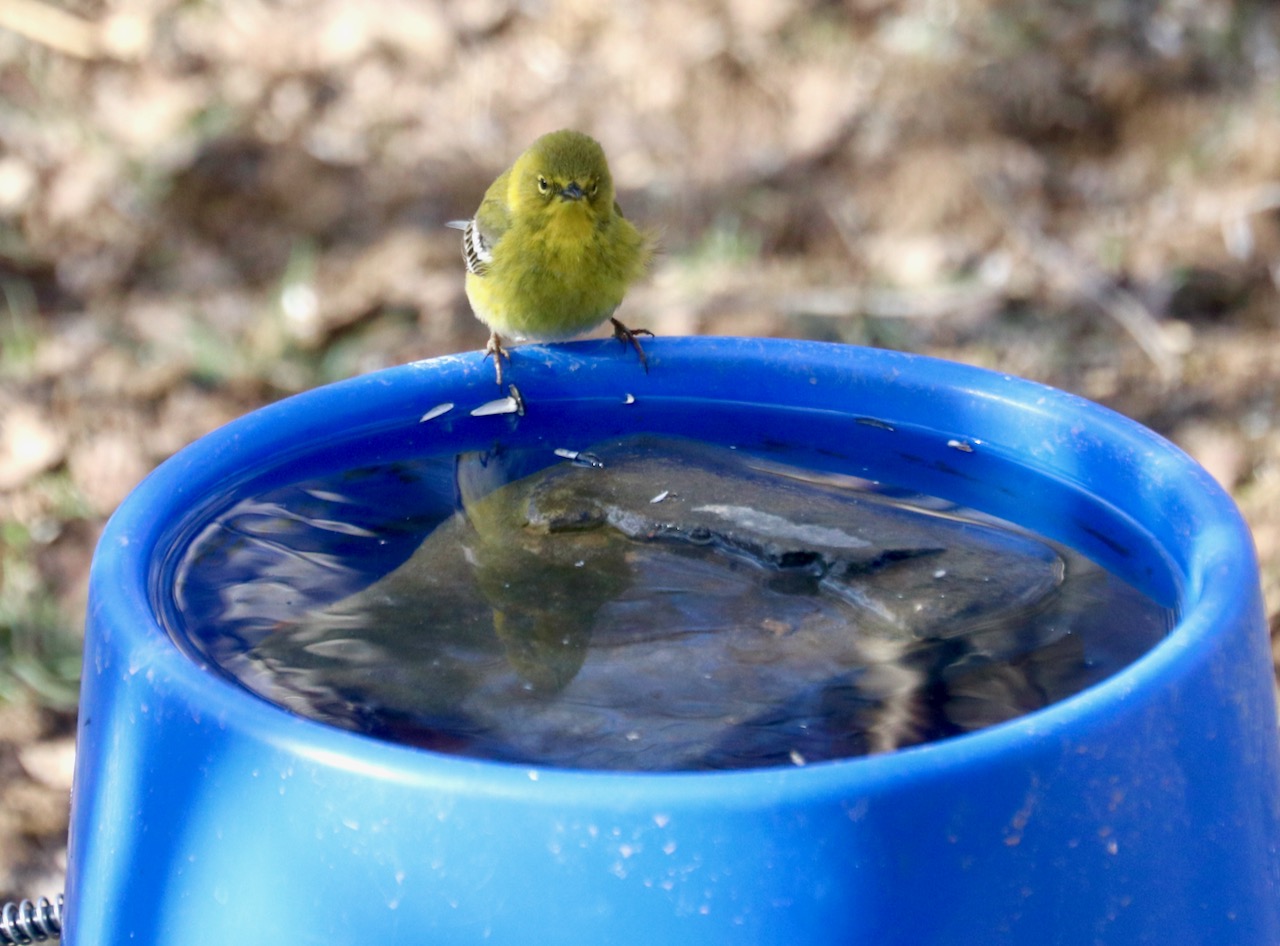

I've been thoroughly enjoying him for about three weeks, as he arrived March 8. I had begun to wonder when a female might appear. And on April 1, there she was, hopping about on the ground near the feeders, picking up who knows what.


You'd hardly know she was a warbler; you'd hardly know she was there. Not a speck of color on her anywhere; she was like the male in grayscale.

She had found a piece of peanut and was gagging it down when the male dropped down, apparently too close for comfort. I was thrilled to get them both in the frame. 


She, on the other hand, took violent exception to the male's intrusion, and leapt on him, pecking at his eyes! 


I had never seen anything quite like it. I guess she's not ready to play nice and be his mate. If this is pair bonding, um, no thanks. 


Over and over they rolled, she pressing the attack; he just trying to defend himself. At least that's how it looked to me. I did not see him peck back; he mostly dodged her blows.


I got concerned for him. 


When they finally broke free of each other, she arrowed after him and chased him to a nearby birch.


Only a minute or so later, he was singing from a feeder hook, unperturbed and apparently not dissuaded.


Phew!! Mr. PIWA, you have a tiger by the tail. Good luck with her.

I've started feeding small amounts of Zick Dough on these cold raw March and April days, to help early migrants as well as residents. The birds sure do appreciate it. 
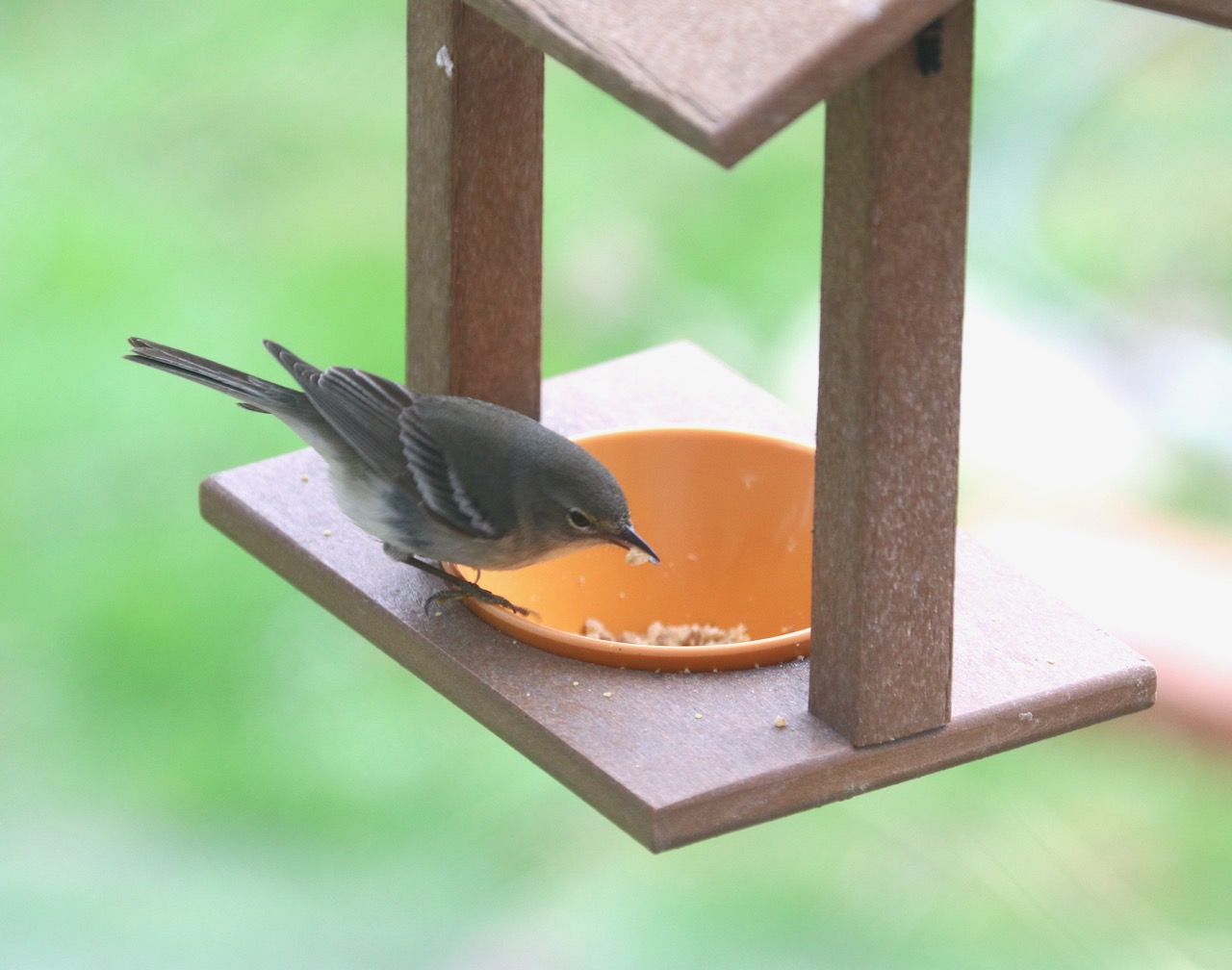

Today, April 2, I was thrilled to bits to see the female pine warbler partaking of the high-energy food! 


She may have seen the pair of Carolina wrens eating it...she's a quick study. I have yet to see the male warbler take any, surprisingly, though he hovers around the suet feeder and picks up millet from the ground.

Carolina wrens love Zick Dough.

So do white-breasted nuthatches.


I'm delighted to have something nutritious to offer these beautiful pine warblers on raw spring days. 


Let's face it, I'm a freak for warblers.  Always have loved these delicate, long-distance travelers and their beautiful colors and songs.


Peanuts. If they're good enough for nuthatches, they're good enough for me!


Eat up, Mean Mrs. Mustard. And be nicer to your mate. You've got eggs to make. Soon I'll put out crushed eggshells for you. I want to hear and host pine warblers every spring!


And I can't wait to see them use the WarblerFall!
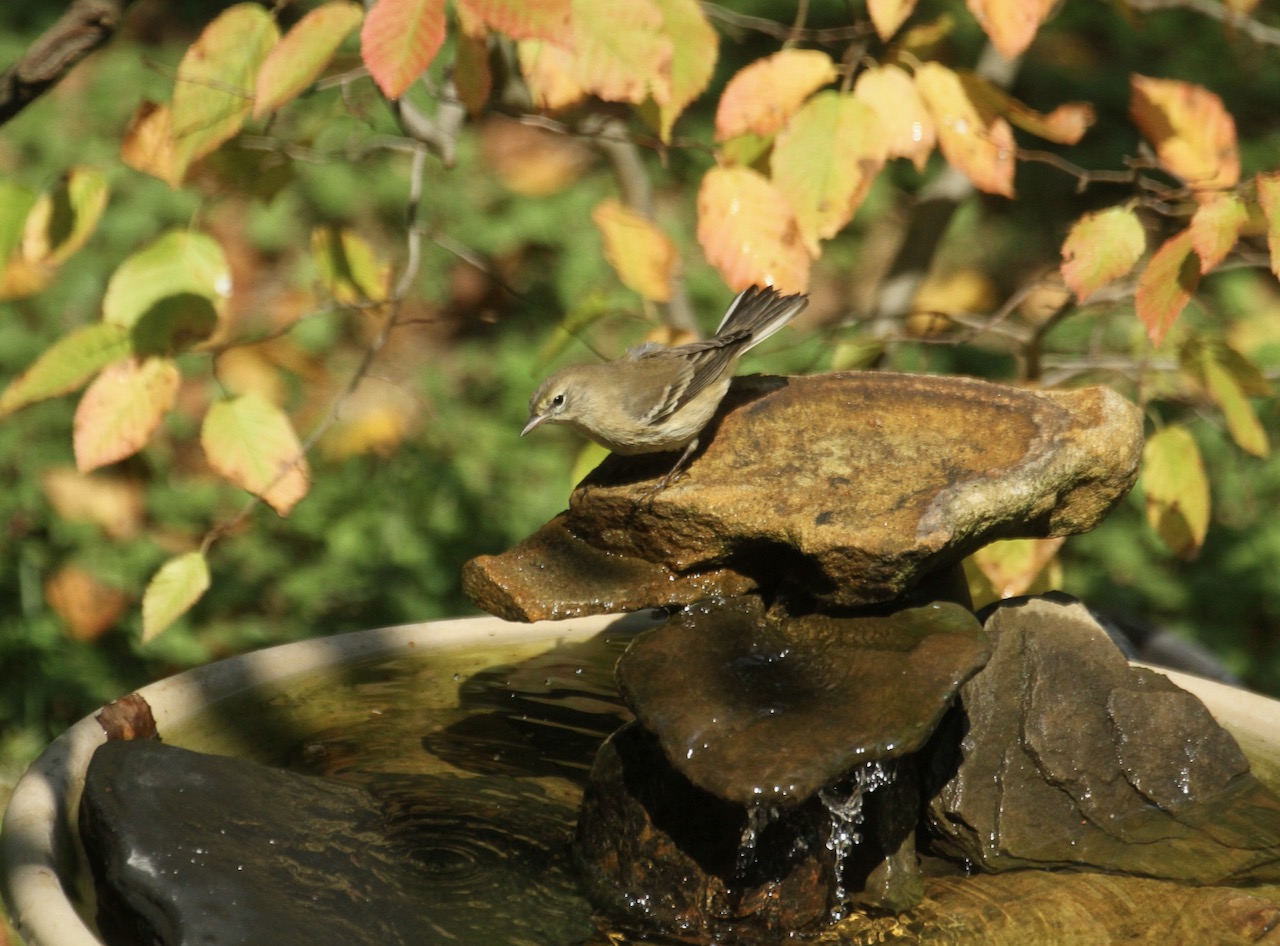

15 September 2022...Mean Mrs. Mustard, that kinda looks like you!



Bat Hampers, At Last

Sunday, March 12, 2023

5 comments

 Although I've been taking bats in for 13 years, I still consider myself a newcomer to them. There are people who know ever so much more than I do. Amanda Lollar is one of them. She wrote this amazing book which should be required reading for anyone wanting to care for bats. It's so well-written and thorough, informative and clear. 


I also follow a couple of great accounts on Instagram: pabatrescue and azbatrescue. I have immense respect for these women and their volunteers. They take in an awful lot of bats, and do vet care as well. Way beyond my level, but they've been kind and encouraging. As a result of what I've learned from this wonderful book and my Instapals, I knew I had to give my bat housing an overhaul. I've ditched the individual critter keepers lined with rubber drawer liner and toweling for a whole new system, one that is more in tune with bat needs for socialization and softness.

Behold the new bat habitats! They're soft nylon laundry hampers that I bought at Wal-Mart. I can access the interior through two large zippered doors. 

The flooring is soft mattress foam, wrapped in a plastic garbage bag which is taped tightly, then put in a washable pillowcase. Any bat that falls is not going to be injured in the least.

Each hamper has two places to roost: the made-to-order black bat roosting pouch from batworld.org (Amanda Lollar's incredible bat conservation organization) and a double folded length of plushy fleece they can crawl up inside. I've got a little plastic water container zip-tied near the top of the enclosure, and a worm dish for self-feeding. 


There is one hamper for Carmelo, and one for all the girls. Males must be separated or they will be males, and will molest the females all winter long. These two hampers should be able to accommodate as many bats as I get, boys with boys and girls with girls. There's plenty of room to scuttle around, climb, groom, socialize, and flap wings.

Their first hour in the hamper together, the females gathered under the pink fleece. Jolie Blonde wanted a little separation at first. 


Fuchsia, Poppy and Laura cuddled right up. It made me so happy to see the bats able to do what they do in the wild, and to know they were cuddled in warm fleece (I have draped another double layer over the outside of the hamper, too, to protect them from drafts).

By the next morning, there were four in a neat row. Isn't that dear? One is hanging with her dark brown back to us; the rest are showing their paler bellies.


Keeping these bats at the proper temperature (between 35 and 55 degrees) is an interesting exercise.  Most of the time, my unheated detached garage is ideal. But when temperatures dip into the 20's, I bring them into my basement and put them right next to a cold door, where temperatures hover in the 40's on a very cold night. I swaddle them to protect them from drafts but it does stay cold by that door.

Ideally, they sleep most of the winter. Initial intake involves getting them up to proper weight (17-22 gm for a big brown) with intensive feeding for each bat for a week or more, and making sure they were strong and well-hydrated. Then I put them to bed in cold temperatures on Jan. 25.  I  took them out and fed them for the first time on Feb. 9 and 10, after three weeks in cold storage. Now that all are in good weight, I plan to stretch that to 4 or even 6 weeks in hibernation. Not gonna lie--I miss them when they're tucked away! As I update this post, they've been asleep for five weeks. I check on them daily. Temperatures have settled down at night, and the garage maintains nearly ideal conditions. Lovely!

When you think about it, these animals in natural conditions probably have no opportunity to eat and drink all winter long, since they don't fly on nights below 50 degrees. And if they were to fly on the occasional balmy night, there aren't any insects out for them to catch, anyway. So I've little doubt that a winter in Zick's Bat Hostel is a fat winter for these bats. And it sure beats wasting away in a heated space with your metabolism all revved up, but without food or water. Or worse, being caught and put outside to die in freezing temperatures, which is what happens to most bats that are found inside a home. I don't know what people think they're doing when they do that. It's not "letting it go." It's a death sentence for the bat. 

I make these posts so people will understand that bats are very much worth cherishing and caring for. When they get into homes, they need help. To find a bat rehabilitator near you, go to batworld.org and click on "I Found a Bat."

Chances are, it'll be someone a lot like me, who is willing to care for these incredible little animals in their home, because they are endearing and special creatures. Bottom line for me: Yes, it's a ton of work. But the alternative to offering these refugees a safe winter home is too sad to contemplate. If you find a bat in your home, do the right thing and call a bat rehabilitator. Put on leather gloves, pick it up gently with a hand towel around it, and put the bat in a box with the cloth. Make sure the box is SECURELY taped up with a couple small air holes, because bats can get out of the most amazingly tight spaces. Don't try what I'm doing--feeding and watering and handling-- without training and rabies vaccination. These are not pets--they're destined for release. They are going back to the sky!

                                                   
                                                Carmelo says thank you for the warm fleece and tasty worms.  


Laura says thank you very much for listening.  


Meet Laura and Fuchsia, Big Brown Bats

Monday, March 6, 2023

6 comments

 When I finally thought to check, I found out that my last rabies booster was in 2013. Wow, ten years can sure fly by! I dithered a bit and then set out in earnest, looking for someone who'd do an antibody titer for me. Finally, my new nurse and doctor at WVU Medicine came through. And I found out I'm still making sufficient antibodies to the rabies virus to be protected. That made me really happy--a lot of bats have gone through my winter hostel since 2013. Glad I don't have to drop $680 on the booster shots.

It's a privilege to care for these bats and learn from them, too. In my last post, we met Jolie Blonde, Poppy and Carmelo. There are two more females this year.

 f

Laura came to me a real spitfire--musking (a skunky smell from their facial glands); chittering, sometimes biting a little (but nothing like Drusilla of Old, the Worst Bat Ever). Now she's my best, most eager eater and not too tough to handle. She has an endearing way of gaping between worms, literally like a baby bird. We are pals now, and she hardly cusses at all. She was found on Christmas Eve 2022, hanging under a utility table in an unheated outbuilding. The naturalists who found her would have been delighted to let her stay, but with the Arctic cold blast of single digit temperatures, we think she might have died out there. Especially since her weight on admission was only 11 grams. She's between 17 and 19 gm now! She'll eat 20 or more worms if I let her, and I'll have to cut her back to a dozen as spring nears...a girl has to watch her weight if she's going to fly!

Fuchsia has been a special little bat from the get go. She was found in the same tattoo parlor as Carmelo on Jan. 28. Skinny and wasted at 11 gm,  Fuchsia had to eat bird formula from a syringe for six nights until she was able to chew mealworms. That last night, I added Delectables Lickable Treat for cats to her formula, and it woke her UP. She was chewing mealworms like she was paid to do it that same evening. 

She did something I've never had a bat do. They all arrive like this--huddled like a tiny mouse.


But when I picked her up, she was so terrified she threw out her wings and opened her mouth! Which gave me a fabulous look at her impressive dentition, a definitive look at her female bits, a beautiful view of her long tail and tail membrane...this is the basket in which bats catch their food! See how the tail tip extends beyond the membrane? One of the hallmarks of a big brown bat.  For big brown bats, the food that ends up in that tail basket is mostly flying beetles, and some moths. That's why they've got great big teeth--so they can crunch down beetles. The bite of a big brown bat--or any bat, for that matter-- is unbelievably strong. I wear deerskin on my handling hand (left) and more pliable goatskin on my feeding hand (right). Deerskin has proven more puncture-resistant than other leathers in a study designed to determine which gloves are best for handling bats.
I can tell you that deerskin outperforms all other leathers in the Multiflora Rose Test to which I put my gloves every morning. Puncture-resistant to the max! If a thorn goes through deerskin, it's time to replace that glove, for it's worn too thin.


The perfection of Fuchsia's architecture was unbelievable. 


She clung, wings still spread, for that whole first feeding. I couldn't get her to relax but I eventually worked her around to a more comfortable pose. But gentle talking and grooming with a mascara brush has calmed her down nicely. This series of photos are all by Liam Thompson, my most invaluable bat helper.


It's hard to believe this is the same bat, but here's Fuchsia eating on February 9.  Amazing what good food and gentle handling will do for a frightened little bat. 


[Back to Top]