Showing posts with label wild muscovy ducks. Show all posts
Best Birding Boardwalk Ever!
From Hotel Las Glorias on Lake Yojoa, Honduras, it was but a short jaunt to Los Naranjos Archaelogical Site, an ancient Lenca Indian ruin that has been developed for ecotourism. A French non-governmental organization (NGO) built the bitchinest concrete piling and wood boardwalk I had ever seen. It wound for blocks and blocks through a flooded tropical forest, and it was absolutely popping with birds.
How inviting is that? You could walk silently on it without getting your feet wet or stepping on a viper. It was like being in a tropical bird museum.
A squirrel cuckoo peered silently around, looking for a big orthopteran breakfast.
Ah, squirrel cuckoos. What a gorgeous bird. Look at those rounded wings, that pheasant-like white-tipped tail. This bird is about the size of a magpie, a big honkin' you're-in-the-tropics-now bird.
When you think about it, the cuckoo family is a great one. Our black-billed and yellow-billed cuckoos are charming enough, with their weird mechanical songs, lizardlike motions and bizarre behavior. For instance, if you frighten a nest of baby cuckoos, they'll point their heads straight up with their eyes closed, like bitterns. They eat fuzzy caterpillars no other bird can manage, and periodically shed their inner stomach lining, felted with the urticating hairs, revealing a new one beneath.
The cuckoo family includes roadrunners and other ground-cuckoos, crown jewels of tropical birding.
And everybody loves a squirrel cuckoo.
I dunno what this orchid is, but I sure liked seeing it growing freely along the boardwalk.
Oh, hello there, hooded warbler! I will see you back in Appalachia soon!
Chink! to you, too.
It was such a gas to see things like climbing begonias
Monstera philodendrons (they ought to look familiar, being fabulous 1950's era houseplants); cool spleenworts (that fern thing in the middle of the trunk), and North American migrants all jumbled together. A hooded warbler is about 1/100th the size of most of these leaves, so it messes with your mind a bit to see them foraging in this kind of vegetation.
Nesting Amazon parrots (these are probably red-lored Amazons) added their cacaphony to the chips and twits of migrants.
Robert Gallardo, our highly overqualified guide, called birds in with pishes and squeaks. Organizer of the first MesoAmerican Birding Festival, Robert had designed the birding itineraries and chosen the locales with great care, sending us all home delirious with enormous lists of birds. I saw 226 species, ten of them life birds. Mmmm. Thank you, Robert!
I could easily have spent the entire day at Los Naranjos; the boardwalk was generous enough for a scope to be set up, and I had the feeling that each time I walked it, I'd see a completely different cohort of avian marvels. I like places like that, places where you can be silent and let birds come to you.
One of the many attractions of this site is the sungrebe, a reclusive little swimmer in its own weird family, the Heliornithidae. Brown with a black-and-white striped head, it darts silently through the thick underbrush, paddling around in the darkness. My photos are not good enough to inflict on you, but I got some nice, if fleeting, looks at a life bird here.
This lovely thing is a bare-throated tiger heron, a kind of short-legged, long-necked tropical heron.
Cool flight profile, too, quite bitternlike; a neck propelled by a pair of wings.
No feathered birds of paradise in the New World, but they grow their own.
A gray, rainy day, with spots of sun reflecting in the vine-tangled waters.
Our walk came to an abrupt end where a massive tree had crashed through the boardwalk. No getting around that, but I trust it's been fixed by now.
I was thoroughly amazed at the engineering and construction of this massive birdwalk.
And I felt privileged to be here, drinking in the sounds, sights and smells. Just as we left, my eye was drawn by a patch of shining white. I peered deep into the vegetation to see a drake Muscovy duck preening his viridian wing. This, the ancestor of those weirdest of barnyard ducks, the Muscovies, with their red face patch, warty caruncles and hissing voiceless voices. No matter how fat a domestic Muscovy may get, it can still fly, and fly they often do. This wild drake, slender, secret and shining: a sight to hold in my heart.
|
Widget for blogger by Way2Blogging | Via Spice Up Your Blog Gadgets
|
Guyana's Savanna
Sunday, January 4, 2009
10 comments
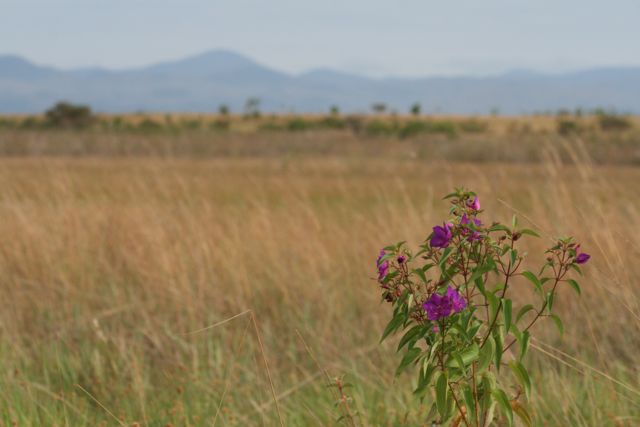
One of the things I hadn't expected to see in Guyana was grassland. I guess I thought it would all be Amazonian rainforest. I was stunned by the visual similarities between Guyana and South Africa, which I visited in 1994, when I was still shooting film. I couldn't get my head around Guyana being in South America when I saw vistas like these.

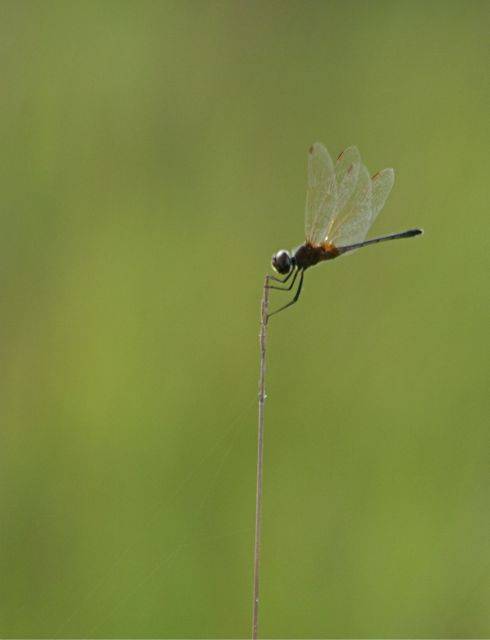
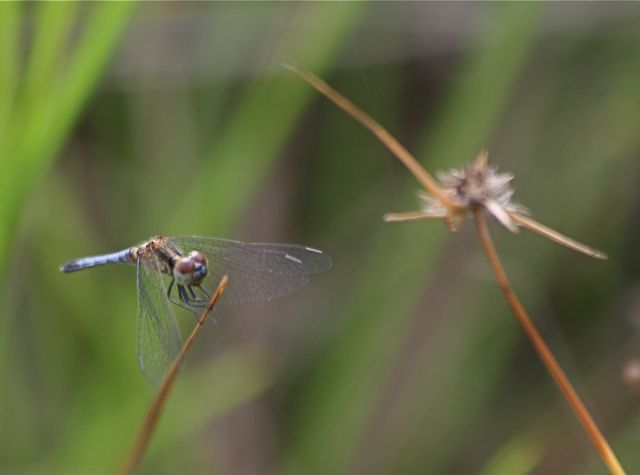
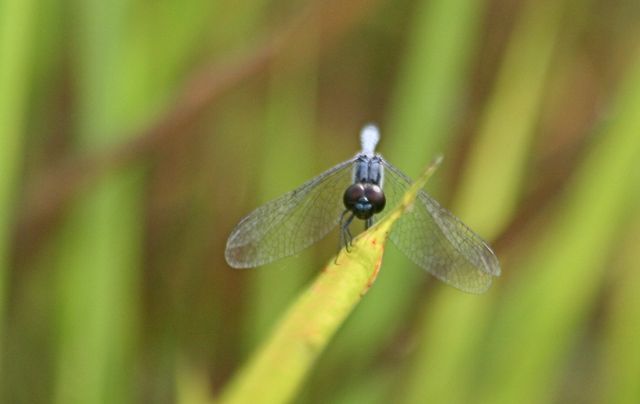
Guyana's savannas are natural, formed where the soil is too thin to support trees. Lightning helps maintain them. We had but a taste of the unique life these savannas support, so very different from the tall forest flora and fauna. There were dragonflies, for one thing, beautiful ones, and one blue one that must be among the smallest true dragonflies on the planet--less than an inch in total length.
As a naturalist, it was a thrill to me to realize that I was looking at a life form that might be undescribed; endemic; that would set every nerve to tingling in my friends who study the Odonata--and to have no idea what I was looking at. I felt like a musicologist who had stumbled on a remote tribe who'd made instruments out of monkey skulls and shells, listening to music none of his colleagues had been privileged to hear.
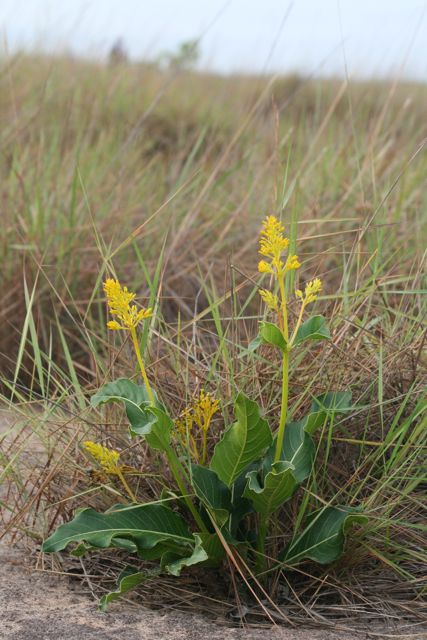
Who are you, elfin one? Does it matter to you?The mystery continued in the plant kingdom. No idea what this is, even what family it occupies.

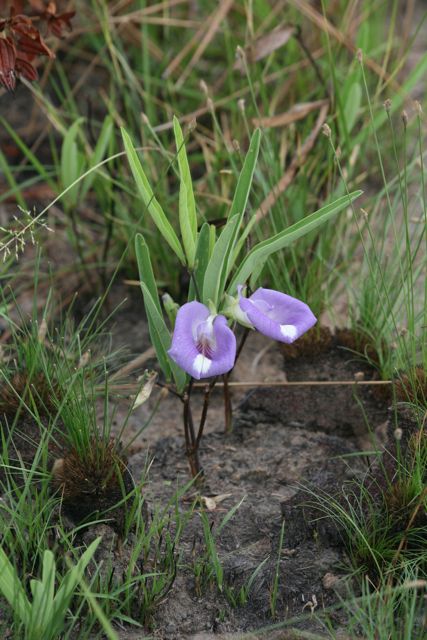
This one, I think, is in the pea family. Had to get down on my knees to see if it had a scent. Not at the moment.

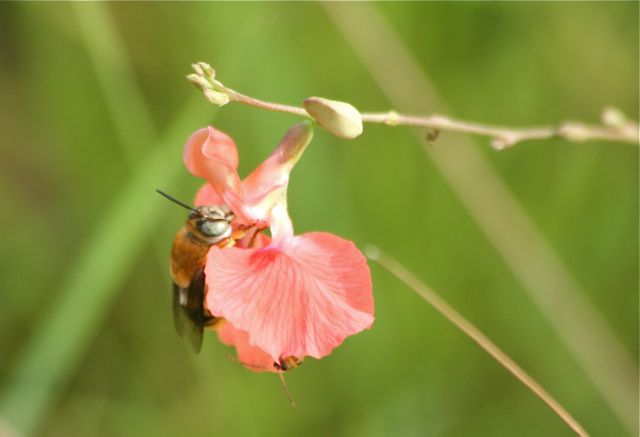
This lovely thing was reminiscent of a Gaura. It also reminded me of Salvia greggii, or Autumn Sage, one of my favorite hummingbird flowers. Even the bee looked exotic.

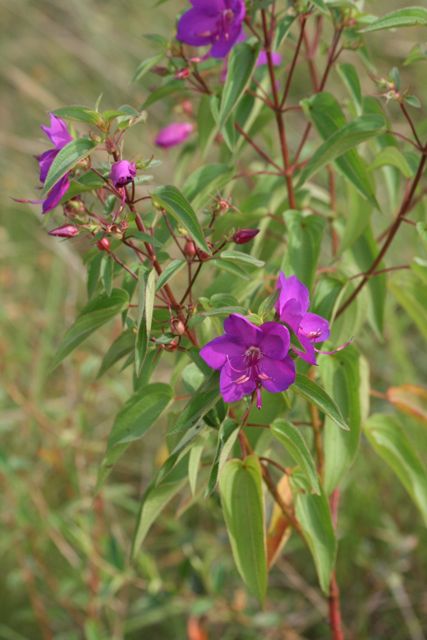
This one, I know, is a melastome, a large tropical family easily identified by the parallel veins in their leaves, and the quilted look made by the cross-veins. I've seen a similar flower grown as a tropical ornamental in San Francisco.

Pull back, and see the landscape--are we in Africa?
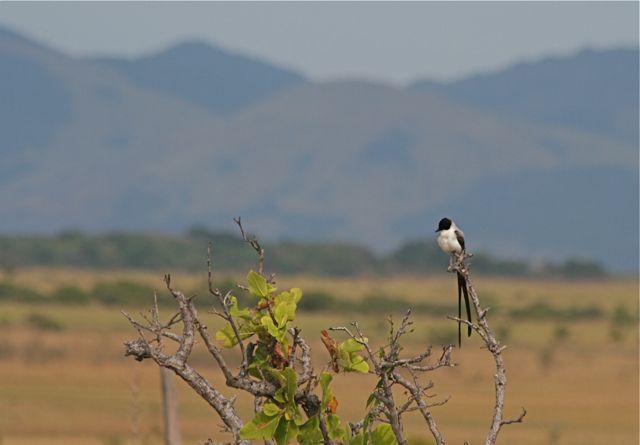
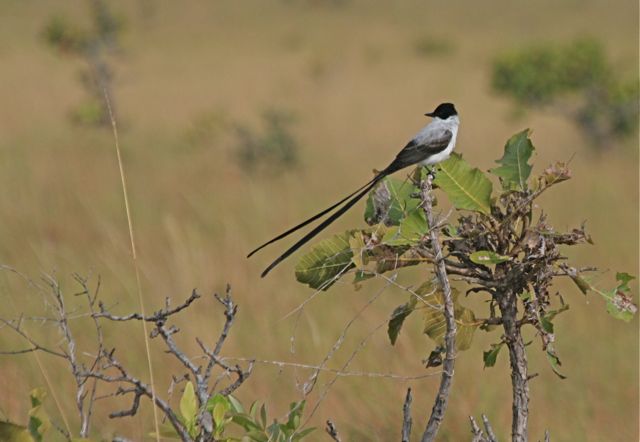
A fork-tailed flycatcher says not. East coast birders will recognize it as a strangely frequent fall vagrant, which inexplicably flies up from South America, showing up along the coast from NJ to MA, just when it might freeze to death.

It was good to see this lovely bird at home. It's reminiscent of our scissor-tailed flycatcher, with none of the paradise pink on underwing and flank. Like a kingbird in a tux.

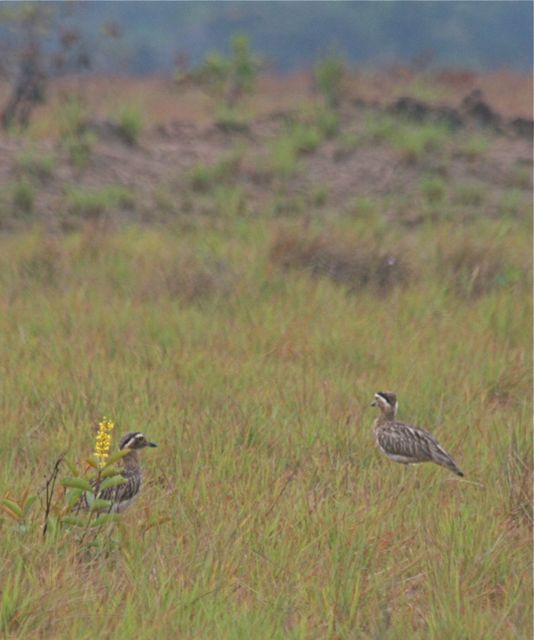
Near the airstrip where we landed, a pair of double-striped thick-knees stalked warily. Enormous relatives of plovers, they have a huge yellow eye with a heavy, weary-looking lid.

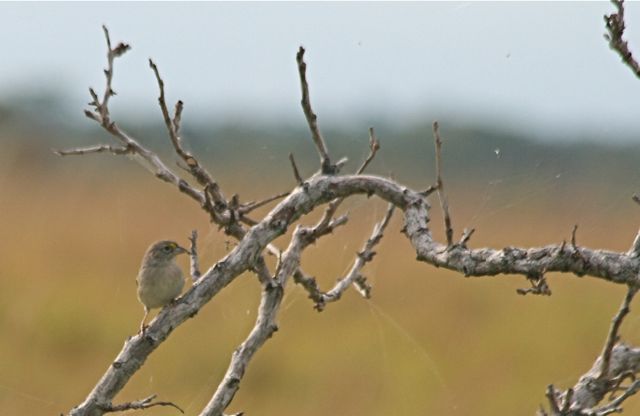
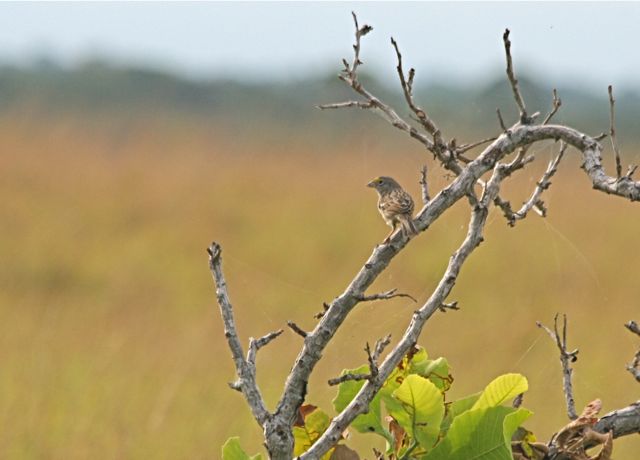
Savanna being hard to find in the Amazon basin, sparrows are hard to find. This plain little creature is the grassland sparrow.

It sits in a pepper tree and voices a buzzy song that might have been a Savannah sparrow's.
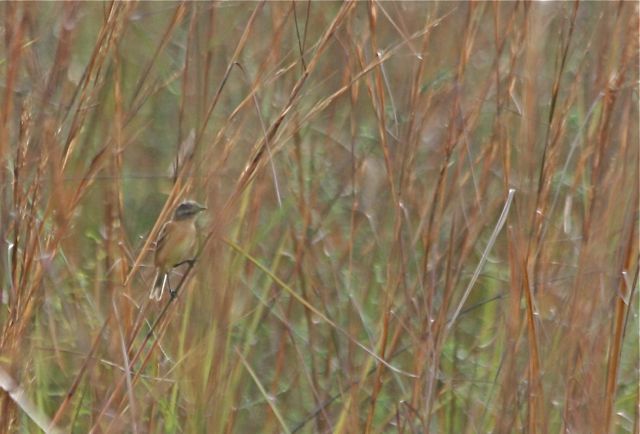
We found all these treasures while ostensibly hunting for an endemic, a skulky little thing of wet open marshes. It's a flycatcher ally called the bearded tachuri. Tell someone you're hunting for a bearded tachuri and see what they think it might be. I somehow snagged a photo before he dove back down into the grass. I love getting photos, any images at all, of weird endemic life birds. But the nice thing about being casual about one's life list is that it's fine with you if you don't see the bearded tachuri. For me, it's all about enjoying the ride. And having probably the only blog on the Internet with "bearded tachuri" in the tagline. Heh. Ooh, that sounds like hubris. I'm sure there are other bloggers writing about tachuris. Somewhere.
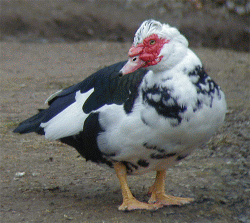
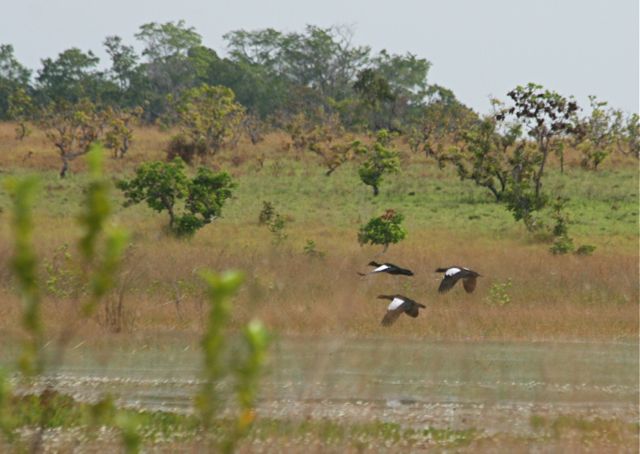
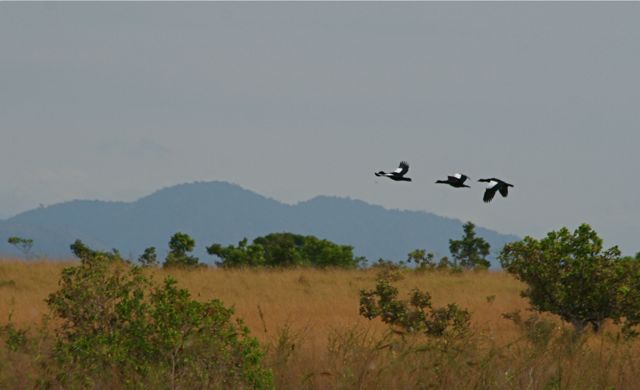
In the marsh, we scared up a trio of muscovy ducks--the slender, wild progenitors of the pot-bellied, red-faced, hissing ogres we've made of them. I will say this--even fat Muscovy ducks retain their ability to fly, which is more than I can say for Pekins.
Domestic Muscovy duck--photo lifted from businessafrica.net.
Wild Muscovies, in Guyana. It was so good to see them as they were meant to be. 
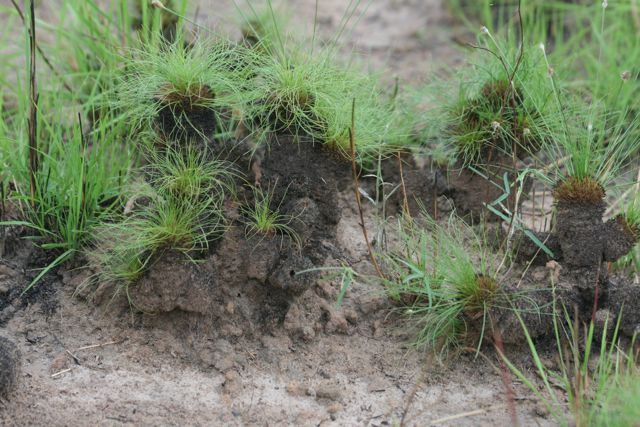
At our feet, an elfin forest of sedges and grasses. I wondered how many decades--perhaps even centuries--old these tiny "trees" might be, their trunks built up with each season's growth.

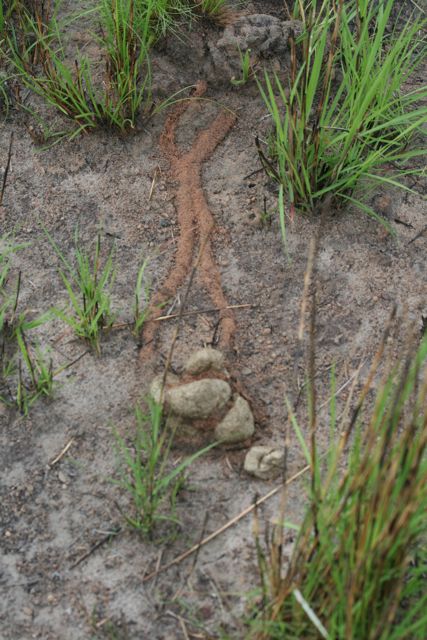
And realized that beneath my feet, termites dwelt in a teeming Gotham, making covered tunnels from one pile of horse dung to the next.

In this metropolis of insects, there is one bad actor--one enormous, all-powerful villain, perhaps the strangest animal that walks the earth, one I had never dared dream I'd see in the wild. We will meet him tomorrow. (Picture Mr. Burns, rubbing his thin white hands together).
I do enjoy cobbling a cheesy serial out of my little travelogue. Cackle!
ZICK ALERT: Wren at The Nature Blog Network just posted an interview with moi at the Nature Blog Network Blog. If only for a couple of highly cute pictures of Chet Baker, and some thoughts on why we blog and what might come of it, please go check it out!
|
Widget for blogger by Way2Blogging | Via Spice Up Your Blog Gadgets
|


Thursday, April 7, 2011
7 comments