
I'm running again, have been since late June, doinky arthritic toe and all. It's fine. It hurts sometimes when there's a big weather front coming in. I'm careful not to stand on tippytoes, wear flip flops, roll it under or push off on it too hard. You do what you must. I'm almost pathetically grateful to be able to run at all, and never a morning comes that I fail to count my blessings.
Some blessings are a little odd. This one made me very sad. It's the height of common nighthawk migration (early September) in southeast Ohio. And I was so, so sad to find one car-hit, head bowed, in the gravel of my beloved road as I chugged along. This is the position it was in when I found it. Almost didn't see it, but there was a bird where there had been no bird before.

Still of the nighthawk
Merciless chunk of metal
Bird angel struck down
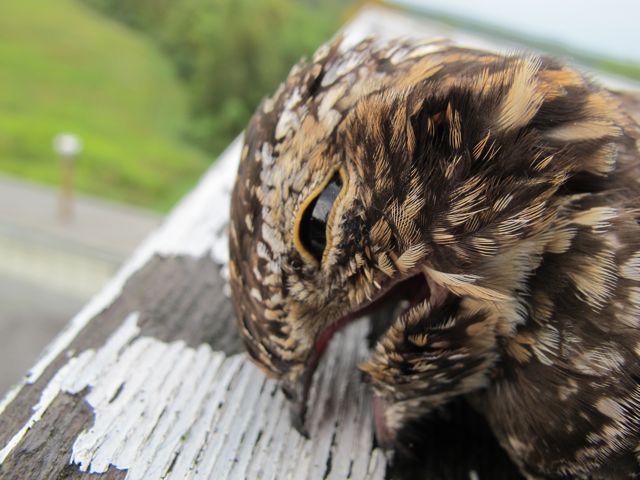
Come, look at this miracle with me. The most interesting roadkill yet on my running route. After two years, the count is three American toads, a black rat snake (get your tissues out for the post about that one); an immature American robin, a female box turtle (waaay too sad to blog about), and a big male opossum (also too sad).
I see right away that it's an immature bird, because it's got reddish flammulation running all through its facial plumage. And the throat patch, which would be bright white on an adult male, is buffy, too. Probably a young female born this year on a city rooftop somewhere.
Nighthawks lay two white eggs on gravel or sand, and most now nest on flat gravel rooftops--they're relatively free of predators but for the occasional rat, I'd expect.
I'm fascinated by its enormous gape. The better for snagging dragonflies, moths and June bugs.
The last thing a giant silkmoth sees.

She's got no rictal bristles to speak of, which is an interesting factoid about nighthawks. The closely related whip-poor-wills and chuck-will's-widows (all caprimulgids like the nighthawk) have giant rictal bristles coming out like whiskers. Go figure. Still thinking about that discrepancy.
Such gorgeous liquid eyes. When I found her they were perfect and rigor mortis had yet to set in. I think she'd been killed within a couple hours of my finding her, probably in the pre-dawn "rush hour" on my country road.

I hadn't noticed these cool white headlights on the leading edge of the wing, but I mean to look for them on the next migrating flock that floats over.
How about that herringbone underwing covert action?

Ahh. The pectinate (comblike) middle toenail. Used in preening. And you can see a filoplume hanging off it. So poignant, to think of her running through her feathers with her toes perhaps just before she fluttered into a truck grille. Well, as you can see, her tiny hooked bill isn't much good for preening. So she has a comb on her toe. I would so love to see how a nighthawk uses its pectinate nail.

I have often thought it would be handy to have a built-in hairbrush somewhere on a digit.

The right wing. Those white slashes are diagnostic for common nighthawk.

Were this an adult male, it would have white slashes in the tail, too.

Beautiful underwing. In flight, common nighthawks look like drunken terns, zigging and zagging side to side up and down in pursuit of erratic insect prey. Or just because flying a straight line bores them.

I know the feeling.
So into the freezer with a date and place label she'll go, and thence to the Cleveland Museum of Natural History, whose Zickefoose specimen collection is well over 100. I'd much rather be looking up at her than down. But she will not go to waste.









Tuesday, September 4, 2012
24 comments