We're trying to hash out whether this is a sharp-shinned hawk (probably female) or Cooper's hawk(probably male). Female hawks are bigger than males, and that introduces a whole 'nother level of uncertainty in their ID. Is it a big female sharp-shin or a small male Cooper's? Who can say?
Now that you've had a chance to look at these shots, I'll tell you what I see in each one. You can see if your observations match mine.

This first picture shows the hawk's overall build--small and light--and long, rather matchstick-like and spindly legs. They don't look very substantial, do they? Maybe even a bit sharp on the leading edge. I always check the legs on any mystery accipiter. If they look so thin that you could snap them with your fingers, I think sharp-shinned.

Do this Cooper's hawk's legs look like you could easily snap them? Nope. He's got gams. He's also got big fluffy white undertail coverts. In Cooper's hawks, these are so long that they sometimes curl up over the top of the tail, especially in flight. In none of the mystery bird photos can you see any fluffy undertail coverts. This is not a diagnostic feature, but certainly a small piece of a confusing puzzle.

This angle on our mystery bird is dandy for ID. First, look at the way the black crown flows down back of the bird's neck, almost melding with the dark upper back. It's not a cap. It's more of a hood. Though there is a narrow lightish stripe between the hood and the back, this bird could not be said to have a pale nape, nor does it have a blackish round cap sitting atop the head, both typical of Cooper's hawk. This dark crown-hood, flowing into a dark nape, are sharp-shin traits.

Nice dark cap cutoff in this Cooper's hawk. Like it's wearing a little cap, not a hood. Super pale nape. Also note the wider white terminal tail band. Compare to photo above this one.

Now look at the tail in the shot above. There is a very narrow whitish terminal band. The tail feathers seem to be the same length throughout. In other words, the tail does not appear to be graduated, as a Cooper's hawk tail would be. Keep an eye on this in subsequent photos. You'll see a square-tipped tail, all the feathers seemingly of equal length: sharp-shin.

Here's a Cooper's hawk, with graduated (uneven length) tail feathers. (This is a feature visible ONLY from underneath, however!) The tail is, by any measure, long for the size of the bird. It's also showing that squarish, hatchet-headed profile. Bill is substantial.
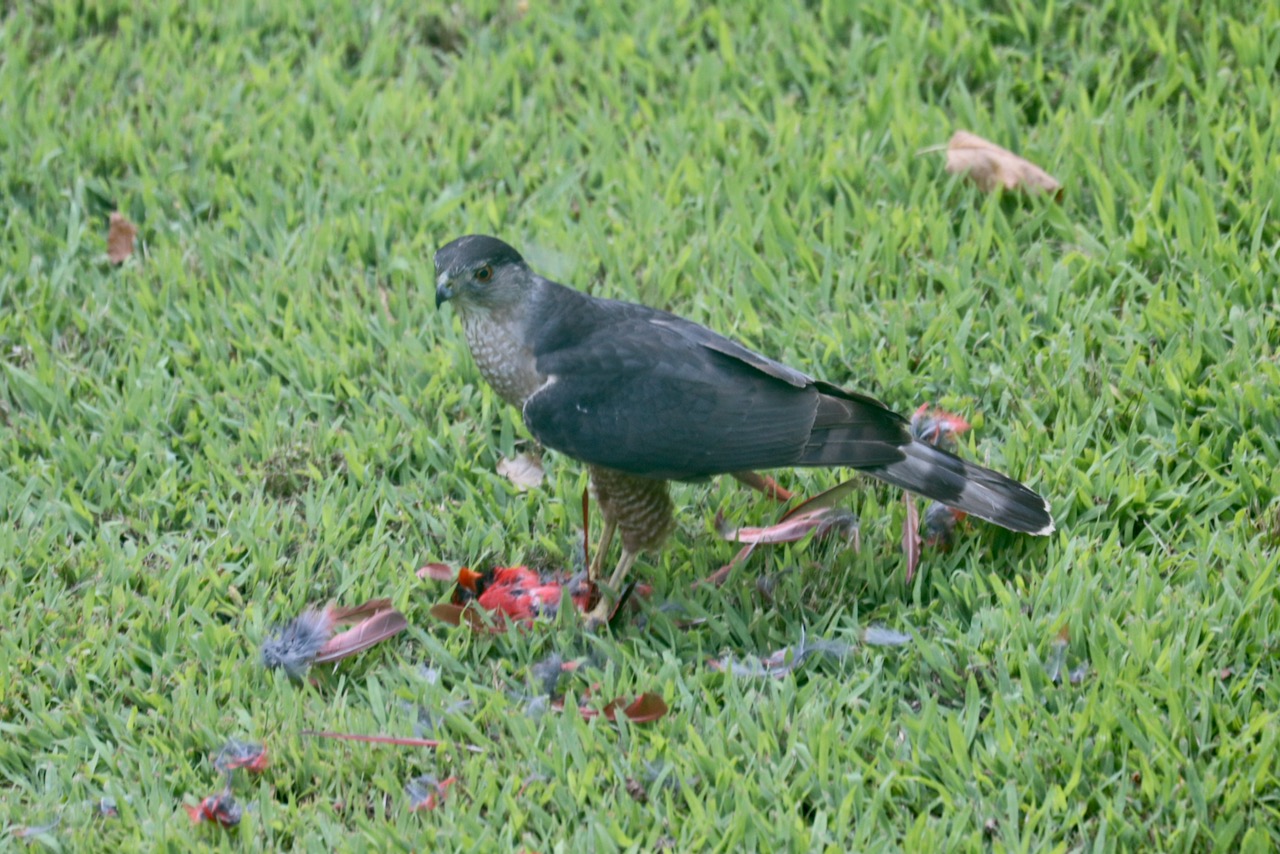
Notice in all shots that the contour of our bird's crown is smooth and rounded. There is no hatchet-shaped crest off the back of the skull (a Cooper's thing).
Note also how delicate the bill appears, protruding from a rounded forecrown, and how large the eyes. Cooper's hawks have a heavier, deeper bill, which seems, at least to me, more a part of the hatchet-shaped head, not a little addendum like the sharpie's bill.

Cooper's hawk. Look at the squared off hindcrown, the abrupt end to the dark cap, and the entirely pale nape.

Cooper's will also show a characteristic this bird lacks: fluffy white undertail coverts. No fluffy panties on this gal!
This closeness in size comparison was a limited time offer, as the cardinal was soon reduced to smithereens.


And so, we'll bid adieu to this beautiful dark female sharp-shinned hawk, and wish her and her nestlings well. Tonight, they eat.
I was delighted to be able to use photos to walk through this ID of a sharp-shinned hawk. What a gift, what a treat. And my first thought, as always, was to share the thought process with you. And that's been great fun. Except that, in endless double-checking before publishing, I realized that I was wrong. The whole post above this line is basically wishful thinking. But I've left it just as I wrote it, so you can see the power of wishful thinking, of persuasiveness. Me, persuading myself it's a sharp-shinned hawk. Me, trying to persuade you that it's a sharp-shin.
It's not a sharp-shin.
Every dang field mark seemed to point to sharp-shin. I was ready to post it. But I knew that I had to be sure. So, like a good Science Chimp, I did some measurements.
I can't tell y'all how long I have been at it, looking for things I could measure. When did I post the first installment? Friday afternoon...and it's Sunday now. Since then, I've been stewing and working on this. Feathers, beaks... I found one entire central tail feather in this shot (below), and then used my cardinal specimen for the actual length of a cardinal central tail feather. With those two numbers, I could then measure the hawk in the shot, and solve for X (total length of hawk).
Cardinal tail feather in photo 38mm = 103 Cardinal tail feather actual
Hawk total length, photo 139 mm X Hawk total length actual
Using the tail feather as a known measurement, and solving for X,
the hawk's total length would be 376 mm, or almost 15" in life.
I wanted another hack at it, so this time I went for a comparison of the total length of the cardinal to the total length of the hawk.
So I measured the cardinal's body and tail separately in this shot, and then extrapolated as if the bird were stretched out straight. I knew from my own specimen, made from a window-kill, that a stretched out cardinal is 215mm long.
Here's the equation for that.
Cardinal total length in photo 68mm = 215mm Cardinal total length actual
Hawk total length in photo 133 mm X Hawk total length actual
Using this equation, I got a total length for the hawk of 420 mm or 16 17/32"
Sharp-shinned hawk females measure from 290-340 mm (11 52/64" - 13 25/64")
The largest female sharp-shin comes in around 13 1/2"
Cooper's hawk males measure around 390 mm (15 23/64")
Using either measurement, the hawk is too big to be a female sharp-shin. It has to be a Cooper's hawk.
For me, this exercise was an incredibly time-consuming but very powerful demonstration of several things.
First is the power of wishful thinking. I wanted that bird to be a sharp-shinned hawk! Sharpies are declining; Cooper's are exploding, and I wanted to go back to the good old days in the mid-1990's, when I found two sharpshin nests in the pines just beyond our south property line. I was so happy to have them, even though they picked off baby bluebirds in my yard. So when I looked at that ambiguous bird, my hungry eyes searched for evidence that it was a sharp-shin.
--Those thin legs looked spindly to those hungry eyes. But all hawk legs look spindly from the front and thicker from the side. It's how they're built-laterally flattened.
--That long, dark cap extending down the nape looked like a sharp-shin's hood, not a Cooper's beret. Still does. I wouldn't call that a "pale nape." But there you go. Their plumage coloration varies.
--On the graduated (Cooper's) vs square (Sharpie) tail: To be perfectly honest, if you can't see the underside of a bird's tail, you can't say if the feathers are graduated in length or not, so we can throw that one out.
--No fluffy undertail coverts like a Cooper's? Well, I guess it just has them tucked up. It's not exactly relaxed while killing its prey.
Second is that this stuff--differentiating sharp-shinned from Cooper's hawk-- is HARD. This is, by any measure you choose, an ambiguous bird. Is it a large female sharpie or a small male Cooper's? Well, Phoebe and I got pretty darn good shots of it and I couldn't tell. I thought I knew! But in the end, I didn't. I hope that makes you feel better when you throw up your hands over a bird plucking something in your backyard. Honestly, it's easier to tell them apart in flight!
Third is that numbers don't lie. But photos can.
In this photo, before the plucking started, it looks like the cardinal and the hawk are practically the same size.
Put them in profile, and ehhh--not so much. The hawk dwarfs the cardinal. Why couldn't I see that before?
Because I wanted it to be a sharp-shin. Back to Tenet 1: the power of wishful thinking.
And that's why I did the analysis, because I had to be sure. I couldn't proclaim that this was a sharp-shinned hawk and that we were all going to learn something about raptor ID without due diligence. And that due diligence gave me data that forced me to reach a different conclusion--that it's a Cooper's hawk. Probably a male. Heck, I can't even say that for sure. But I think it's a male Cooper's hawk.
Presented with new data, I reached a new conclusion. If you don't remain flexible in your thinking; if you close your mind to new information, you're going to be wrong a lot.
I'll leave you with this shot of my cardinal specimen, made from a roadkill* in May, 1986. Just above its head is the skull of a male sharp-shinned hawk that hit the tower window in August, 2017. He'd been nesting nearby; I knew it because he was grabbing birds at the feeders all summer long, and I heard his fledged young keening in the north border. Look at the size of his skull compared to the cardinal's. They're practically the same size. Can we say that about the mystery hawk and its cardinal prey? Nope. We can't. Measurements don't lie, numbers don't lie, and neither does the Science Chimp.
It's a male Cooper's hawk!
 |
| *specimen beautifully prepared by Rob Braunfield |









Sunday, August 9, 2020
15 comments