Background Switcher (Hidden)

Showing posts with label feral cats. Show all posts

Happy National Feral Cat Day, 2016!

Sunday, October 16, 2016

26 comments
Gentle readers:

 I don't usually post book reviews on this blog.  I don't use it for advertising or political purposes. I don't tout anything but stuff I make myself (books, notecards, puzzles and stuff) or the stuff I just happen to love (plants, some jewelry, heated dog dishes, for example). This is a highly personal journal, probably 99% of it a simple celebration of all I find beautiful.

But today, according to Alley Cat Allies, is National Feral Cat Day. Nationwide, events are being planned to celebrate the presence of feral cats in our communities and rural areas. It's OK if you need to read that last sentence twice. All right. So I am celebrating, as an avian rehabilitator and unabashed celebrant of natural diversity. My celebration of National Feral Cat Day might proceed a bit differently than some people's.

I just read a book called Cat Wars: The Devastating Consequences of a Cuddly Killer by Peter Marra and Chris Santella. And while I was flying to and from South Africa, I had something like 34 hours to work on my review, which was commissioned by a major national newspaper. I had read the book carefully at home, but had yet to write the review. I started it over Newfoundland on the outbound leg, and finished it somewhere over Cameroon on the way home.  Well, it came out too long and my editor couldn't figure out how to cut it without gutting it, so he had to pass on it. That's OK. There will be other books to review.

So, in honor of National Feral Cat Day, I'm going to publish it for the first time right here.


My painting of the cat that took the power of flight from Vanna, the savannah sparrow who bounced around a cage in my studio for 17 1/2 years.


Cat Wars: The Devastating Consequences of a Cuddly Killer. Peter P. Marra and Chris Santella. Princeton University Press.

It’s not often that the word “important” floats up as a descriptor for a new book, but Cat Wars amply qualifies; in its treatment of a subject nobody wants to embrace, this fast-paced, gritty and occasionally terrifying book could sit comfortably on the shelf beside Rachel Carson’s Silent Spring. Ornithologist Peter Marra, director of the Smithsonian Migratory Bird Center, plunks study after scientific study on the table, while popular writer Chris Santella, author of the Fifty Places series, pulls back for the long view, then zooms in with anecdote, constantly changing both scene and topic. The resulting narrative pulls the reader in like a cat to a laser pointer.

The wake-up call to conservationists and cat owners alike began in 1989 with Stanley Temple and John Coleman’s University of Wisconsin study, which attempted to quantify the number of birds killed by free-ranging rural cats in that state. Through direct observation of radio-collared cats, fecal analysis, and analysis of stomach contents of live-trapped (unharmed) cats, they established what their subjects were eating: primarily small mammals and birds. Using extremely conservative modeling, Temple and Coleman determined that at least 7.8 million birds die annually at the claws of cats in the state of Wisconsin alone. Subsequent studies by others refined the counts of cats as well as birds, taking aim at a nationwide figure. Even with the charitable guess that only one in ten free-roaming cats takes a bird per day, ornithologist Rich Stallcup arrived at the estimate of 4.4 million birds per day, or over one billion birds taken annually by owned cats in the United States. In his analysis, Stallcup didn’t even address the problem of feral cats, which is likely much larger.

“Along the California coast it is common to see 10 to 15 during a day’s outing (and these are nocturnal animals.) Certainly, there are many million, country wide. What do they eat? Wildlife. Nothing but wildlife.”

Scott Loss and colleagues used two independent pet owner surveys to come up with a mean figure of 84 million owned cats in the U.S. as of 2013. Using eight independent studies, Loss was able to estimate that more than half of these are allowed outdoors, and about two-thirds of those animals hunt. An additional 60-100 million unowned cats likely roam the nation, and every one of them hunts to survive. Median estimates of the yearly national toll on wildlife run to 2.4 billion birds per year, 12.3 billion mammals, around 200 million amphibians and more than 600 million reptiles. This study points at cats as responsible for more bird deaths than all other anthropogenic (wind turbines, window collisions, car collisions, pesticides) factors combined. These figures, sickening as they are, are conservative. They do not, as cat enthusiasts claim, represent a subjective, emotional vendetta against cats. Nor would any scientist deny that habitat loss is a major factor in rapidly declining songbird populations. Direct mortality from cats is real, and it is preventable. This book sounds an alarm too long silent.

Cat Wars could serve as a textbook for its clear explanations of subjects such as the processes of extinction, island biogeography, and population modeling, as cat impacts on wildlife are discussed. But the book hits its stride in illuminating the rarely discussed and truly terrifying role of domestic cats as vectors for zoonotic disease in humans. What more perfect vehicle could zoonotic diseases employ than an animal that kills and eats sickly wildlife, then defecates around and inside human homes? Black plague, carried by rodent fleas, but now thought to spread through aerosol transmission, killed one third of Europe’s population, starting in China the 1300’s. It’s still present in eight western states, infecting small rodents, the cats who eat them, and (rarely) the people who own those cats. 

Far more common, and now taking hold in managed feral cat colonies in Maryland and elsewhere, is rabies. The baffling double standard where dogs and cats are concerned is here thrown into sharp relief. Dogs are registered, licensed, confined with fencing and leash; vaccinated yearly, and annual U.S. cases of rabies in dogs had dropped to 59 in 2014--a 34% decrease from 2013. Cats, on the other hand, roam freely; are not licensed and are often unvaccinated; and 272 rabid cats were reported nationwide in 2014, a 10 % increase from the 247 reported in 2013 (CDC data). While people managing colonies with TNR (trap-neuter-release) vaccinate the cats against rabies on first capturing them, cats are clever. Once caught, a cat will very rarely enter a trap again, meaning they do not receive rabies boosters.  About 13,000 post-exposure rabies treatments are given annually in the U.S. due to cat exposures, which is approximately 1/3 of all rabies exposures (Gerhold and Jessup, 2012).

Black plague and rabies are rare. There is a cat-specific parasite which is extremely common; which finds its way into soil and drinking water; which works in silent, seemingly calculated concert with rodents, cats, and humans alike, and has been recently found to have public health implications undreamt of. Toxoplasma gondii reproduces wildly in the digestive tracts of felines and is shed in oocysts in their feces; most people recall warnings that pregnant women should not clean cat boxes, as the parasite can cause birth defects in people. Rodents pick the oocysts up through contact with contaminated soil and water. And from here, it gets stranger and stranger. Controlled experiments with Toxoplasma-infected rats have shown that the parasite alters the limbic regions of their brains such that the rodents lose their fear of cats, and the smell of cat urine, which repels them when they’re healthy, becomes irresistible. Seeking out cat urine, of course, helps ensure that the parasite-laden rodents end up in the guts of cats, where T. gondii reproduces and is shed in feces to start the cycle again. Most disturbing are findings that people are similarly affected by toxoplasmosis. It is the most common parasitic infection in humans, affecting up to 22 percent of the U.S. population. Outdoor cats defecating in children’s sandboxes and the loose garden soil and mulch around homes present a concentrated risk of human and cat infection. Even more insidiously, the hardy cysts of Toxoplasma can persist for years, finding their way into streams, rivers and marine environments, as well as drinking water. Toxoplasmosis kills endangered monk seals in Hawaiian waters; sea otters and seals elsewhere.

Recent studies have shown that humans bearing Toxoplasma antibodies show some of the same behavioral changes as rodents, including decreased anxiety and an attraction to the smell of cat urine. If you actually like that smell, having more and more cats around you is a good thing. Along with these changes come a stringer of others, including tendencies toward severe depression, bipolar disorder, obsessive-compulsive disorder, and even schizophrenia. Toxoplasma-positive individuals were 2.7 times more likely to develop schizophrenia than uninfected people. Wait. 22% of the U.S. population is Toxoplasma-positive??

In the face of scientific evidence that cats take a shocking toll on wildlife; that they are frighteningly efficient vectors of zoonotic diseases, some of them real doozies, it is puzzling that society has turned a blind eye to the impact of their largely unregulated, unchallenged, omnipresence in our ecosystems. Cats kept indoors for life are vastly less likely to come into contact with diseased animals, and transmit disease to their owners. They don’t kill birds, mammals, reptiles and amphibians, and are safe from cars, dogs, fights with other cats, and persecution by people who take exception to their presence. Indoors, they are graceful, loving, amusing pets. Left free to roam they are, collectively, a disaster for already-struggling songbird and small vertebrate populations.

A strong and vocal segment of the population lobbies for the “rights” of feral cats, such that municipalities nationwide have been convinced to sanction the maintenance of cat colonies in their midst. Over and over, TNR (trap-neuter-release) has been shown not to reduce cat numbers, but rather to provide obvious dumping places for unwanted pets, which go on taking prey as cats naturally do, subsidized with food and shelter or not. Yet, because it is presented to municipalities as a solution, however imperfect, for addressing the feral cat problem, TNR is endorsed, as a less politically repugnant option than advocating the removal of the animals once and for all. Cat Wars gives cat lovers and pro-cat lobbyists a chance to be heard, profiling several devoted colony caretakers who work tirelessly to feed, water and care for street cats, and give them the best lives possible under the circumstances. It is clear that, along with the belief that free-roaming cats have a place in communities, goes denial at their real impact. The most vocal cat advocates hold the "right" of this domestic species to live free and kill wildlife above any concern for affected wildlife, and stridently question the validity of the studies cited. Calling any work--no matter how exhaustive, careful or conservative--that counters their conviction "junk science" is a defensive pose that looks all too familiar to scientists and citizens speaking out, for example, about climate change.

Ironically, it is a microbe—Toxoplasma gondii—which has been predicted to “dethrone” malaria as the protozooan most dangerous to humans—that may hold the key to changing hearts and minds. In the end, the multiple public health threats that roaming cats present look to be the only force that could propel any real initiative to reduce free-ranging cat populations.  Cat Wars gathers together an ironclad case for action over emotion; for a turnabout in public policy that in many municipalities literally supports the perpetuation of an introduced domestic predator of dwindling native wildlife; for an overhaul of the lassiez-faire attitude of more than half of America’s cat owners. If we would have cats in our midst, we must learn to keep them inside, for they create nothing but havoc—and countless more cats--when they slip out the door.


If you'd like to do something about all this, please send donations to American Bird Conservancy, whose Cats Indoors educational campaign is the most effective I've seen. You can donate here. Please tell them Zick sent you, on National Feral Cat Day.

You can purchase Cat Wars here. And pay no mind to the stack of one-star "reviews" from cat enthusiasts who haven't read the book. They flooded in before it was even released. Read the five-star reviews now rolling in, then get your hands on this book! It's a beautifully constructed and paced page-turner...I literally couldn't put it down. Thank you.


Happy National Feral Cat Day, 2016!


Things I Saw Along the Way

Saturday, December 6, 2014

8 comments
November 10, 2014. Seems like it was the last beautiful day I can remember. I used it well, with a long run along the Ohio and Muskingum Rivers in Marietta. We have a modest bike trail, growing a mile or two each summer, and boy does it get used!
I took a lot of photos, reveling in the last of the autumn leaves and flowers. I'm glad I did. For it's been unbroken gray and often rainy ever since. Bleh. It's nice to go back...

to the sycamore limbs, limned in low sun. A word meaning "illuminated," and one that I sometimes write but never say. There aren't many words like that. 


I don't know how many photos I have of these two limbs along the Harmar bridge. Many. They are spectacular.
They reach out and go on and on. I don't know how sycamores do that.


I was shocked to see a Dutch iris putting out a brave snow-white blossom in November. I wonder if that means it won't bloom in May? It smelled delightful. Front Street. Just noticed Smitty's Pizza in the right background.


A nearby hydrangea was not to be outdone. What a brave showing!


I was stunned by the beauty of this Japanese maple against the Potomac blue paint of its house. (I think of trees as part of the family, somewhere between pets and residents). Is there a more graceful tree? I think not. 


These maples are most beautiful when they're allowed to spread out and wave those baby-fingered hands wherever they want. It's a little tough along a city sidewalk. You have to keep them sort of trimmed. But these homeowners are doing a wonderful job. 


For stark contrast, a Japanese maple FAIL. 


Here is a haiku, by me, written about this tree.

No no no no no
No no no no no no no
No no no no no.

If the office manager comes to work one day and finds a gaping hole where this little tree once tried to grow, he or she should not be surprised. I would like to free it and bring it to Indigo Hill, let it grow the way it was meant to, beautifully, gracefully. Out. And Up. 
 This is not a yew or a privet hedge. This is a Cutleaf Japanese Maple. You BOOBS!!

I looked for seedlings in the mulch beneath, but found none. :(


I did find doggie tracks in the stamped, dyed concrete of the levee. I had always thought it was brick! Fooled me, until I saw this. Nice. I like the way the paddyprints have collected pebbles. I wonder if this dog is still with us? I always wonder that when I see prints in concrete.

Did you make them, DracuPug?


Never have I seen a more fetching underbite. Coupled with the potchy belleh, that's one kissable pugga. Little-known fact: I went into shopping for dogs intending to get a pug. After a little research and thought, I decided on a Boston terrier because I thought, having longer legs and muzzle and a more slender build, it would be able to run better. At that point (2004) I wasn't even running, but I hiked a lot, and I wanted someone who could keep up with me. The rest is history.


No underbite. Potchy belleh, check. Athleticism, check. Winsome expression, kissability, check. 

The romantic in me smells every rose, even landscape roses, which rarely have much scent. These were lighting up a November twilight near the bike trail. What a wonderful plant is the Knockout rose. Tough as nails. Mine all died to the ground last winter, and only one didn't come back. They were puny last summer, but they were alive, and that's saying something. The Japanese beetles left them alone. Maybe they all died last winter, too.


Sarah and Dandy, looking out of their stalls at the horsebarn at the Fairgrounds, casting some boffo head shadows.


 Girls board their horses there and ride them around little corrals and the racetrack. If I kept a horse there, I'd light out on the bike trail. But that's probably not allowed. I've never understood riding a horse around a ring. But then I don't get treadmills either. I have to go somewhere, see some things.

 I would make a very poor convict. So I try not to break laws. 

(Would rescuing a tortured Japanese maple constitute theft?)
Is there such a thing as justifiable theft?


A small part of the feral cat colony being fed and maintained at the Fairgrounds, handy by excellent riverine gallery forest habitat full of song sparrows, cardinals, Carolina wrens, eastern kingbirds, yellow-throated warblers and warbling vireos. Lots of delicate wild fare to choose from for the burgeoning kitty corps.

On to things that make sense to me...

A glorious sugar maple, somehow hanging onto its full raiment as every other tree drops its leaves.


I am stunned and amazed at its gold against the rare azure sky.


It's like an epiphany.


Back to town. There's a guy smoking out the back of our brewpub. I like to look for people smoking out the back of restaurants. I wonder why so many people who work in restaurants and bars smoke? And they're always so young.  It's quite odd to be asking your good old body to run 7 miles, and trotting past someone half your age, who is sitting there wrecking his nice young lungs on purpose. 


Two little apparitions in pink, chasing mallards down by the water. I can safely say I have never worn that shade in my life. Nor will I. Not even as a costume, or a joke, or for a cause. Phoebe says all my clothes are dung-colored. So be it.

It looks nice on them!


The geese put themselves out of reach.


Sunset on the Harmar bridge.


Walking the dachsies. Now there's a breed I love which could never make the athleticism cut. I grew up with a superb dachshund, fathered by a mini, with a standard mother. But a distance runner he was not.


Ended up with a little fro-yo with my boy at Whirl, where Phoebe worked last year. So good. I get the sugar-free stuff, then throw fresh fruit and Heath Bars all over it. :D I always misbehave, too, laugh too loudly, go for one too many samples, that kind of thing. It's tradeeshun.


Is She Really Going Out to Maine?

Sunday, August 10, 2014

15 comments

I've made it a policy since starting this blog in December 2005 not to apologize when I miss posting. I do my darnedest to get three posts up each week, but sometimes life rolls right over me like an ocean comber and it doesn't happen. I know that if you're here in the first place you probably are happy to see a new post whenever it goes up. Especially if it has a dog in it.

Gratuitous Chet/Demon photo.


Silver-browed Chet's finally mellowing at 9 1/2. He only bites Demon about once out of every four times we see him now. But note his spraddle-legged power stance. Turd-tail out straight. Gotta be The Boss. Always overdressed in a starched tuxedo shirt, too.

Chet and his best friend Wally get along great because Wally doesn't care who's boss.


Back to the blogpost at hand. Part of what's got me so tizzied and tied up is Phoebe's imminent departure for Bowdoin College in Brunswick, Maine. Which feels like a very, very long way away from Whipple. And is. Good for her. She's stepping out fearlessly on the untraveled path.

We're buying things like detergent and desk lamps and little rugs and extra long twin sheets. And seeing other parents buying those things too, a slightly lost and stunned look on their faces. Is it really all over, this fast? In August?

Friday night we threw a party for her and her school friends. 44 people showed up. Almost everyone we invited came. It was amazing. Bill and I were hopping for two whole days beforehand. When your catering staff is but two, and you're determined to cook, if not grow, everything you serve yourselves, it's a lot of work. But we'd have it no other way, and it's so worth it. Because in our world, growing and serving delicious food is a way to love your friends and family. 

The morning of the party, I got a call from someone on our county road that there was a hawk hopping around her meadow, and it had a hurt wing. Well, what I didn't need with 44 people on the way was a busted hawk. But who ya gonna call? I couldn't say no.  Out I went, gloves and cat carrier in hand. The second I stopped the car and raised my binoculars to look at this young red-shouldered hawk, it began hopping toward the woods. So pitiful, to see a hawk brought low. It knew I was coming for it. Hawks miss nothing. And they put two and two together. They are not slow.


I had no trouble catching it before it made cover. It was pitifully emaciated, and according to the homeowner a wandering cat had attacked it. The cat had been hunting rabbits in her field for several days. It takes quite a cat to kill a rabbit, and I believed her about that cat, because a cat like that would attack a grounded hawk. When I examined it, I found that the @#$#%#$ cat had broken the hawk's right wrist and dislocated its elbow, too. No hawk worth its salt should be attacked by a feral cat.  I knew from its painfully thin condition this bird had been struggling for awhile. Some young ones just don't get the hang of hunting, or they get hurt. And they don't make it. 

Hoping I could reverse this craptastic turn in its short life, I took it home and stuffed it full of raw chicken thigh and Ensure. Chet Baker told it that I was OK, that it was safe now, and with a full crop for the first time in weeks it slept peacefully in our basement while we went on cooking for the party. 


I put out an appeal on Facebook, and within minutes our wonderful Managing Editor at Bird Watcher's Digest, Dawn Hewitt, volunteered to take it to the Ohio Wildlife Center that same evening. I met her at a gas station as she drove on her way to Indiana, handed her a cardboard box full of hawk and a plate of nice party food, and she dropped the bird off that same evening. It needed antibiotics and perhaps surgery, and it would get that at OWC. If I had any extra  money I would send it to Ohio Wildlife Center.  Thank you Dawn. Thank you, OWC. Even if it doesn't make it back to the wild, we will all have done our best by it. 

When I looked up from feeding and housing and preparing the hawk for its journey, it was noon. And 44 people would arrive in five hours. YIKES! I started dragging ingredients out of the fridge, made two quiches, prepped a watermelon to chill, set the kids to shucking some of the 50 ears of corn Bill had brought home, made two confetti cakes and the frosting to go on them (Phoebe loves my almond buttercream!), helped Bill peel potatoes for mashed (she loves those too). Bill was grilling the chicken and vegetables and icing the drinks and bam! the party started.

Arrive they did, and it was wonderful. I really tied one on. Had two beers. I'm usually a party with one. Two? Look out. Sumpin' gonna go down.


Bill climbed up in the tower (you can see his shadow!) and got a rare photo of me sitting down (just beneath his shadow!) Oh, it was magical. Phoebe's in the middle of the little clot of girls at the left side of the circle. They're all playing with her hair. The almost full moon rose on the gathering and nobody wanted to leave, but eventually they straggled back down the driveway, bellies full of smoked chicken and garden vegetable quiche, mashed potatoes, Witten's sweet corn, homemade tomatillo salsa, watermelon and birthday confetti cake. 


Liam and Bill and Phoebe and Chet and I sat around the little fire Bill had built, and the katydids rang so loudly we could hardly hear the coywolves howling. And I thought about what a magical life these kids have had, growing up here, and I was grateful to have been blessed to raise them here.


As I was finishing this post, Phoebe came in, fresh and smelling of ozone, from a long bike ride on our steep foothill roads. She was bursting with the news that she'd found two stands of rose gentian and a red-headed woodpecker. 


She's going to do fine in Maine. She is a creature of the moment, a creature of place, one with roots that go deep and strong. And I will miss her like I miss the summer when November rolls around.


But we will still have the irreproducible and irrepressible Liam here, and he's going to get all that extra love, and we get to watch him blossom as we did his sister.


You don't get luckier than that.


Happy National Feral Cat Day!

Thursday, October 16, 2008

52 comments
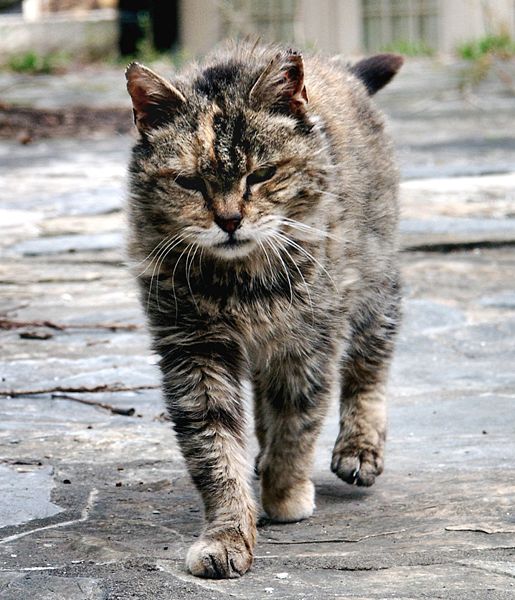
a feral photo from the Web; if I could find attribution I'd gladly give it.


Across the United States, perhaps 90 million domestic cats are kept, the majority of them allowed to roam and hunt outdoors. An additional estimated 70 million feral cats--nonnative predators that live by their wits outside-- annually kill hundreds of millions of songbirds and more than a billion small animals such as mice, voles, chipmunks and rabbits. The problem grows exponentially; one breeding pair of feral cats can produce produce 420,000 offspring over a seven-year period.
New Yorker Book of Cat Cartoons

Various solutions have been offered; among them are shooting (South Dakota and Minnesota permit shooting of feral cats) and the popular trap-neuter-release programs, in which volunteer veterinarians have spaying clinics for trapped feral cats. After that, the cats are released back into the habitats where they were trapped. Hmmm. And that's because these exotic predators belong in the wild, preying on native birds and animals? Ummm...Because nobody knows what else to do with a wild, unsocialized cat? Because it's a kind thing to do? Because it's OK with us that they're living on a diet of warblers, sparrows and thrushes, chipmunks and voles, frogs and lizards? Because it makes us feel better? What am I missing here? Is there something right and good about allowing cats to decimate native wildlife that I just don't get?

A California study showed that neutered feral cats live an average of seven years after being released; seven years in which they will continue to prey on native birds, reptiles and mammals.

A good summary of the issue can be found at National Geographic's web site.

In an effort to become more informed about the problem, I subscribed to Alley Cat Allies. I get their e-mailings, and I've learned some things I didn't know about feral cats and birds. Apparently, I'm mistaken in my conviction that feral cats kill a lot of birds. My 45 years of observations of cat predation on songbirds, including the countless cat-bitten songbirds I've dosed with antibiotics and tried to repair, are wrong: They eat mostly small mammals, insects, and reptiles, according to Alley Cat Allies. Oh, that's OK. Whew. Nobody much likes mice, bugs, and snakes anyway.

And did you know that, according to Alley Cat Allies, human activity in the form of unregulated hunting is actually the cause of the precipitous, non-cyclic decline of migratory birds, and the reason that migratory bird protection laws were passed? Well, that may have been true of shorebirds, gallinaceous birds and waterfowl in the market hunting days around the turn of the 20th century, but I haven't run into a human hunting party that's after tanagers, sparrows, thrushes, warblers, and vireos lately. I have seen an awful lot of those that were killed by cats, however. Hunting doesn't even enter into it: Habitat loss, window strikes, and cat predation are the Big Three songbird killers, and the studies exist to prove it.

Outside of the trap-neuter-release programs, which allow feral cats to go on doing their native wildlife predation work for an average of seven more years, the life span of a feral cat in the wild averages two years. It's a short, brutish existence, rife with disease and peril. Because they become pregnant as kittens when they're a few months old, before they've even attained full growth, two years is plenty of time for a female cat to crank out four or more litters. Which crank out more, and more, and more...70 million and growing. Millions and billions and trillions of cats.
From Millions of Cats by Wanda Gag

Living outside is rotten for cats, and feral cat predation devastates native wildlife. Cat predation is an unnatural, and most importantly, preventable cause of songbird and small mammal deaths. But people have to recognize the problem to do something about it. Education!

So, in celebration of National Feral Cat Day, this morning I sent a donation to the American Bird Conservancy's Cats Indoors campaign. You can donate online here, or send a check to:

American Bird Conservancy
Cats Indoors Campaign
PO Box 249
The Plains, VA 20198.

Please write: In Celebration of National Feral Cat Day in the "Memo" line of your check. Tell 'em I sent you.

Happy National Feral Cat Day! Party at my blog.

Footnote: This post, from October 16, 2008, is enjoying a renaissance as of January, 2015. Huzzah! It's still pertinent, and the comments section is good reading, if you've got about 30 minutes. In the meantime, American Bird Conservancy is still doing a bang-up job fighting for the rights of those birds, mammals, insects and reptiles. In the U.S., kind-hearted people are still nurturing countless burgeoning colonies of feral cats. Australia, faced with the certain disappearance of some 124 endemic bird species, has gotten very tough on them, announcing a plan to eliminate 20 million feral cats by the year 2020. You can still have kitties, but you have to keep them inside. Sounds pretty good to me. When an endemic species is snuffed out, another heaven and another earth must pass before such a one is made again. Feral cats, not so much.
[Back to Top]