I'm an artist and writer who lives in the Appalachian foothills of Ohio. With this blog, I hope to show what happens when you make room in your life, every day, for the things that bring you joy. Strange...most of them are free.
Thurs. Feb. 27, 2020, 7 PM: "Saving Jemima: Life and Love with a Hard-luck Jay" at
Mt. St. Joseph University Theater, 5701 Delhi Rd., Cincinnati, OH 45233. Doors open 6:30 pm.
For info call Colleen McSwiggin (513) 244-4864
Mar. 11-15, 2020: Bird Friendly Backyard workshop and Saving Jemima talk at Joint Conference, N. Am.
Bluebird Society/Bluebirds Across Nebraska, Holiday Inn Convention Center, Kearney, NE. Right in the middle of
sandhill crane migration! Call (308) 237-5971 for reservations.
Mon. Mar. 23, 2020, 6 PM: "Saving Jemima: Life and Love with a Hard-luck Jay" at Morgan Co. Master Gardeners Event, Twin City Opera House, 15 W. Main St., McConnelsville, OH. Free and open to the public. Call (740) 962-4854 for information.
Sun. Mar. 29, 2020, 3 PM: "Saving Jemima: Life and Love with a Hard-luck Jay" at
Sunday With Friends,, Washington Co. Public Library, 205 Oak Hill St. NE, Abingdon, VA 24210. For more information, call (276) 676-6390
Apr. 30-May 2, 2020: Julie Zickefoose at New River Birding Festival, Opossum Creek Retreat, Fayetteville, WV. Friday night keynote: Saving Jemima. Curtis Loew, miracle curdoggie, presiding.
May 7, 2020, 7 pm: "Saving Jemima: Life and Love with a Hard-luck Jay" at Campus Martius Museum, Washington and Third Streets, Marietta, OH. Booksigning after. If you missed the Esbenshade lecture/ People's Bank talk in November 2019, this is your event!
Weds. May 13 2020, 5:30 PM: "Saving Jemima: Life and Love with a Hard-luck Jay" at Roger Tory Peterson Estuary Center's event at Essex Meadows, 30 Bokum Rd., Essex, CT 06426
This event is open to the public.
Thurs. May 14 2020, 6 PM: "Saving Jemima: Life and Love with a Hard-luck Jay" at New Haven Bird Club's Annual Banquet, Amarante's Restaurant, 62 Cove St., New Haven, CT 06512. This event is open to the public!
Sat. May 16, 2020: "Saving Jemima: Life and Love with a Hard-luck Jay" for Bergen Co. Audubon Society at
Meadowlands Environment Center, 2 DeKorte Park Plz, Lyndhurst, NJ 07071
Time to be announced. Call (201) 460-1700 for more info.
Sun. May 17, 2020, 2 PM: "Saving Jemima: Life and Love with a Hard-luck Jay" at White Memorial Conservation Center, 80 Whitehall Rd., Litchfield, CT 06759. Call (860) 567-0857 for information.
Tues. May 19, 2020, 7 PM: Good Reads on Earth Author Series, by PRI's Living On Earth with Julie Zickefoose and Saving Jemima at Mass Audubon's Drumlin Farm Wildlife Sanctuary, 208 South Great Rd., Lincoln MA 01773. Includes audience participation, and will be taped for airing on public radio! Get the book first, read up and call (781) 259-2200 for information.
Thurs. May 21, 2020 6 pm: Julie Zickefoose, "Saving Jemima: Life and Love with a Hard-luck Jay" at
Bigelow Chapel, Mount Auburn Cemetery, 580 Mt. Auburn St. Cambridge MA 02138. Call (617) 547-7105 for more info.
I have been so very busy with bluebirds of late...have left some teasers about fostering orphans on Instagram and Facebook, and I'm sorry about that, but the story is still unfolding and I am learning so much! I hope to pass it along soon--I've been keeping careful notes. Today, with work and springtime and grounds and house maintenance all smashing me, I don't have time for a bluebird story so I'll tell you a little chickadee story. I haven't been to the grocery store for two whole weeks, had to dig out a frozen pizza last night. But a Science Chimp has to blog!
I have had a pair of Carolina chickadees nesting for the past few years in a tiny slot box along my driveway. I suspect it's the same female at least, because she has a habit of building a nice, deep, soft nest, then digging allll the way down to the floor of the box until she's clean out of nesting material. Let's call her Digger.
There's something about knowing this bird, and knowing she is going to do this every year, that brings me a little glow inside. Mostly because I love knowing it's her, in all her quirky sweetness, and because I always helping out.
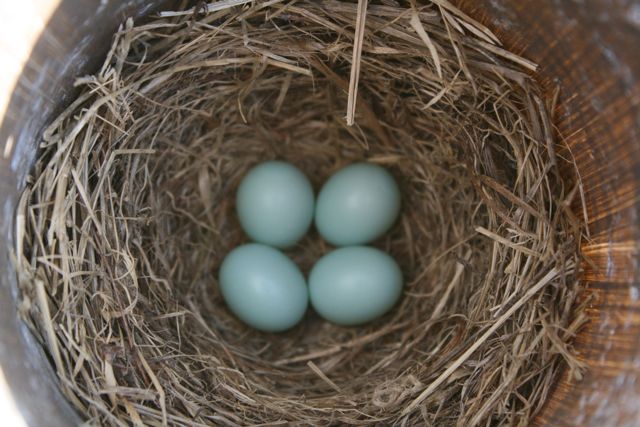
I peeked in Digger's nest on April 18 and there were six beautiful tiny eggs. To the untrained eye, all looks well.
Because my eye is trained, I could see, even in the dim interior of the box, that the eggs were in a peculiar order and spaced much too far apart for efficient incubation. And why is the background so dark? No no no. She's laid them on the bare wood floor of the box again!
To confirm, I lifted the nest. Mm hmmm. Welp, we have to do something about this situation, and fast! Baby chickadees, born on hard bare wood, are at certain risk of splayed leg joints that could make for severe disability as they grow. Luckily, I check my boxes often, and working backward, I see that I found this sorry situation on the first day of their incubation.
I took the nest out. Oh for Pete's sake. The most important part of the nest--its cup-- is not even there!
Now, why would a bird as smart as a Carolina chickadee do something this apparently dumb, year after year?
I have thought about it, and I think it's the fault of the box. Designed to thwart house sparrows, who like a deep, dark nest cavity, this box was deliberately made shallow, with a slot opening to let in lots of light. A chickadee, like a house sparrow, feels safer in a deep nest cavity, so her instinct tells her to keep digging and building downward. She hits bottom way too soon in this shallow slot box, but by then it's too late, and she's laying her eggs. Poor wee thing. It's not her fault, it's mine. As usual. So it's mine to rectify.
Every spring, before the grass really gets green and growing, I go out and gather dried hair grass in my meadow. I believe the species is tufted hair grass, Deschampsia cespitosa, though I am always happy to be corrected. It's my favorite grass, not just because it is elegant and beautiful, but because it's so useful. I carefully curate the patches of it in my prairie meadow, and they have grown and expanded. I love it because its dried winter blades make such a fabulous bed for baby birds. I gather clumps of the dried stuff and put them in feed sacks for use all spring and summer long. When you are seriously into bird ranching, you value fine, soft bedding, because you wind up having to replace nests when they get infested by parasites, soiled, or wet. Mites, blowflies, nasty stuff, too much rain--all can make a nest sodden and stinky and downright dangerous, and I don't hesitate to jump in and replace such nests with fresh new grass, packed and wound tightly in the box.
You don't want just any grass--it must be fully dried and cured, and it must be absolutely free of anything sharp, stiff, or pokey.
So I gather dried tufted hairgrass by the armload before it rots in April.
I cuddled the eggs in a temporary nest of hair grass while I worked.
I went to my handy sack of hair grass and pulled out a wad, from which I made a chickadee mattress. I added some dry moss to make it more like something the chickadee would make herself. I wadded and wound it tightly to try to foil The Digger, and installed it on the floor of her box.
I'm holding the original nest so you can see the giant hole in the bottom. The new Tempur-Pedic is installed in the shallow slot box.
You see the problem. She has nowhere to dig to!
It's so hard to believe there will be birds inside these fingernail-sized eggs, but there will! Just have to wait 12-14 days! I installed them on their new springy soft mattress and carefully replaced the original nest.
And on May 2, c'est voila! Three-day old Carolina chickadees, five of them, off to a much better start than they would have been otherwise. Lucky babies, lucky Digger, lucky me!
I can't begin to tell you how sweet it is to stand on my dirt road on a May morning and drink in the sights: the light, the sky, the clouds and the sounds of the birds who make their homes on our land. It's such a simple thing, to walk out the door, trot out the driveway and about a half-mile down the dirt road. I find myself praying it stays dirt for good; that nobody plops houses on the haymeadows or lets them grow up to woods. Simple prayers, but heartfelt.
In this video, you can hear, more or less in order, Carolina wren, song sparrow (scold), indigo bunting, scarlet tanager, American redstart (the really loud see see sweew) Eastern towhee, Tennessee warbler, a school bus turning around, orchard oriole, common yellowthroat, American robin, a possible blackpoll, and northern cardinal. Of those, only the Tennessee warbler and blackpoll are migrants, headed farther north; the rest are going to hang around and breed right here. I'm pretty used to picking apart a cacophony of birdsong into its various contributors, but this presents a bit of a challenge. It's a birdsong menudo. Everyone's singing at once!
I watched the young male redstart and a pair of white-eyed vireos fluttering in the sunlit edge, looked for but couldn't find the tanager and orchard oriole, and gazed at my beautiful new doggeh, feeling very lucky.
It's all so beautiful. I could never tire of seeing the light stroke across this landscape, especially with a cur in the foreground. Going out with Curtis every morning puts a big piece back into my scattered jigsaw puzzle of a life.
The field daisies are just beginning to bloom, dotting the haymeadows with clean stars of white. They always start blooming well before I'm ready for them, and every year they're a delightful surprise. Oh! The daisies are out! Even before it really warms up for good. It's a disgusting 46 out at 5:47 AM which is what you get when the skies clear and all that heat radiates out into space. But then what will follow is a sunrise and a sparkling sunny day, so hauling all that stuff back into the greenhouse is ultimately worth it. I've let daisies come into my flower beds, because they make me happy. I can see how they got out of gardens and into everyone's fields.
One of the things I do in spring and summer is check my bluebird boxes. Technically, I try to hit each box at least once a week, but when there are babies, I check a bit more. Things can always go wrong with babies, and it's good to be looking in.
Checking my boxes gets me out into red-headed woodpecker habitat like this. Hearing their querulous squirks! lifts my heart. Seeing their banner colors stops it.
Really, how can a bird be so gaudy, so perfectly clean-cut, so noisy and social; so delightful? Red-head was a pretty obvious choice by Bill for his favorite bird. Someone less enthusiastic and outgoing might have chosen something more subtle. (Says the person who chose blue jay).
You may detect hazy August light in these shots. I certainly do. Though I usually post up-to-the-moment iPhone photos, for the birds I occasionally have to go back and raid the long-lens archives. Not apologizing. Just 'splainin'.
Ahh, that's better. Look at this glowery May day!! And I get to be out checking bluebird boxes in it! Lord. What a place I get to live in. These skies, I'd put them up against Tuscany's any day.
Here's a box, perfectly sited by my sweet late friend Jeff Warren. He built the box, I built the pole and baffle. We were a team.
Inside that box, three bluebirds, two males and a female, 14 days old. They're atypical 14-day-olds, small and not as fully feathered as they should be, but thanks to all the rain, the hay is tall and foraging is tough for bluebirds when the hay gets so tall. They'll be OK, even through these nights in the 40's, because it's going to warm up and quit raining so much now. Right? This is why I check more often when there are babies. Someone might need help.
Though it's really pushing Blogger to ask it to publish two videos in one post, here's the father of these babes, dive-bombing me. Turn the sound up to hear the angry castanet snapping of his bill as he comes close. This bird was paired for years with a female who was just as aggressive as he. She disappeared, and their box went empty for the first time this spring. He's turned up at this box, several hundred yards away, now paired with a female who vanishes under duress.
Of course, I am perfectly aware that the dive-bombing male here could be the son of the pair in question, but finding the box the Aggressors had occupied for at least five years suddenly empty led me to the possibility that the female died and the aggressive male moved. My observation from 37 years of running bluebird boxes is that, in eastern bluebirds, female choice drives nest location. I've seen male bluebirds try to override their mate's choice of a nest site, and it is not pretty. Those girls know what they want, and a male can resort to beating her up and even tearing out her nest, trying to get her to change her mind. So, having perhaps lost his mate, Mr. Aggressor had to change locations, letting his timid new mate dictate where the nest would be. It's kind of nice to be swooped on by only one bird. Maybe just a touch of PTSD from my years of working with least terns, who swooped, sometimes struck, and pooped on me, too.
Back in the Aggressors' original box, someone finally moved in! What a wonderful surprise! And not a bill snap to be heard.
I am usually wearing going-to-town clothes when I check the boxes on this road. The tall hay is almost always wet, and so am I. But oh, the sights you'll see!
I watched this pair in a haymeadow on my road fool around with a half-built nest for weeks. They only got serious when a pair of tree swallows showed interest in the box. I suspect the female is getting quite old and just had to gather herself to build and lay this year. She's usually a late nester, but initiating a first clutch on May 12 is really pushing it. Still, she laid five beautiful eggs (the norm around here is four). I honestly think these small Gilbertson PVC nest boxes, and the small slot boxes as well, discourage bluebirds from laying their full normal clutch of 5. Which may not be a bad thing; in times of privation, it's tough to raise all five. It's always a pleasant surprise to see a fiver in my little boxes.
But the best surprise of this day was yet to come. This PVC box in my driveway started out with bluebirds who laid two eggs, then mysteriously abandoned. I think they started over in another box just down the driveway. Why, I have no idea.
Another(?) bluebird came in and covered the eggs with a new grass lining. Well, OK. If they're going to go to waste...I dug down, fished the cold eggs out, and farmed them out into two other nests, where they both proved to be infertile. Maybe that first bluebird knew something about her own eggs.
The renovating bluebird never laid eggs in the nest, and it sat empty for several weeks. I left it, because something interesting could yet happen, and it was a perfectly good, fresh nest. One day I found it all tamped down and neatened up. Oh! Someone's been renovating!
And a few days later, a very pissed off Carolina chickadee shot out and scolded at me when I checked it. Oh!! I left her alone for a week. You don't want to disturb a nest-building bird. And when I finally checked again, I found the MOST marvelous thing.
A patchwork chickadee quilt, made of three kinds of fur (rabbit, squirrel, and something with dark brown wooly underfur); some soft grass, and two wads of green Hollofil!!! I suspect the Hollowfil is still from toys Chet Baker used to shred on our lawn. Hollofil doesn't biodegrade, but it is wonderful insulation. Chickadees know this. They love it, and Polarfleece too. I found a chickadee nest once with purple Polarfleece from Chet's (and now Curtis') favorite blankie. She must have gathered it while it was hanging out on the line!
While she's laying, a Carolina chickadee makes a little quilt that she lays over her eggs to hide them when she's away. Because I have checked many a chickadee nest, I knew to lift the patchwork quilt. It came up in one neat piece, like a blanket. And there beneath, treasure.
I covered the tiny orbs back up and went on my May way.
Can it really be more than two weeks since I've posted? That's June for you, when both kids are home for the whole summer (I'm still dazed at this) and I'm conscious of treasuring every minute in their presence, because what else is there to do that is as important as that? Well, I had a big drive to Chicago in there, too, and a bunch of talks to give, but now I finally, finally get to stay home for a little while. Well, there's a wedding coming up on the East coast...but I still have a week here!!
There's also been the little side job of getting Liam ready for college, going through all the forms and financial aid and work study job applications and promissory notes and rooming assignments and buying extra long twin bedding and field trips and orientation...gaaaack it's like a part-time job. I don't remember anything like this with Phoebe. At all. Maybe because she just handled it herself. Or in part because Bowdoin didn't have an orientation, at least not one we could attend. Anyway. It's hectic as all get out. And he leaves for good on AUGUST 11. HOW IS THAT POSSIBLE OR HUMANE?? So if you don't hear much from me in the next couple of months, it's because I'm too busy loving him up. And if you don't hear much after that, well, assume the worst. Ha ha. Ugh. Not looking forward to rattling around in this too-big house by myself. Good thing Phoebe will be home another couple of weeks after that. Lord. From feast to famine, it'll be. I have a good project, at least, and I'll be deep deep into it then.
I've finally broken through the barrier and switched gears from finishing the writing to doing the illustrations for Saving Jemima. I think, no, I know it gets harder to do that with every book. I grind my gears for weeks, putting off the inevitable. I love to write. I could write hanging upside down by one toe from a forklift, if I could get the pen to work. But I have a really hard time getting started with painting. Every time I sit down in front of a blank sheet, I'm afraid I've lost it. Which, of course, I haven't, but try telling my psyche that when I'm frozen up and looking for anything to do but paint.
I literally got to the point where I couldn't write any more. The story was finished. I had cobbled a fairly satisfying ending out of a story that didn't have a satisfying end. She was here for eight months, and then she wasn't. Rats. OK then, let's recap. What did we learn here? That's the solution I came up with. And I learned a lot from that experience, from that bird. The ending works, I think.
So I selected a ton of photos for each of 20 chapters, and decided what I should illustrate, mostly things that can't be photographed. Every morning when I open my laptop it's like "Get Smart," where The Chief tells Maxwell Smart: "Your mission, if you choose to accept it, is..." except that I don't have a phone in my shoe (it's in my pocket!) and I certainly don't have an Agent 99 to help. All I have is me and my watercolors. And that's fine. I love getting the assignment each day. I've got this.
One thing that really helped was teaching a two-day sketching and painting workshop at the Morton Arboretum in Chicago.
I'd love to post some illustrations but that would ruin the surprises for the book. I'm painting on scraps of very old Fabriano cold press watercolor paper, which I'm sure is a lot better than new Fabriano paper, and loving it so much. Soon I'll run out of that and have to rummage around in the flat file for more scraps. It's not a very big book, so I can paint these things fairly small. It'll be OK.
I have some photos from the last couple of weeks that I like, so I'll share them here, in this disjointed halooo from the Land of Book and Kids and Flowers and Rabbits and Chipmunks.
An
extremely rare photograph of a Carolina chickadee sheltering its
nestlings. Even got a little catchlight in its eye, practically impossible to do with chickadees. They're skittish, and inclined to come out of the nest box
hole like an arrow aimed right at your eye. Staying put is not something
they are good at. I had my iPhone camera on and ready when I took the box down to peek inside.
On my run a couple weeks ago, the same one where I saved the snapping turtle, there was a little thank-you present waiting in a little shed not far from
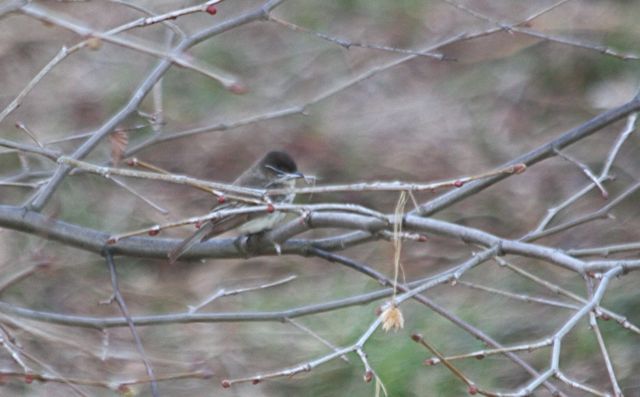
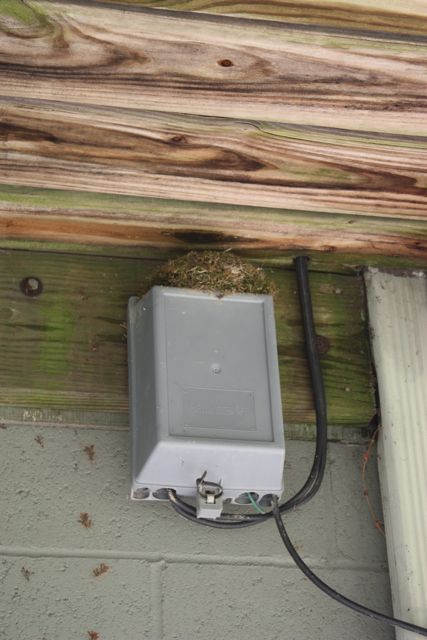
the Three Graces--an active phoebe nest on a light fixture, and the
light coming through the machine shed siding. Oh, I like this picture. I
could tell by the way the phoebe mom was acting that she had new babies
in there. I got my photo and got gone. Looks like years of phoebes in that mud and moss tower.
The chicory was just coming out, and you know how I love chicory.
One of my continuing frustrations is being unable to shoot The Three Graces in the morning. They're backlit and it just doesn't work. But here they are in full summer dress, in the morning.
Daisies do a lot better backlit.
A moment when the sun came out for maybe six minutes and I ran around like Daffy Duck taking shots.
I appreciate cattle. This heifer is absolutely lovely. She's got that deep deep mahogany red coloration I like.
Never mind the dirty bum and the poop bindhi on her forehead. She's still a looker, and she made me laugh too.
The Shadow Barn, from another angle. I'm worried about it. Pieces of siding keep falling off. Dang it. But there's an orchard oriole nest in that beautiful oak, just like there was the last two years running.
Here's a little video of my first fawn of June with its mama. You might need to full-screen it to see the fawn, which is barely more than a wake ripple behind the big doe.
And some of the sweetest music I know--begging eastern bluebirds. Yes, I'm speaking bluebird to them. One of my parlor tricks, learned of necessity as a rehabilitator. It's so much easier to whisper to them, and ask them to open up, than to force-feed them. Everybody's happier, and everybody eats.
And in the perfect metaphor for how time and birds fly in June, here is the same brood recently, at Day 14. This photo taken with my "magic eye," held up to the box hole. I wrote the book, and the change in these birds in two weeks never ceases to amaze me. Time and bluebirds wait for no one.
Living in spring's paradise. This light regime lasted for about 20 seconds, and then it all went dark. Moments like this are why I carry my cameras everywhere I go. So when I'm smashed by the beauty of a cloud, a landscape, a flower or butterfly, I can share it with you.
So long we waited this winter, and we waited all of March and April, too, for some sunshine, some warmth. It was very slow in coming, but when it finally did, the moments of warmth and light were all the sweeter. Bill and Liam walk to the bus stop, spring's filmy yellow-green shining in the road puddles.
And we dawdle too long, and hear the growl of the bus as it pulls up and idles. Julie the bus driver is unfailingly kind to dawdlers. She knows to wait on these golden green mornings for our little boy to come puffing around the bend.
Because along the way we have been exploring, finding a Carolina chickadee nest in the driveway box, laden with seven eggs and Hollofil from Chet's toys, just exactly like it was last year.
It's so good to have the same little neighbors who do the same things year after year.
I am holding out the slim hope that this nest in our meadow belongs to a tufted titmouse. I want to paint baby titmice in the worst way. Must return this week to see who's incubating!
On this morning, we bring our friend John along. John has a cat at home named Gunga Din. I could tell by the way he was holding Chet Baker that he had a cat, without even asking. You don't bunch a Boston terrier up on your shoulder like that! Chet looked a little pained but kissed John anyway. He is that way.
We showed John the proper way to hold a Boston terrier. You let him jump up on your lap and then you give him a half-hour massage, working on the knots in his poor stressed muscles. Of which he has none.
Bill and John walk the driveway, hunting morels
but all we manage to find is chickadee eggs. Another chickadee nest in the backyard, this one still being laid!
And though, being in the yard, she's much closer to the motherlode of Hollofil, she prefers grape bark and rabbit hair and goldenrod fiber.
Individuals all, the birds on our land. If you're wondering how I got these nest photos, I'm shooting down into our faux birchbark PVC bird boxes. The light comes through the sides, which is one of the things that invasive, nest destroying house sparrows hate about them. House sparrows like deep dark cavities, not nicely lit ones, so these PVC boxes, designed by Steve Gilbertson of Minnesota, are just the ticket where there are house sparrows bedeviling your bluebirds.
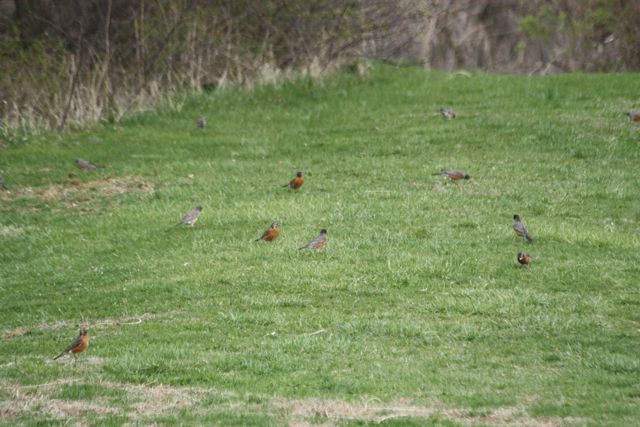
Well, the spring flocks of robins are all gone, paired up, moved off to get down to business.
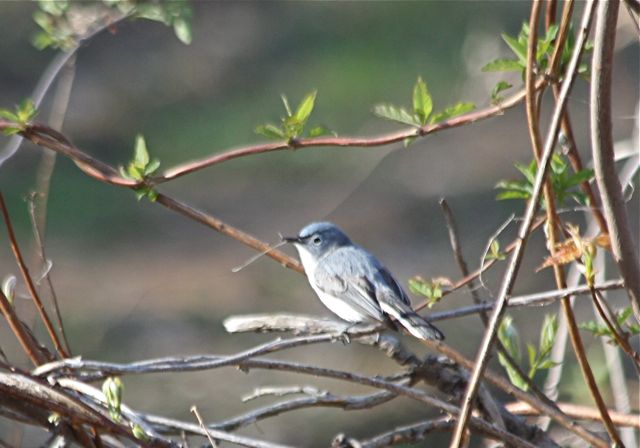
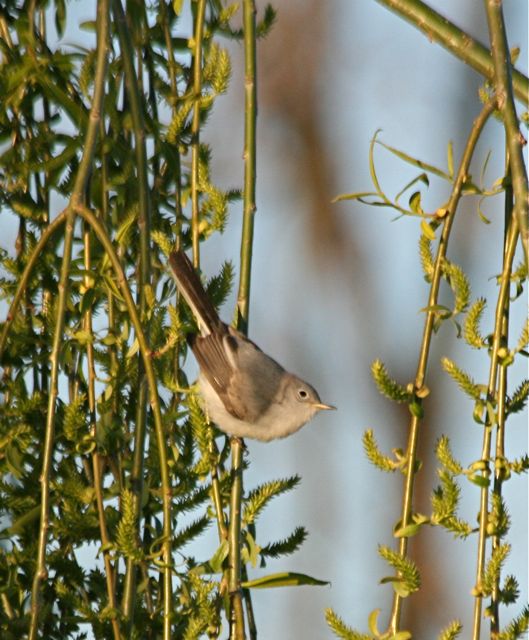
Everywhere I go I hear the tiny dry trill of nest-building blue-gray gnatcatchers. I know that's an unusual sentence, but I do. They say Prreeeeeep when they're gathering nesting material.
The inner bark of honeysuckle vines is great for gnatcatcher nests, and he tugs mightily to free it. His mate has a plain face and an eyering, and she's grayer, but just as curious as he.
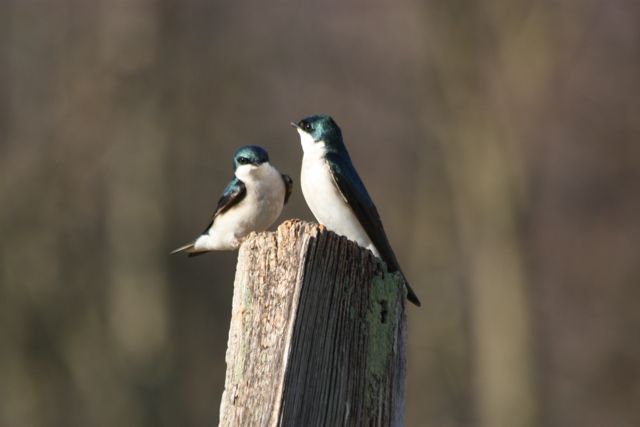
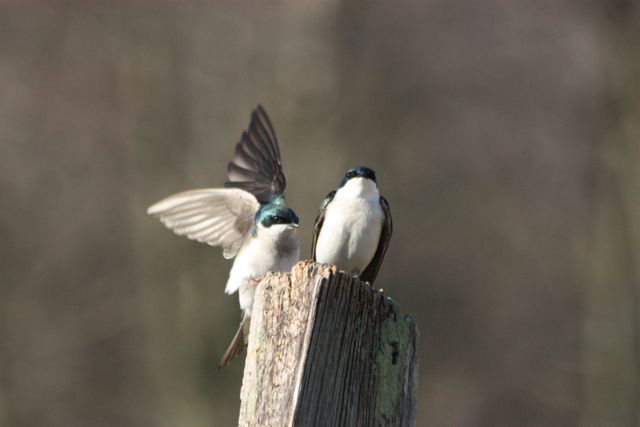
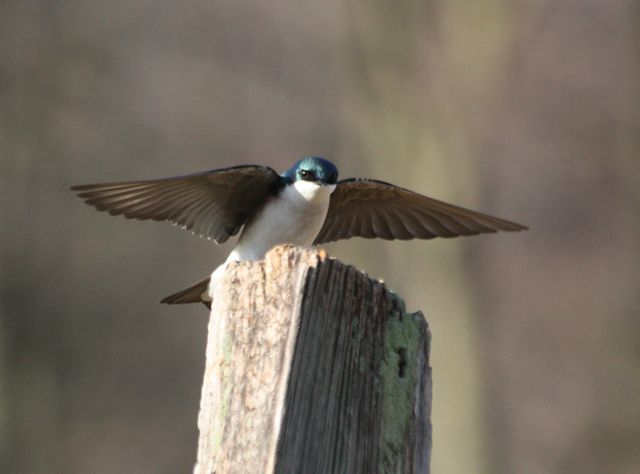
Out in the meadow, the tree swallows are well underway on their nest construction. They've started to line it with the white goose feathers we provide. Eggs won't be far behind.
They both try to sit on the same post near their nest box, with mixed results.
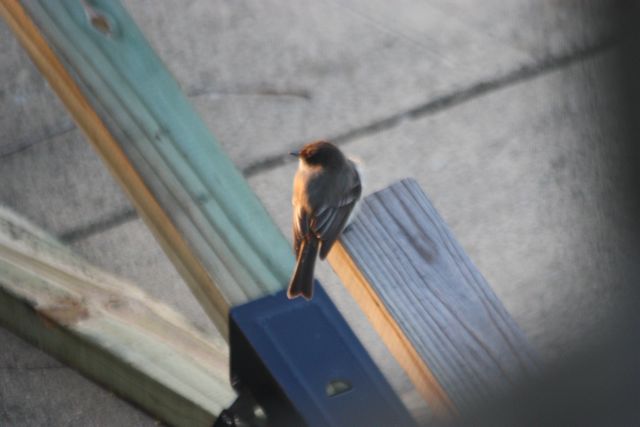
An angel lands. Under the deck, the phoebes have been busy, making a nest on the little television relay box. They haven't nested here for two years, since a snake got the nestlings. This year, I built a better baffle, one with no toehold for snakes. Three large panes of tempered glass and a lot of duct tape were involved. She laid two eggs, then they disappeared, before I even built the new baffle. I am hoping so hard that they come back, but I haven't seen them for a couple of weeks. Why would a bird lay two eggs, then leave? There are questions I can't answer.
A billful of deer hair for the lining. She also added Hollofil from one of Chet's toys.
The finished nest. Phoebes like a low ceiling.
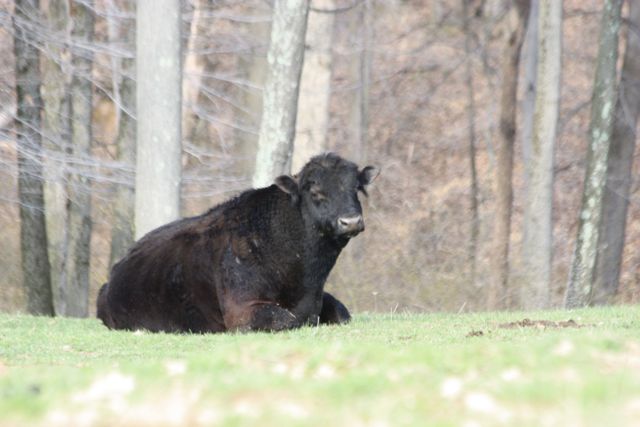
The kids love to come with me when I check bluebird boxes. They especially love the road where Buck the Bull lives.
Hello, Ma'am. I made it through another winter.
So you did, Buck. So you did. Looking a little rough, but some new grass should take care of that.
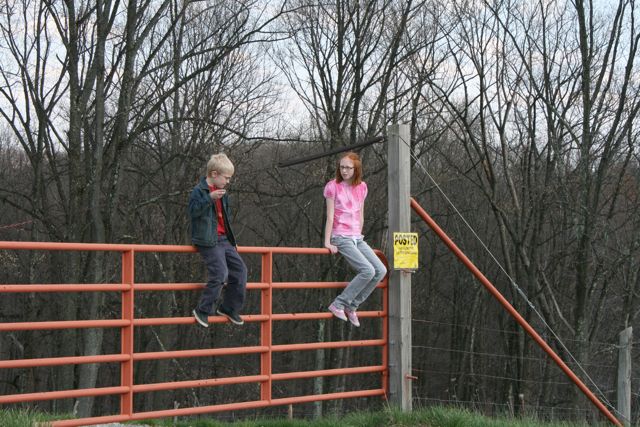
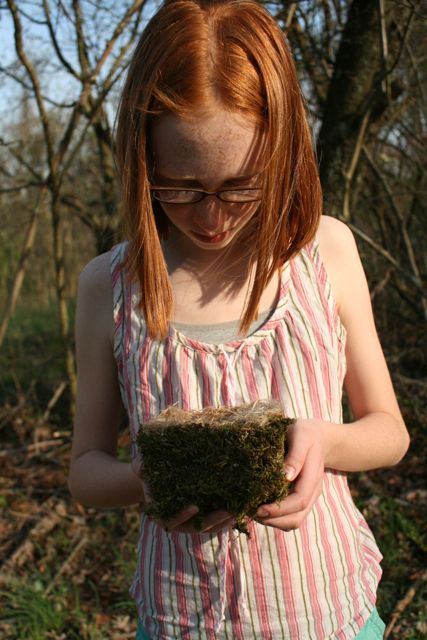
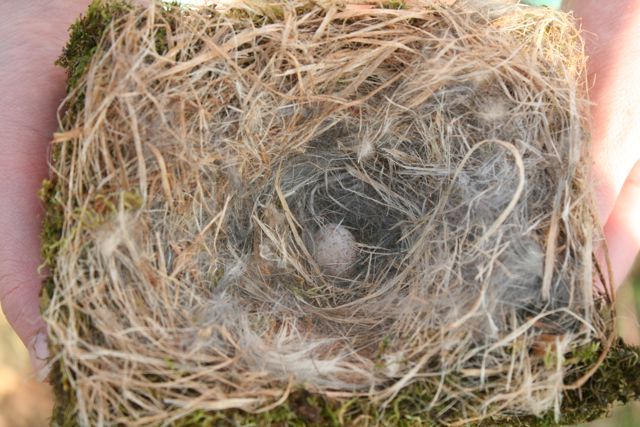
Phoebe and Liam sit on Buck's gate, talking. They love to peek in the boxes. Sometimes there's a different surprise. Phoebe holds a Carolina chickadee nest of moss, goldenrod stem fiber and deer hair.
The first egg.
Chickadee mothers cover their eggs with fur and plant down when they have to leave the nest. It's very sweet. They make a little blanket that they pull over the eggs. I adore chickadees. I would love to tell you how many eggs the little hen has now, but she won't budge off the nest when I open the box, and I am not about to kick a chickadee out of her home just so I can know how many eggs there are. Still, it would be nice to know, because eggs are much easier to count than squirmers.
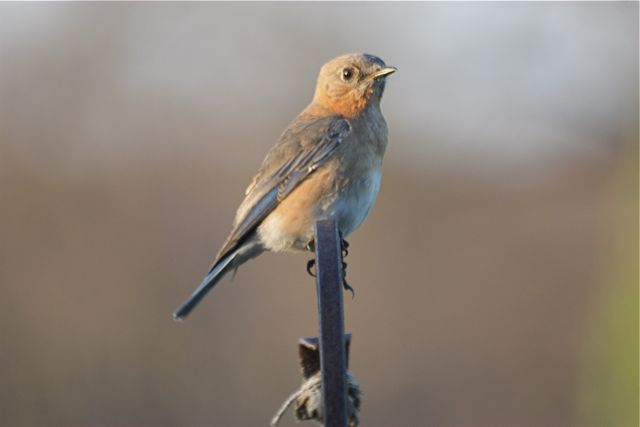
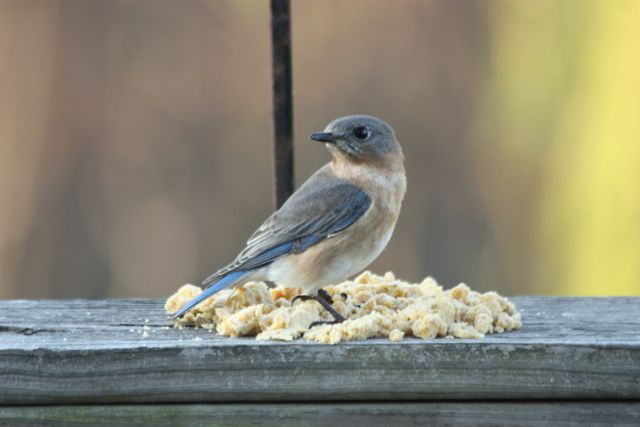
And what of Gouty, the female bluebird who overindulged in Zick Dough last winter and spring? Well, she's fine, and her feet show no traces of swelling, but she does have stiff middle toes, which stick out in this picture. I've all but stopped feeding suet dough for the spring. Just a snack in the morning.
Gouty's got four daughters about a week away from fledging in the same box she used the last two years.
Here's Whiskers, named for her dark malar stripes, knee -deep in Zick dough. She's got five babies all but fledged in the box by our vegetable garden.
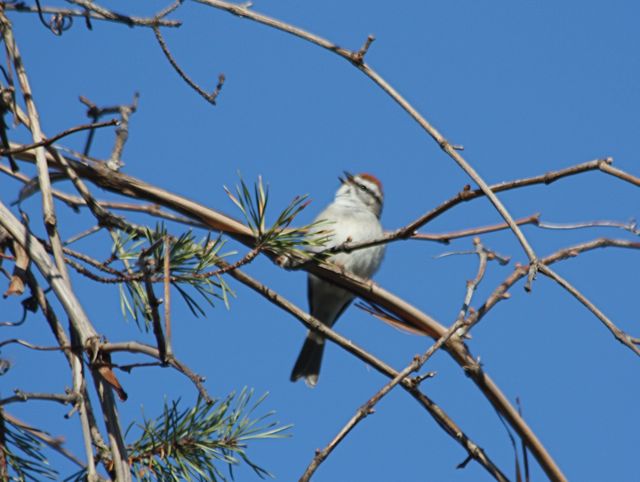
And the chipping sparrows are trilling everywhere you turn.















Monday, May 3, 2021
7 comments