Background Switcher (Hidden)

Showing posts with label bonsais. Show all posts

The Lady Vanishes

Sunday, November 4, 2018

5 comments

I started this post before I left for Ecuador October 24. I wound up leaving only one day to pack and prep for the trip, so it has been orphaned for awhile, floating around in cyberspace, hoping to become a whole blogpost. I'll leave the first part as it is,  and finish it up. Heads up: It's going to be tough going for people who aren't used to looking at kills. Proceed with caution, and, I hope, with the same sense of wonder and curiosity that I have.

I've been working really hard lately to get Saving Jemima as done as I can get it before I go to Ecuador. I've barely looked up. One good thing about having no one around is I can work a 14 or 16-hour day and not offend a soul. So that's what I've been doing. I have loved every minute of it.

I glance up a lot, watching the blue jays at the feeder, watching the red and white- breasted nuthatches, the cardinals, the woodpeckers. I'd been seeing turkey vultures sailing over all day, which I found unusual for late October. I thought about it and wondered what was up.

Late afternoon came and it was spitting rain. I wanted to get out and see the sky, but I knew better than to start a run. So, uncharacteristically, instead of heading out on foot, I climbed in the car to drive out into the country. I took my big camera along. I just had a feeling.


And there they were, lots of them, circling over a big hayfield on the corner of my road and the county road. Glory rays streamed down. They looked so fine up there.

I parked the car to take some photos and wonder what they were up to.


I decided to head into the hayfield to see. I had a feeling I knew what it was. There were too many vultures for it to be something small. And bow season has just started here.


Yep. Knew it. In early November of 2016, they killed my crooked doe Ellen this way. Just a small, inconsequential doe, an animal nobody would miss, a little something for live target practice. Maybe the same person who killed Ellen had turned his truck into the approach to this field, just one over from ours, fixed this doe in the glare of his headlights, and taken her down. What sport, what fun. Just getting in shape for the season, sighting in the bow or gun.

I know the poachers are stalking when I find things like this, when the beer cans start to accumulate along my road.  They show the same disregard for beauty as they do for life.

I didn't know this animal, thank goodness. Though it would be hard to tell who she was now. Now, she was nothing but a carcass.

I made some images. How could I not? The grass was flattened all around her where the vultures had been tramping. I could see that no other animals had been there, because the carcass was opened only at the back and front, the way vultures do. 


They'd been working on her all day. I stood there, with the fermented contents of her rumen scenting the air, thinking that at least she'd go to feed a nice flock of vultures, to speed them on their way to Central America.

I left her then, and went on to see some old house friends on up the county road. It was that kind of day, glowering and gloomy, and old houses look good in this kind of light.


If there's a classic Ohio farmhouse, this is it. Although the beveled corner is atypical, the porch and foursquare design is not. There's a ramshackle addition off the back, which adds to its interest. Gosh, I'd love to go inside. But I have never tried the door.

 Across the street, two other dwellings are slowly deliquescing. 

I like the addition on the big house, like a sloping rump off the back. Sooner or later, people ran out of space, and then they'd tack something on the side or back of the house to give them a little breathing room, a place to hang some coats, stack some boots, keep the egg baskets.

I'm not sure what the little building is off to the side. A summer kitchen?

 Whatever it is, it's sweet, and it reminds me of North Dakota. 

The birds have been perching on what little furniture remains inside. 
I'm thinking that's an eastern phoebe's latrine there. 


 I love this little scene. The table isn't much good any more. But oh, the patina on the walls and floor.


Heck of a view out the window: cattle moving easily across the land. While I was shooting the scene, an osprey flew over. A late osprey! They usually like to be gone before it gets very cold, as they don't have down feathers.


It was getting so dark I figured I'd head back home. A pale spot in the woods border resolved into a young red-shouldered hawk. If you click on the photo you'll see it can't be anything else. Well, I could see that. So many things go into telling me that's a redshoulder and not a redtail or a Cooper's hawk. I'm not even considering broad-wing, because they're long gone, having migrated in September.

  
It's got big blobby markings on its belly, and no belly band--the blobs are just scattered across the white. It's got really small feet. Redtails have big feet. The tail is banded, but nondescript, as would be that of a young redtail. Overall it's small but chunky, not lean and long like a Cooper's hawk would be, or urn-shaped like a redtail. And it's just a-settin' there, redshoulder style. Yep. For whatever reason young redshoulders just pop up this time of year. Maybe that's where they get the old name, Winterhawk. 

I passed the carcass site again, and the vultures were still wheeling very low. I left them to their meal.


The next morning, I came out early to see what had happened to the carcass overnight. 
When I last saw her, she looked like this. Entire, but for some missing bits.


There was still a vulture coursing low, unusual for so early in the morning.


As I approached, a great flock of crows rose up cawing. It was such a beautiful ragged sight I had to make a video. One vulture was already up and feeding.


I walked up to where the doe, who had weighed more than 100 pounds, had been, and she was simply gone.

I hadn't expected that!

Nothing but the stain of her last meal remained. 

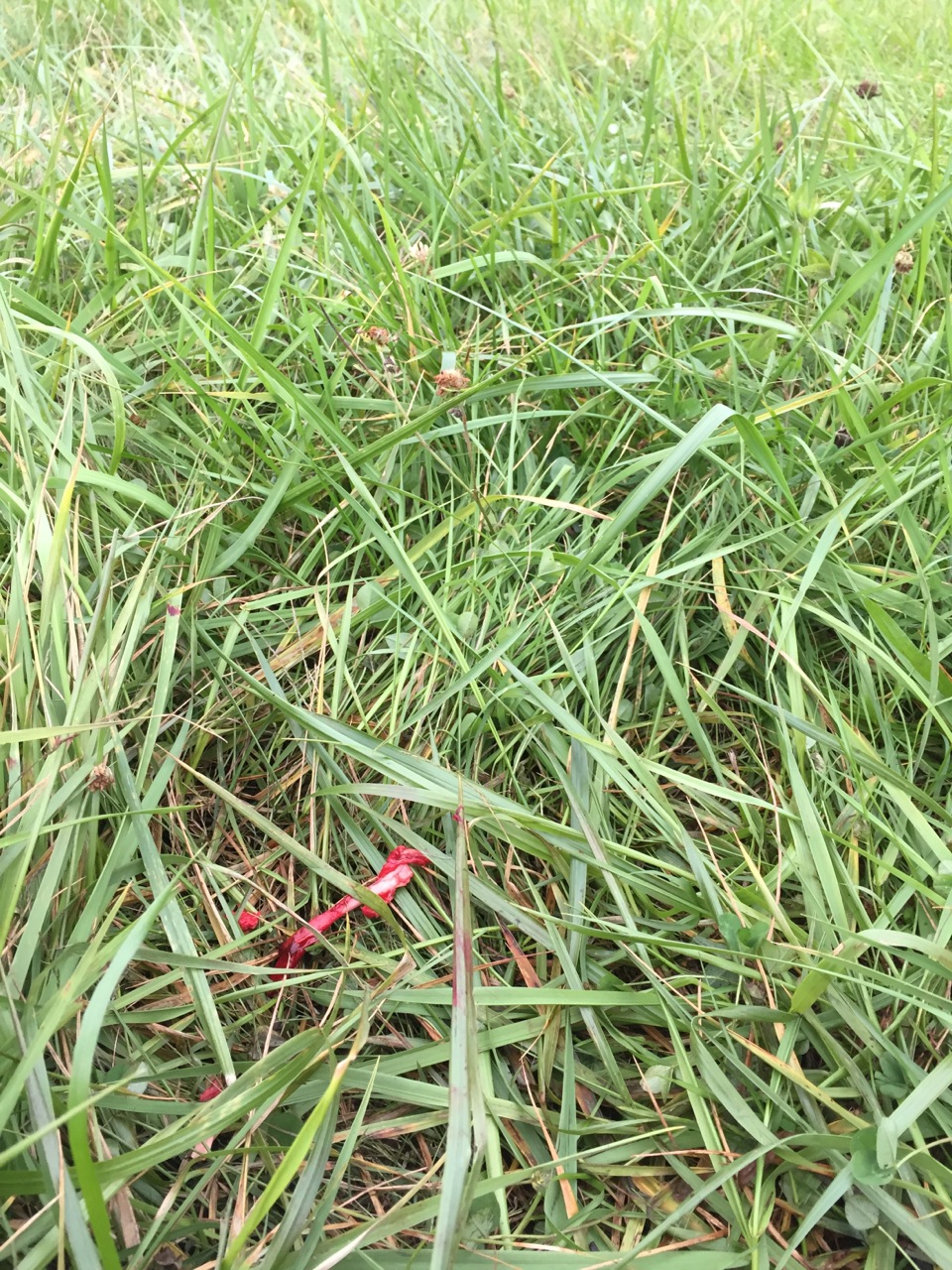
But there were plenty of clues. A stray bone:

One ear.


I could see the drag mark where she'd been pulled away toward a distant line of firs, originally planted as a windbreak for the farmhouse that no longer graces this field. I stood, stunned, thinking about the power of the coy-wolf or coy-wolves that must have done this.


A forelimb!

I continued to follow the trail. Here's the other ear.

  Finally I found all that was left of the doe. 
I was flabbergasted. 


How many coy-wolves would it take to reduce her to a ribcage and a head, overnight? 


A single turkey vulture feather, black with a surprising white base, reminded me that the coy-wolves had had help.

There she lay, in the dancer's point in which they'd left her, dragged by one hind hoof hundreds of yards down the haymeadow. And there they had finished her off.

I could only marvel at the efficiency of the operation; the day shift of vultures and crows starting the cleanup, and giving way after dark to a pack of coy-wolves. She was gone, overnight.


In the ditch, a brace of asters and the spent heads of Queen Anne's lace gave a shot of fresh beauty to my wondering eye.


Back home, the flowers bloomed as if there were no tomorrow


and the bonsais promised to peak while I was away. 
 
when I left October 24

I don't want to leave in late October, ever again. There is too much beauty, both harsh and soft, all around.

when I got back Nov. 3

A Gathering In

Sunday, November 22, 2015

9 comments


This fall has been a long, slow, luxurious time for harvest. Mostly, it's been a gathering in of beauty. I really appreciate Japanese maples for their form and the beauty of their tiny baby-hand leaves. But I love them most in November, when they start coming into color as all the other trees lose their last leaves. Thank you, Japanese maples.


 These are the two liberated bonsais now living in the yard.


I enjoy imagining them back in their tiny pots, twenty-three years ago. They've always been full-grown trees. It's just that being in the ground lets them realize their full potential of growth.

Here's to being planted in good ground.

I keep the bonsais out on display until they're pretty much leafless. Then it's time to put them to bed for the winter.

I've been thankful every minute for the mild, sunny weather this fall. It makes everything so much easier. 
As many of you know, I've been wintering these trees in a pit in the backyard. When they got too tall for the pit, I started heeling them in on their sides. Then I'd cover the pit with glass for the winter. I had to take it off and water them every couple of weeks. 
When they got too big for that, I built the pit higher with cinder blocks. 
And then they got too big for that.

This fall I'd finally had it with trying  to shoehorn them into the pit. They were losing branches from being half-buried on their sides.  And I realized I had been fighting this for more than a decade, and decided to change the program.
I decided to ask Bill to dig a hole in the nice loose loam of our vegetable garden, and bury the unpotted trees halfway up their trunks. This would put them about 8" underground, far enough, I think, to keep the roots from freezing.  They'd be in a deer-proof enclosure as well in Jurassic Garden.

Bonsais awaiting burial. At this point, my back was still buggin' me and I couldn't do it myself. I was very grateful for the boys' help.


 I was there in a supervisory capacity, helping bury the trees. I hope this works. It's got to be better for the trees than being half-buried in soil. If it gets wickedly cold, I may heap fresh straw over them to help insulate the tops from the cold. But they should be just as hardy as the big trees in the yard.

While the boys dug, I harvested the sweet potatoes. Last spring I found a sprouty sweet potato in the cupboard and lopped off the top third and stuck it right in the garden soil.


The fork turned up the most marvelous treasure!


A dozen red yams from 1/3 of one--that's math I understand. And the coolest thing, to me, was the way the yam fragment I'd planted in May stayed intact. It didn't rot or wither away. It simply sent out a fountain of roots that then made a headdress of tubers. That we are now eating. 
Being a tropical plant, I wonder if this old yam piece would keep on going, throwing out tubers, but for November cold. I guess I'll never know.


As I worked around the yard, I took stock of all the lovely things still clinging to life after one frost.
My old tea rose "Rio Samba" is on its way out. It sent up only two blooms this year, off one thin stalk.  How fitting that it should push forth a flower in November.


I watched the bud swell, while the zinnia hung in there, waiting.


The rose seemed to find strength from the red zinnia that found itself in similar straits: blooming in November, the last leaf on the tree. 

I found myself going out at dawn, dusk and other times to photograph them together. I liked the way they clung together.


By and by the rose opened full, and the sweet sunny days wore on and on. 

All told, they had more than two weeks together, rain and shine, watching the winter come on. For flowers, that's an eternity. Something was keeping them fresh. Maybe the cold nights.


 I found myself visiting those two flowers at all times of the day. 

My favorite shot of them together conjured a Sheryl Crow lyric from "Home."

I want to watch the sun come up
In a stranger's arms


That same morning, looking the other way...you can see the Groanhouse twinkling with lights and flowers. I'm already looking inward, building my fortress against the dreary winter.
What's my choice? Killing frost and snow are coming soon. Get those twinkly lights up, girl. Bring in everything blooming, cheat winter as much as you can.

And the rose and zinnia bloom on.

 I think this will be the last blossom we see from Rio Samba. There's no way it's going to send up another shoot next spring. It's 20 years, and goodbye. You were the best rose of all.

And then I walked out to see them on November 21, and a deer had come in the night and nipped off the rose, leaving the classic angled snip of a white-tail's tooth. 

A single petal lay on the patio. And the zinnia bloomed on.  If she mourned her sweet fragrant friend she wasn't going to show it. She was going to trudge on, into winter.

But I thought she looked a little puffy under the eyes.

And just behind them, what was left of the great morning glory tower bloomed on, taking warmth from the cement patio.


I had cut the frost-bitten top off the vine, and carted it over to my brush dump. While taking another load days later, I found Zombie Glories still blooming on the pile. Rootless but hopeful.


 I kept shooting the morning glories that were left, this miniature landscape of ethereal color, withered balloons of flowers past and the twirled buds of flowers yet to come, frost permitting.


 I'm pretty sure this is my last photo of morning glories. November 21. That's darn late, and I'm thankful to have had their beauty, however tattered, for this long.


Fall rituals: the hoisting of the Halloween jack-o-lantern to the top of the tower for tossing off. Liam's up top, cranking the dumbwaiter to raise the pumpkin, which is in a laundry basket. It was so far gone that when tossed 42' to the ground, it vaporized on impact, which made us laugh for a long time.


And the dog warms his old bones by Liam's birthday fire. Like a cat, he jumps up, finds the warmth wherever it will be found.


[Back to Top]