Background Switcher (Hidden)

Showing posts with label blue-eyed Mary. Show all posts

Crawling Toward Mecca

Sunday, April 18, 2021

8 comments

 It's a pilgrimage that I have to make a couple of times each spring, timed around the emergence of the Virginia bluebells and everything, everything else. I am not sure why this particular stretch of mesic deciduous forest near Nelsonville, Ohio, is so darn rich, but it is, and the show these wildflowers put on is not to be missed. I've never seen wildflowers like I've seen them grow in Ohio. I try to take a friend and a kid or two with me--Liam and I made it last year, but thanks to school schedules, this was Phoebe's year.

We were delighted to be outfitted with teeny weeny Swarovski Pocket CL binoculars, 8 x 25. Just the thing for biking, hiking and running! Phoebe has my old pair, and I'm sporting a new loaner set from Swarovski Optik. Mmm mmm good!


The show of bluebells Mertensia virginica lasts only a few weeks, and then it's over. In a cold gray spring like this one, the flowers are in suspended animation, waiting for warmth and the pollinators it brings. You have a little more leeway, a grace period to get your body over there. The Hockhocking Adena bicycle trail is an old railroad bed that goes from Athens to Nelsonville, and you can ride the whole way on asphalt, with flowers as your companions for the deliriously delicious stretch between Chauncey and Nelsonville. 

I missed the bloodroot Sanguinaria canadensis--only its leaves show in the foreground--but oh, look at the Trillium grandiflorum!


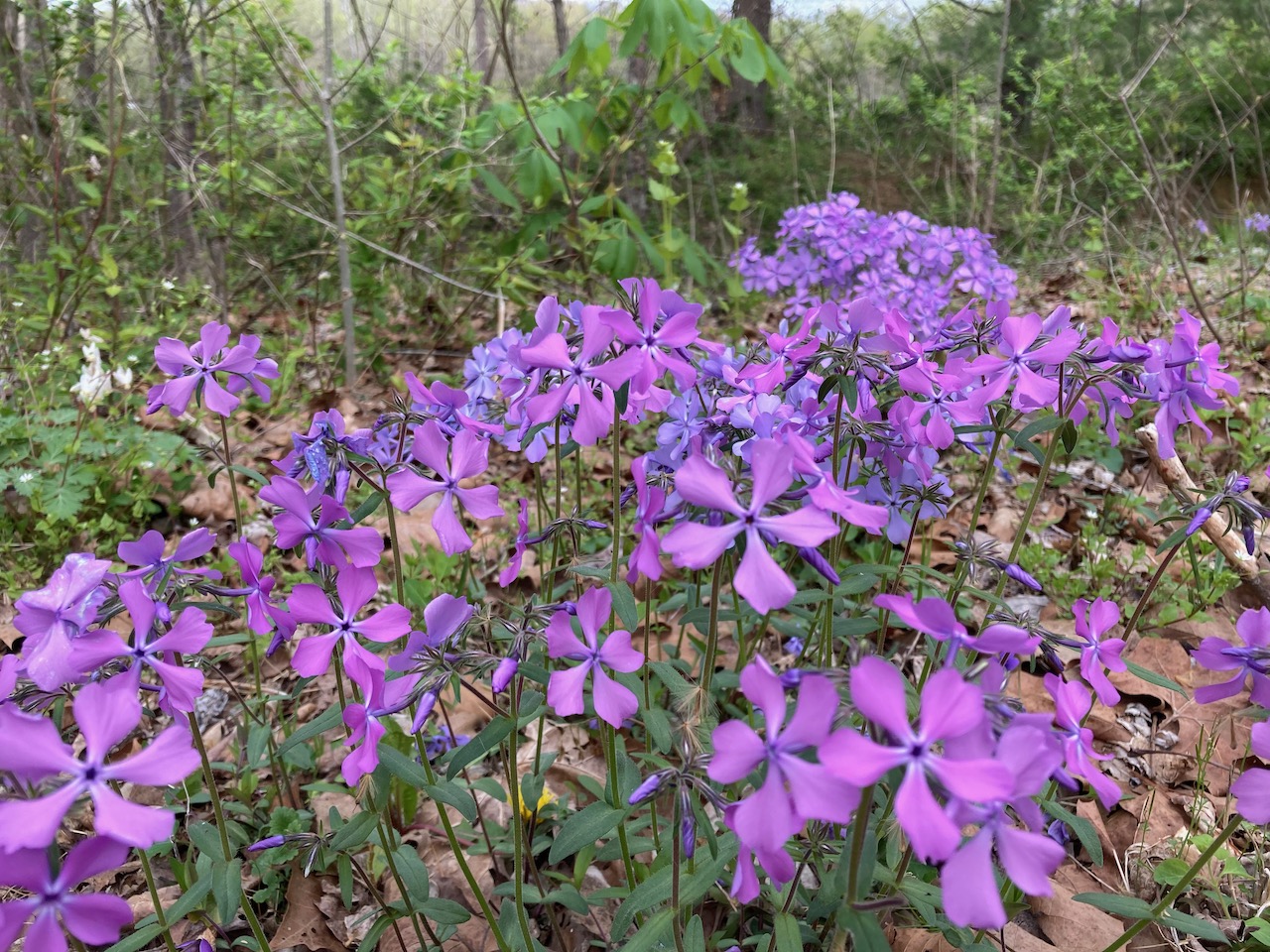
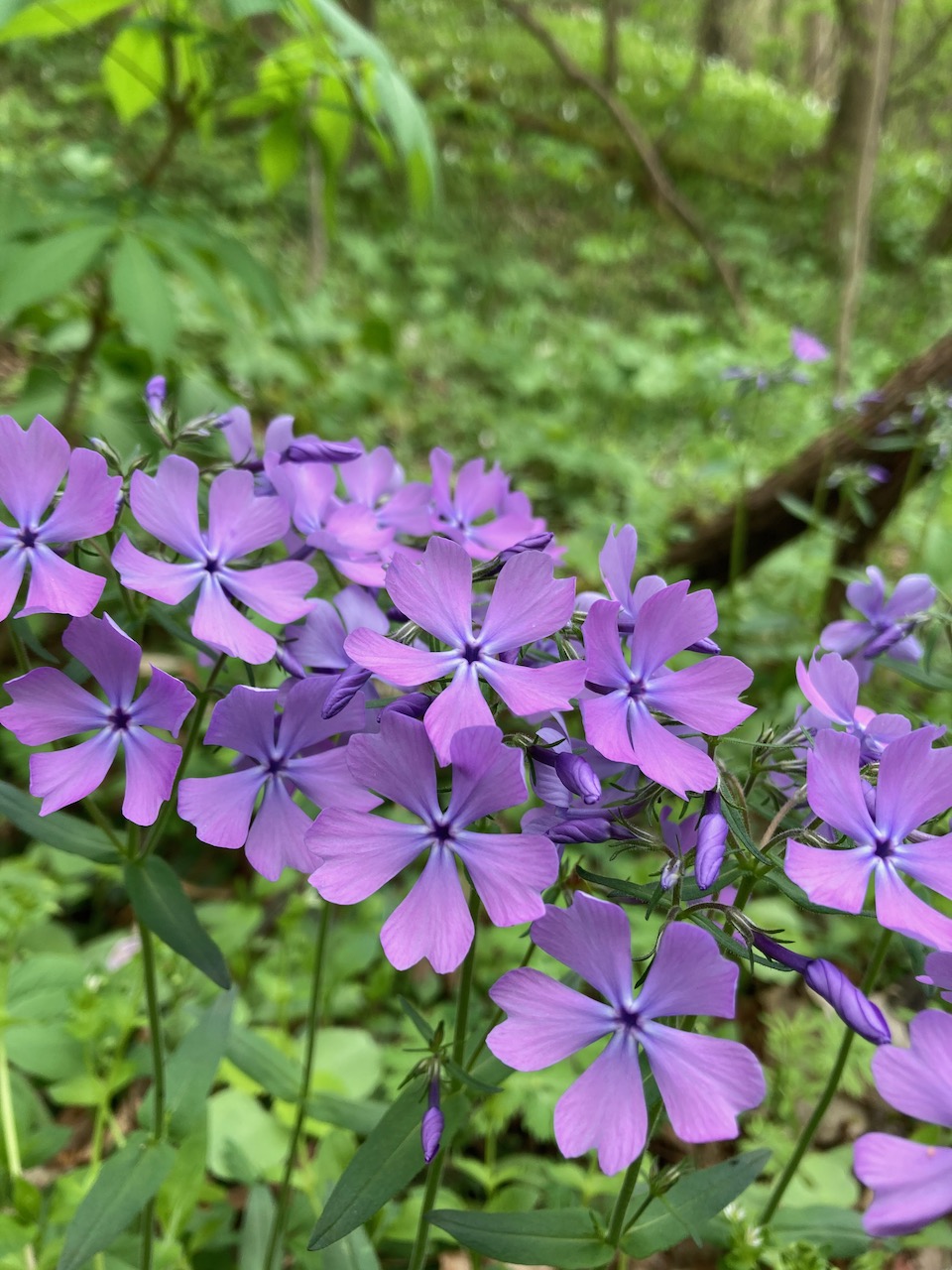
Each blue phlox plant seems to sport a different shade of rose-purple-lilac--anything but blue. Blue is a term botanists, who are so precise in everything else, seem to throw around wantonly. 


If you want blue, look to Collinsia verna--blue-eyed Mary. This free-seeding annual charms the dickens out of anyone beholding it in bloom. Now, THAT's blue. True blue. As a plant freak, I spend a lot of time and energy trying to get that blue in my garden and greenhouse. 


This magical thing happens when blue-eyed Mary is viewed en masse, at a distance. At middle distance you see this...


Step back, and it looks like mist is rolling down the hillsides.  Do click on this one, to see tiny Phoebe off to the left, and try to grasp just how many spindly little plants it takes to make smoke like this. 


It's not all blue-eyed Mary. The forest goes through phases as you ride along. At the beginning of the good stretch, Dutchman's breeches are the stars. Meet Dicentra cucullaria!


Everybody loves these cheery little pantaloons, hung up on their lines so neatly. 


And they are so very beautiful. I am fascinated by their diverse forms. Some are curved like bull's horns; some are straighter. 


And one was chubby, almost heart-shaped; even PINK.


Growing right in amongst them are their closely related congener, squirrel corn, Dicentra canadensis. I can't tell their leaves apart, but oh, the form. Look at that perfect closed heart. 


Pull back, and see how many there are. This stand seemed to be composed of about 80% Dutchman's breeches to 20% squirrel corn. (It's called that because it has a little yellow corm underground). 


It is staggering. I don't walk far up into the stands--too easy to crush the plants. But oh, I wonder what I'd find if I did. I fantasize about walking up the slope, peeking and peering. 


Every now and them, I'd find a Tennessee starwort. In my ignorance, I'd been calling this star chickweed, and it is a chickweed, but its sepals are equal in length or longer than the petals, and that means it's starwort, Stellaria coreyi. 
The Buckeye Botanist set me straight. :)
I love the firework explosion of stamens!


You can see the down on the leaves of the downy yellow violet. 


I love the name, cream violet, Viola striata. It's such a pretty little thing. 


As is the early saxifrage, Micranthes virginiensis, clinging to rock walls with little rosettes of winter-hardy leaves. 


Also on the rocks: early rue, Thalictrum dioicum. Here's rue for the Queen. 


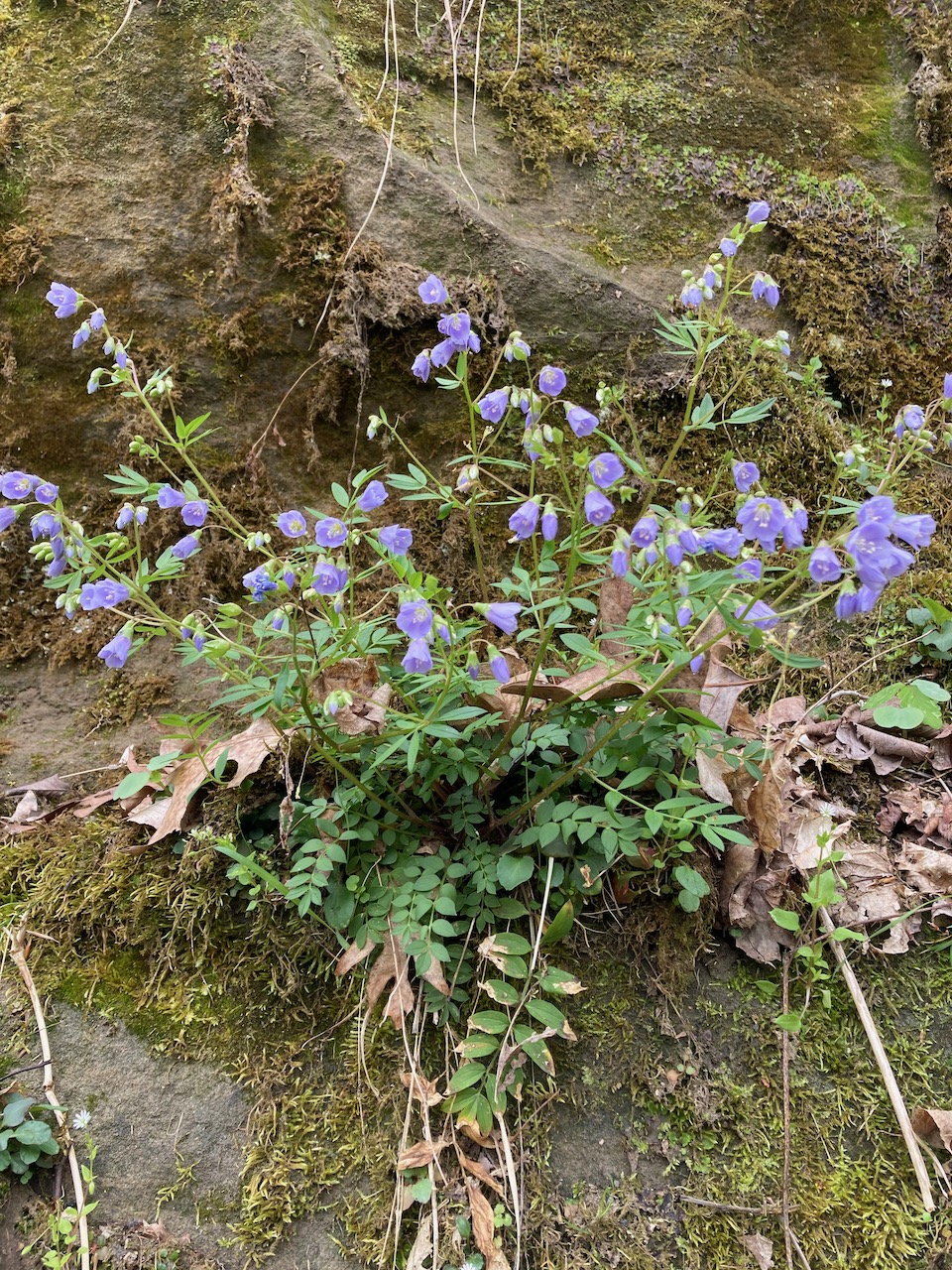
Also clinging: Greek valerian,  Polemonium reptans. This one is fairly rare on these slopes, and we were thrilled to find such a splendid specimen. 


Patches of blue phlox Phlox divaricata light the forest floor. It's so exhilarating to see it in big clumps. I learned in writing this post that it's in the Polemoniaceae, along with Greek valerian. Huh? I thought it was in the Caryophyllaceae, or pink family. Always good to find the holes in one's knowledge.


Large-flowered bellwort Uvularia grandiflora was just coming in. Such a cool plant, with great architecture. 


 The lower slopes were punctuated with toadshade, or sessile trillium Trillium sessile. The flower is stalkless, or sessile. 


Everything is in threes with trillium. I adore the variegation on their leaves. This is one of my few shots taken from directly above. I generally get down on their level to shoot their portraits. 


Much showier is the diva, Trillium grandiflorum, large-flowered trillium. 


One of my favorite shots from this spring is this trio of trillium, blue-eyed Mary, and spring beauty, with the spangled stars of a zillion more large-flowered trillium behind. I must confess I am a little sore, two days later, from climbing on and off my bicycle many dozens of times, and crouching to take each of these shots. It's of little use to take wildflower shots from a standing position. You get no feel for where they live. 


Just a tiny part of the trillium slope. It's breath-stealing to behold. 


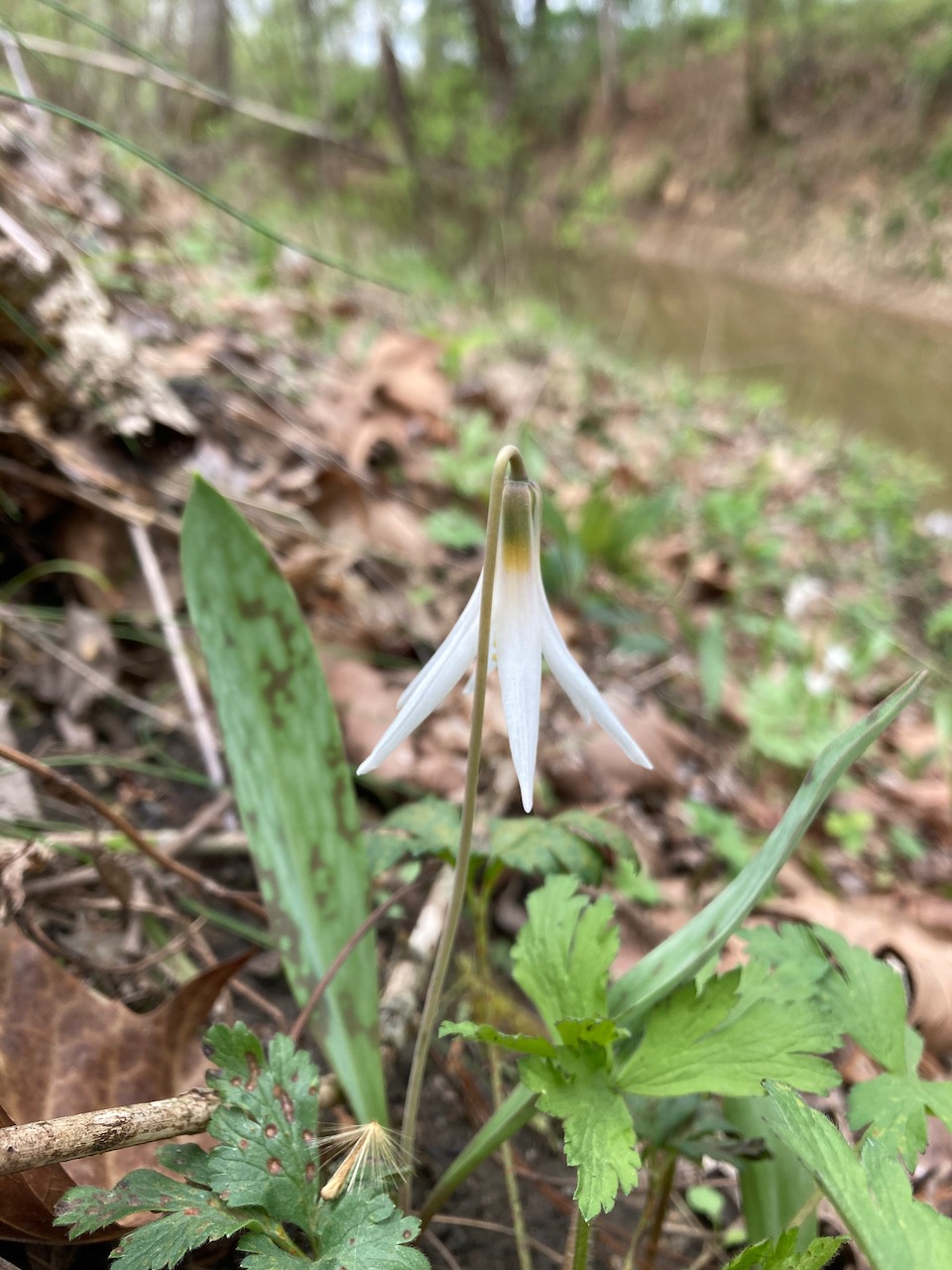
Phoebe found my very first patch of white trout lily, Erythronium albidum. 


And a flower I've yet to see in bloom--it's very early. But I recognized the paired leaflets and the distinctive seed-urn of twinleaf Jeffersonia diphylla. Get this: when the seeds are ready, the lid pops up and is hinged!


After lying prone, it's good to get up and look down again. Look at this toadshade and Virginia waterleaf Hydrophyllum virginianum!


A closer ook at the waterleaf's beautiful variegation, with spring beauties Claytonia virginica. As waterleaf ages, it loses that gorgeous pattern. It's a much later bloomer than the others, too, sending up weak stems of palest lavender bell-shaped flowers in May and June. It must be very shade-tolerant, because the canopy overhead is closed by then, and little sunlight reaches the forest floor. 


Perhaps my favorite shot from the 16th of April was this one--it speaks of the diversity, the jumble of native wildflowers, that stuns me every year.


And then there were the bluebells that didn't know whether to turn pink or blue. Sigh. I almost can't stand how beautiful it all is. I get overwhelmed.


There are a couple of places where I can get a little river plain behind the bluebells, and that is a fine thing.


To thank the woods for their incredible, abundant gifts, Phoebe and I pulled a buttload of invasive garlic mustard--diversity's worst enemy-- and laid it out to die in the middle of the path. This is ugly but necessary, as this plant will continue to grow and set seed if given even a ghost's snowball of a chance on the damp forest floor. I have faith that all Athens would turn out for a garlic mustard pull if called upon. It's that kind of town.


Thank you to the slopes, thank you to the humus, thank you to the God of diversity and all that is wild. 


Thank you to Geranium maculatum  for sending up just one flower in time for us to see it. Thank you to Phoebe and Liam and Shila, my safari companions, for loving the wildflowers as much as I do, content to crawl the slopes in search of such mid-April beauty. 


 Listen to the next video clip, and you'll hear the northern parula warbler we had just gotten in our tiny binocs! Oh! the yellow and red of his chest, his tiny white eye crescents, and the rising zzzzip! of his song!


and your blogger, speaking...with my thanks to Swarovski Optik for outfitting us with the fabulous 

Swarovski CL Pocket 8 x 25


Please note that in this video I erroneously refer to them as CL Companions, but they are Pockets. 


Video by Phoebe Thompson 

Ospreys and Eagles, Oh My!

Thursday, May 4, 2017

1 comments

I'm still celebrating my father on April 10, 2017. You can get a lotta blogposts out of one good day in the field! I started the day at Zaleski State Forest which is situated, oddly enough, in Zaleski, Ohio. And then I moved on to the bike trail that runs from Athens to Nelsonville, Ohio, with beautiful wetlands on its north side.


As I walked along the bike trail near Chauncey, Ohio, I heard the chicklike cheeping of an angry osprey, and darted over to a clearing in time to see the fish hawk routing a bald eagle from what must have been the osprey's nesting area. Not so long ago, I would never have seen such a thing in this part of Ohio. Both osprey and eagle have been gone for so very long, and are now, with the recession of persistent hydrocarbon pesticides such as DDT, repopulating their former range.  The ospreys have had some help from the ODNR, which began releasing (hacking) osprey young into the wild at suitable sites in 1996. In fact, I did the paintings that were used on educational signs at hack sites! Here's one of them. 

This painting has had a lot of exposure, besides being used at fledgling hack sites in Ohio. It appeared on the cover of the Journal of Raptor Research not long ago, where it was pointed out to me after it was printed that I'd accidentally put 13 tail feathers on the bird. Oopsie!  You know there are supposed to be 12, but mistakes happen. And I am a feather counter, too. This may be a first.

When the Department of Defense expressed interest in having me paint an osprey with jet fighters in the background, I painted some jet fighters in. Heh. I'm easy. In the digital world, you can always scrub 'em back out. All in a day's work for an illustrator.


But I digress. By 2011, ospreys were detected in 213 blocks during the Ohio Breeding Bird Atlas research. 92 nests had been found. The presence of both osprey and bald eagle in mid-April virtually ensures that they are both breeding somewhere near. And that is a beautiful thing. Here's an active bald eagle nest I can see any time I go to Parkersburg WV. 


If you click on the photo you can see the female on the nest. Awesome!


The osprey along the Athens-Nelsonville bike trail gave that eagle all kinds of hell, driving it from the territory. Eagles for their part return the favor,  routinely pirating the osprey's catch in an act called kleptoparasitism, and even eating about-to-fledge osprey young. Ugh. We are only just seeing what a world with lots of bald eagles looks like, and how it all works. Having ugh'ed, I must say that seeing a bald eagle nest when I come off I-270 on my way back from John Glenn International Airport in Columbus is quite a thrill and welcome home! If I don't remember to look for the nest, there's usually an adult eagle soaring low over the highway cloverleaf. My, my, my how things have changed in the last decade. And it's vastly for the better, where bald eagles are concerned. ODNR surveys estimate 207 bald eagle nests in the state as of March 2016. Eagle populations appear to have stabilized. Bald eagle chick production in 2016 was estimated at 327. That's a lot of eagles!

I still find it amazing that there may be more bald eagles in Ohio than ospreys. Perhaps it's a reflection of the eagle's "moral flexibility" in its search for food. Dumps, carcasses, catching everything from rabbits to fish, it's all fair game to the bald eagle...by contrast, the piscivorous osprey is a specialist.


Look out, ospreys. Stay en garde.


I saw the first bluebells on the river side of the trail, and knew it was but a taste of things to come. Bluebells like to congregate in masses. This perennial plant is such a miracle, unfurling big glaucous-green leaves and tall stalks in a matter of a few days. I think about what kind of root it must have there below the rich silty soil, to put on such a show in such a short time. 


Mertensia virginica, goin' for it.

I walked past a couple of cabins and into a fanfare of spectral blue. Running down the hill were smoky mists of blue-eyed Mary Collinsia verna, one of my favorites for its delicacy and two-toned petals. The overall effect is of a bluish white haze; the purity of its color must be appreciated at close range. You can just see the bluebells farther up the hill, especially if you click on the photo.


I found one sport that was rose-magenta, a red-eyed Mary, with the audacity to be a few inches taller than its companions as well. It reminded me of a sport of my own, a willowy prize, a few inches taller than most. By comparison to her hobbitish mother, she is a fine mutant indeed. This photo was taken in spring 2016. We'll have to get some more soon.


Coming up next: Wallering in Bluebells


Wildflower Safari!

Thursday, May 1, 2014

6 comments

It's that time of year again. Wildflowers are coming out. Everything's about two weeks late. It's kind of disorienting. Red-eyed vireos singing in leafless trees. But the wildflowers are coming along nicely.

I love, love, love taking friends out on wildflower safaris. 


From left: Sara, Kelly, Murr and moi. Cackling. 

Murr, holding a chickadee nest. For her take on chickadee sex, go to her fabulous blog. 


Bluets. Honesty. Quaker Ladies. Call them what you will, I love them. There is a man who lives down our county road who weedwhacks the bluets that grow on a bare bank in front of his house. He will get his just reward in Purgatory, for bluets hurt no one. Neither does honesty, properly and kindly administered. 


There is blue, and then there is BLUE. Blue-eyed Mary is BLUE. Oh, what a blue, the kind of blue that home gardeners lust after but almost never achieve. Only delphiniums approach this blue, and those are hard to grow in Ohio. I know, because I've probably bought two dozen delphiniums over the years, only to have them rot in our rainy winters. 


Blue-eyed Mary is an annual that grows in misty blue drifts down rich slopes, spilling like smoke into pastures.


I never tire of oohing over it.


Blue phlox blooms at the same time. But there's blue, and then there's blue, and I'm sorry, Phlox, but you're only almost blue.


Blue larkspur, same deal. You're royal purple. Chet Baker for scale. 


The Bacon loves a good wildflower safari as much as the next guy. He just likes to come along and sniff out new places, harass new squirtles and chiptymunks. 


Jacob's Ladder.


Another kingly larkspur. There was more of it this year than ever. We were thrilled to see it had spread so widely.


I couldn't resist shooting this gorgeous bank of Trillium grandiflorum, with some idiot's old mattress flumped down on it. Around these parts, a steep slope is just an invitation to pitch the big stuff you're too lazy to take to the dump.


If I could have hauled it away I would have, but rain-soaked mattresses are more than I can handle. I tried not to think of the trillium trying to come up beneath it. Dang it!!


 Back home, my zygocactus is going absolutely bu-freakin'-onkers. After an initial winter bud drop, it has decided it loves, loves, loves the greenhouse. I brought it up to the kitchen table for a little house vacation, because I didn't want to miss a minute of its fuchsia perfection. Just FYI it is in a great big pot with dense moist soil. Seemed like what it wanted.

 I like this dreamy off-kilter shot of the wildflowers of Newell's Run.


Yes, it is a fine thing to meet them when and where they're blooming. I recommend it. Get out there, now!


[Back to Top]