
Here in southeast Ohio, rose-breasted grosbeaks have always been one of those inestimable gifts of migration time. You look out your kitchen window of a fine early May morning, and there's this whazzat!? in the birches.

Your heart pounds and you wait for that full frontal BAM of carmine-rose to hit you smack between the eyes. It's usually a male, maybe one in five is a female. That's fine. We'll take males.


Every year I take ugly pictures of them on our feeders, knowing they're pretty much useless, but helpless in the particolored birds' thrall.
So imagine my delight when I heard a rose-breasted grosbeak singing through the thick chorus on my beloved Dean's Fork early on the morning of June 10. It was a day when Chet was still feeling logy, and I went out alone, my heart heavy but also strangely light, knowing I needed to be selfish, to put some miles on my chassis after throttling it back for several weeks. That rich song, ringing out practically in my backyard, well after migration; knowing that means the birds are on territory: for the alert birdwatcher, it doesn't get any better than that. And traversing my favorite road's three-mile length that day, I located three more singing males, one following a female around as if prospecting for nest sites or nesting material.
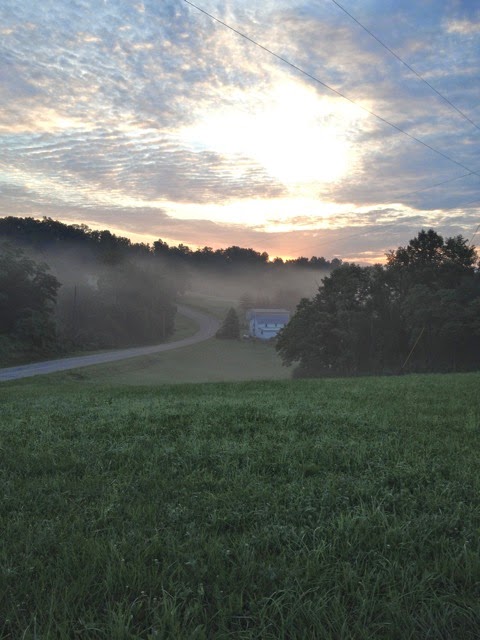
This landscape, with this light, and a singing rose-breast in it. By its presence, the bird sonically and spiritually lighting the whole place up. Like looking out over the Lamar Valley at Yellowstone, and knowing there are wolves there. It changes the place. It changes you.

Like looking in the widening crack in our back patio, and seeing Mr. and Mrs. Fak lying there, placid, waiting for another dratted chipmunk to scurry past. Take them. Take them all. Everywhere I plant, they dig. Everything I nurture, they upend.
We visit the Faks several times a day, wish them well. They're fat with cicadas this year. You don't need venom for cicadas. You just gulp them down.
Living with copperheads: it isn't so hard, when there aren't so many.

I bring friends to Dean's Fork. It's the best thing I can show them. This is Jim Coe, plein air oil painter, diggin' the scene. Rose-breasts are no big deal for this Hannacroix NY boy, but Acadian flycatchers, Kentucky and cerulean, yellow-throated and worm-eating warblers are, so we found him some of those.

Here it is. It's the best place I can show you. If you want to know what I've been up to since we last saw each other, well, this three-mile dirt road is pretty much it. Well, that and a book on baby birds.

Painted fish fly wings, scattered by a bird.

Red efts on the move, nearing adulthood, nearing their final homes, wherever they may be. When they find the right body of water, they'll dive in; their thick and rough skin will thin, and they'll become denizens of the water again. And then we'll call them red-spotted newts.

The neatly nested halves of a robin eggshell, carried from the nest by a parent. The chick may have pushed them together in hatching, or the parent may have nested them for carrying, but either way, a thing of joy. The neatly pinked edges and remnant blood vessels say this was a successful hatching. Often you can find the chick's first yellowish dropping in the eggshell, too!

Beauty and the beast: summer azure drinking ichor from a smashed American toad.

A wolf spider carries her seething young on her back, something I always love to see.

Go in peace, good mama.

I see a wood thrush fly across my path, carrying an enormous wad of nesting material: dead leaves and trailing blonde grass. How odd to see one building a nest on June 10; they should be incubating or even feeding chicks by now. And not 50' further on, I find the work of a jay: a wood thrush egg, pierced and emptied. And I realize that she is ripping apart the nest she'd made, to build it elsewhere, away from sharp dark eyes. She's starting over.

Yes, it's the same color as a robin's egg, but a third smaller. It's good to know these things. If I didn't know the color and size of a wood thrush's egg, I wouldn't be able to piece together the story. If I didn't know the song of a rose-breasted grosbeak, I wouldn't know they're here. If I didn't know when red efts go from orange to army-green, I wouldn't know why they're walking.
The only way to know these things is to get yourself out, to wonder, and put together a million tiny pieces into a bigger picture. And then you realize that there's this great big show going on all around you. Then it calls to you and you have to answer. Then, and all along, come the gifts.
Because you may wonder: The strong, lusty, liquid warble in the foreground is a rose-breasted grosbeak. The insistent chip chip chip chip chip is a chipmunk. The sudden pit-SEEK! and higher squeaky notes are an Acadian flycatcher. The burry hurried warble is a scarlet tanager. A cardinal sings his purty purty purty, followed by a wood thrush in song, then giving his hard glassy wit wit wit! alarm call. Finally, an American redstart's sis-sis-swew!, and a scarlet tanager again, the rosebreast singing over it all. It's a book, it's a movie, it's a community, and paying attention to it is the thing to do when you're in the woods.













Friday, June 17, 2016
14 comments