Background Switcher (Hidden)

Showing posts with label New River Gorge. Show all posts

Cerulean Homemaker

Monday, May 30, 2022

9 comments


It seems I've just returned from a week in West Virginia, and yet I look at the calendar and it's been almost a month. Such is my life during Vegetation Time, when all that free time I fritter away doing things like editing, blogging, writing and painting gets sucked up in Vegetation Management. Oh, there's plenty of that all winter long, but it's more like upper body workouts, and not as horribly pressing. In southeast Ohio in May, you manage your vegetation or smother under it.

People have been asking me about No Mow May. "Is it bad to mow my lawn during No Mow May?"  The whole concept makes me laugh in a snorty way. Whoever came up with that doesn't live in southeast Ohio. Maybe doesn't even have a yard to maintain at all. I've thrown a belt and broken a pulley mowing my paths this spring. Yesterday I mowed a path that I had inadvertently skipped--it went about three weeks without mowing. Aaaack. I barely got through it; the rider mower was gagging and growling and burping on grass.  Then, just as I was finishing up three hours of path mowing, I threw a belt again. What fun. It takes my beloved neighbors Bill and Kathy and me to get the damn deck off, belt replaced, and back on the mower. Every time.  I'm all for not mowing. But around here, you'd better have a tractor and a brush hog ready if you quit for the month of May. Honestly, what could those No Mow May folks have been thinking? 


Kathy and Bill, saving my bacon again, and again, and again.
I am in the market for a new rider lawnmower. I need one that doesn't throw
belts like a Chippendale dancer, and doesn't give me PTSD
every dang time I climb on it.


Anyway, I'm not here primarily to kvetch about having to mow. I'm here to celebrate West Virginia, ancestral home of the Zickefooses, West Virginia University, ramps, and kick a-s birds. I celebrated my 20th year of involvement with the New River Birding and Nature Festival this spring by committing to an entire week of guiding. It wasn't nothing, getting up at 5 every morning, leading a 7-hour field trip, then getting up and doing it again the next morning, and the next...

But oh, the places we went, and the things we saw! 


I will now share some glorious things in a random way. 

One of the things I love about our field trips is that they are entirely bird-driven. If we find a bird, or birds, we stop dead and hang out for an hour or more, just taking in what the birds give us. Such was this moment with a female cerulean warbler we found visiting a junky-looking pile of winter stems on a Fayetteville road bank. 

You'll want to click on the photos to see her.
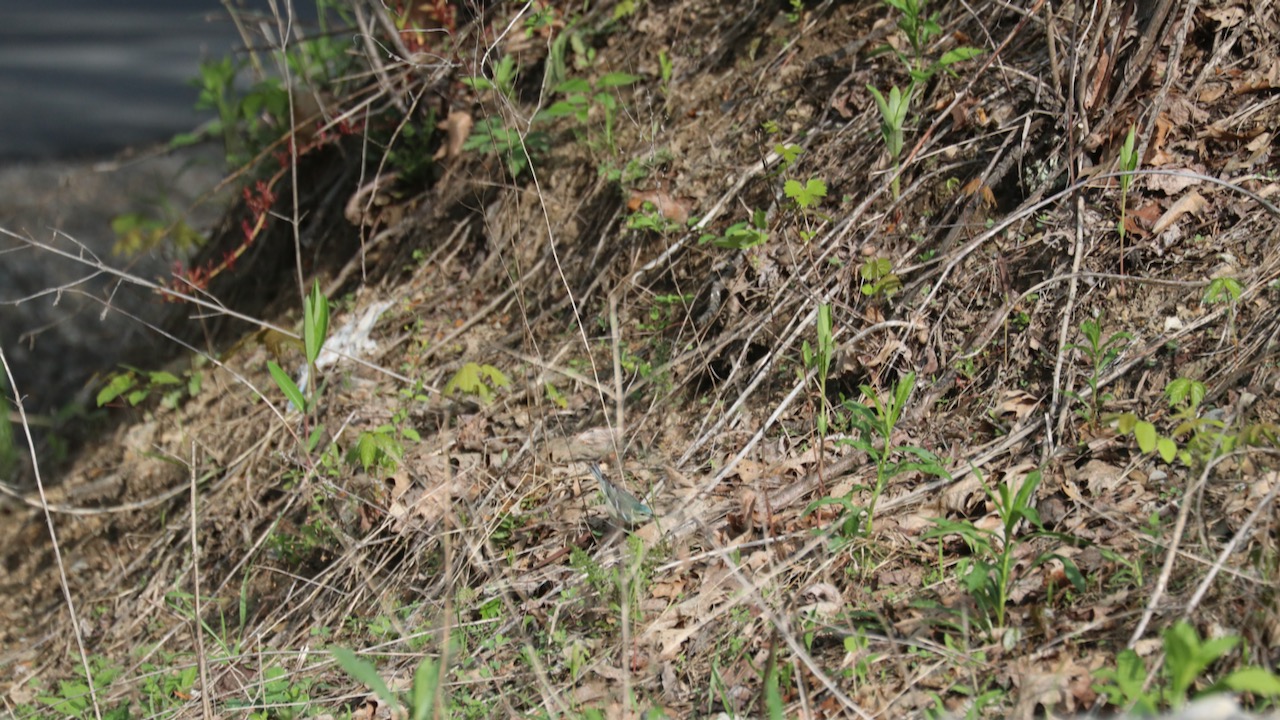

Birds are natural botanists and artisans. Like me in an art store, they know what materials they're looking for, and when they find the right stuff, they'll keep coming back. This little beauty was stripping papery fibers, perhaps from a winter milkweed or goldenrod stem.


It took some effort, and she'd throw a wing out and flutter as she pulled, which is what drew our attention.
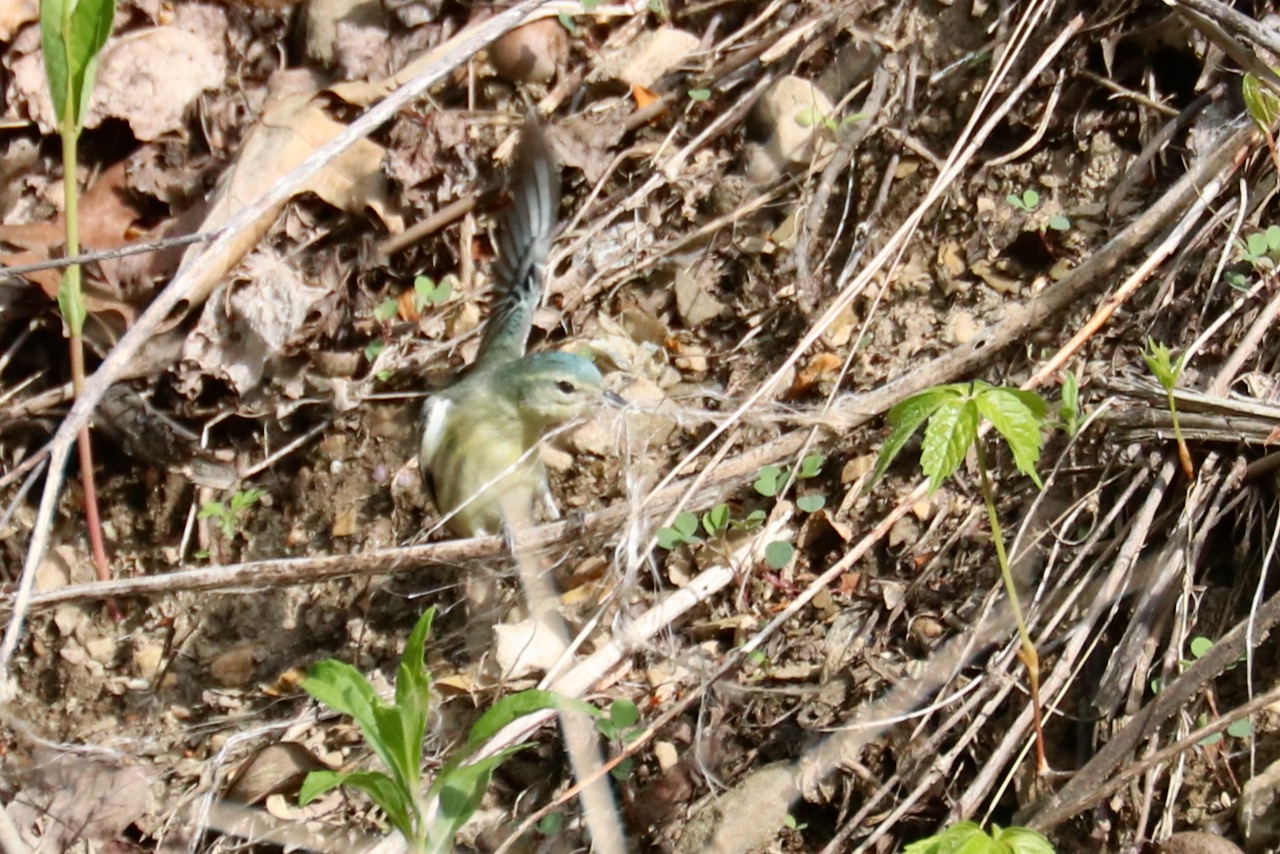

It didn't take her long to get a billful, and she'd bear that off into a tall maple where, unseen, she was weaving a masterpiece.


We were charmed beyond delirium.


The female cerulean warbler has a dusty aqua/cornsilk yellow/dove gray color combination you just don't see on any other bird. She owns that muted color scheme, wears it beautifully. Please see her crown. Heavenly blue!


Seeing this little miracle taking place before our astonished eyes was such a full-circle moment for me. Years ago, I received a commission to paint nesting cerulean warblers in a West Virginia mountain setting for the WV Breeding Bird Atlas. I watched cerulean warblers and shot some landscapes for reference on this very same road, with my same WV friends. And the great big beautiful vastly informative and carefully researched book is out, and it's SO good, and I'm so proud to have decorated the cover. You can find out more at https://www.psupress.org/books/titles/978-0-271-08980-5.html
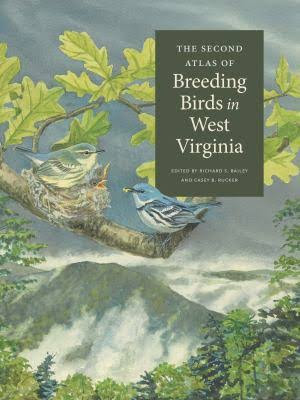

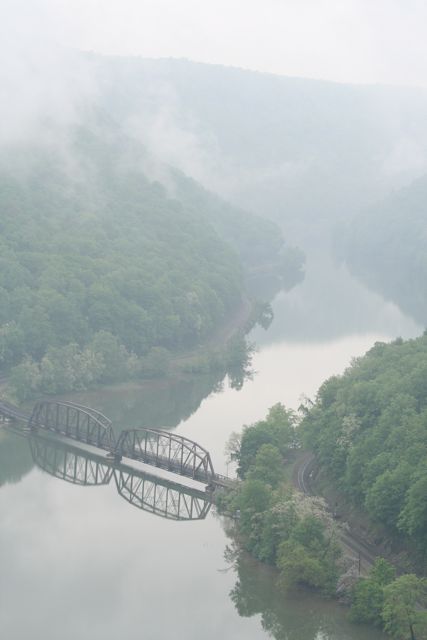
It almost always rains for part of the festival, and I really wanted to convey a sense of West Virginia's mist-shrouded mountains. 

Taken from the New River Gorge bridge early one morning during this year's festival...wonder where I got the inspiration for the painting?


The little cerulean warbler didn't know any of this stuff that was swirling around through my head. She had work to do. And so she kept tugging and pulling and gathering, and we kept smiling. 


All this on a trashy-looking mountain road bank, that just happened to have the right kind of bark for the nest of one of our most beautiful and imperiled warblers. 


The Peregrine's Gift

Tuesday, May 5, 2015

9 comments
This is birding. 

You have some days when you have to beg for a freezing cold ovenbird in pea-soup fog. And you have fun anyhow, because you're with people who get that sometimes birds appear and sometimes they don't. And you're outside and who can have a bad time outside?

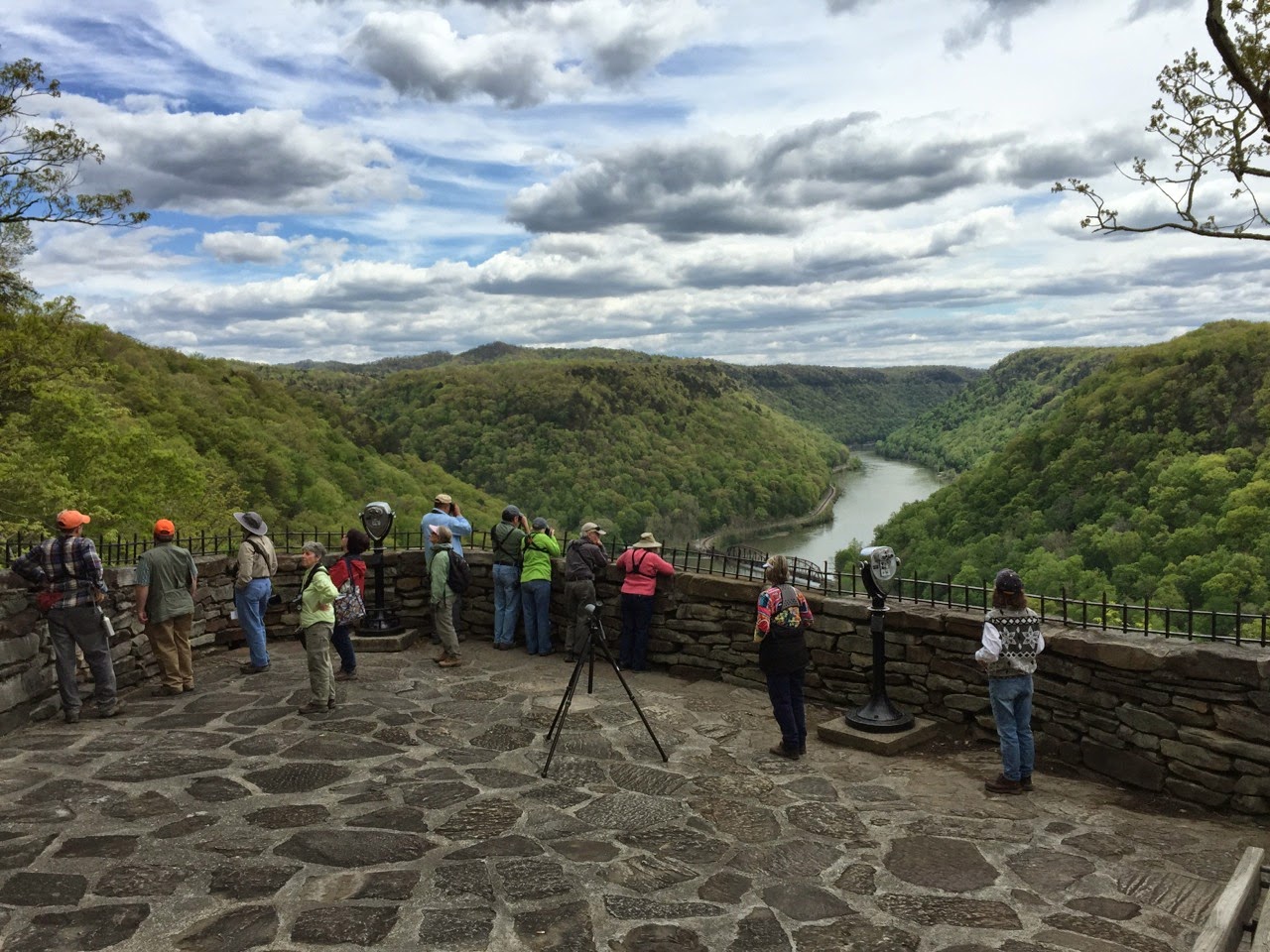
And then there are days like these, Saturday May 1, 2015. On the last day of the New River Birding and Nature Festival, we've been imbibing warblers and tanagers on a trip I'm co-leading all morning. After lunch we all tromp down to Hawks Nest Overlook and gasp at the beauty of the wild and savage New River Gorge. 


It's getting hot and we're peeling layers like crazy. Those of us who aren't wearing long underwear and can't. Heh.


I just can't believe I get to be here and look out at all this. I'm kind of overloading, so I look down at the stone steps and find a teeny tiny plant which, in my bookless botany, I determine by its four petals and whorled leaves to be related to bluets, in the Rubiaceae. I can't go any farther, and it takes Jim McCormac, summoned via electrons, to tell me this is Blue Field Madder, an exotic weed. But a cute one. 


How bad can it be, tiny as it is? I decide I love it anyway.


Birding friends have a stony chat.

And someone says, "There's a peregrine perched up in that tree!" 


We crane our necks and marvel and feel blessed. But the show hasn't even begun.

The peregrine launches out over the gorge and suddenly rolls over in flight and falls like a stone or a spear. Somehow I manage to follow it in my binoculars, though it's likely doing better than 120 mph in that stoop, and I see it hit a barn swallow which explodes in a puff of feathers, falls limp and disappears into the river.

The peregrine circles a couple of times, looking for the swallow, but it can't see it. Too bad, waste of a good bird, but that's hunting for you.


I am shooting and shooting as the falcon circles up from the water's surface without once moving its wings. It rises, using the updraft from the river and cliffs, rises like a thought or a dream.


The raw steel blue of his back, the muscularity of his shoulders, the bright buttery cere. 


I can't believe he's coming so close. I fall over the dopey giant swiveling binocular, the kind that takes up precious space at every overlook, the machine nobody ever uses, trying to keep him in my sights. I click and click.


I have to show this bird to you, cropped in closer.


It's a male, Paco and I agree, murmuring softly as we watch it circle and rise; something subtle about its build and size and big eyes and bright cere. We are rapt, enraptored. He makes me promise to send him these photos. Here you go, Paco. Here's that bird we saw. 

As exquisite as it is up close, this living missile is even more thrilling against the backdrop of man's attempt to tame the New River, the dam we put in its wild and rugged path.


The peregrine is a gift, snatched away when we couldn't stop spraying DDT everywhere, and now returning. In my lifetime, it's back. When I was 14, I never thought I'd see a peregrine, ever. And now I'm reaching out and catching this one and keeping him to look at forever. And he's nesting somewhere on these ledges, or under the bridge, making more peregrines. My friend Tiny worked several summers hacking baby peregrines out in the Gorge, and now it's all paying off. They're here. They're HERE. Killing barn swallows, somehow making it past the great horned owls who like to eat its chicks, and thrilling us all.


I didn't even see the people on the rocks until I got these photos on the computer. Epic!

Eventually the peregrine circles back to its branch, then leaves altogether, the branch wiggling in the empty air as I look longingly at where it was, wishing.


Thus endeth the Peregrine Show. A fine show it was. And a fine bird it is. A gift.


Misty Mountains

Thursday, June 5, 2008

11 comments

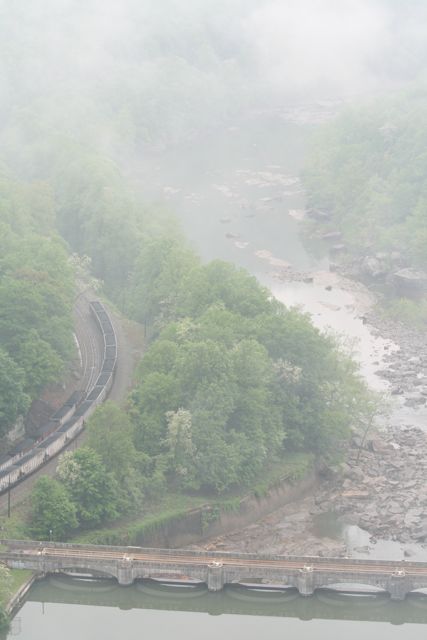
Some things are a lot more beautiful in the rain, and West Virginia's New River Gorge is one of them, I think. There's an overlook where you can lean over a fence and gaze down on the river and the slow-moving coal trains grinding along the tracks at the bottom of the Gorge. Hearing them gives me a wild, nameless feeling, mystery and longing rolled into it, marveling that those hundreds of cars are rolling along to a nameless destination, pulled by a locomotive a mile ahead.

Watching the coal in the seemingly endless train, I wondered how much longer we'd be taking coal out of these mountains. I hoped what I was seeing had been mined the old-fashioned way, by excavating from below, rather than by taking the mountain apart and dumping it in a valley.We always pause here and study the river and the rocks, looking for birds to fatten the festival list. It's like a game of I Spy--we scan carefully with binoculars and scopes, hoping to be the one to find the special hidden bird. Spotted sandpipers, black vultures, a gorgeous pileated woodpecker (seen flying from above!) and common loons rounded out the list for us this year.

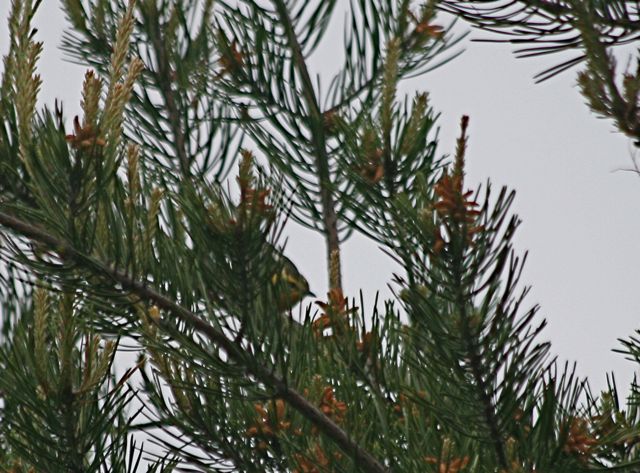
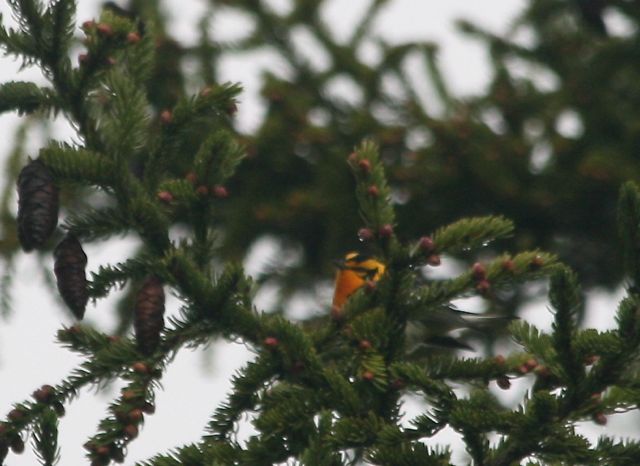
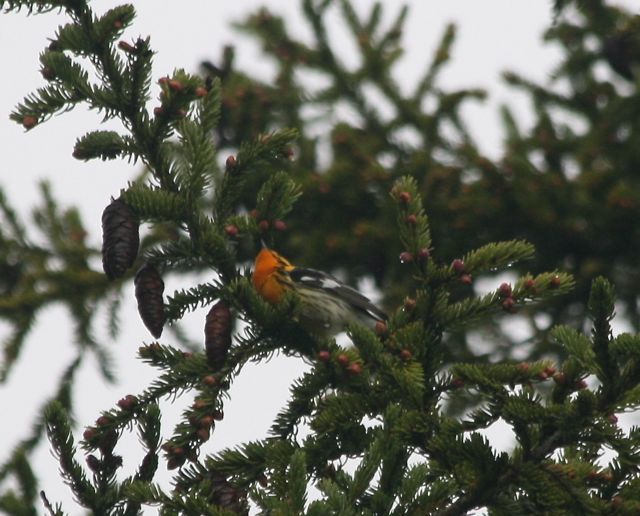
At higher elevations, Blackburnian warblers sing their thin song, a jingling, loose series of notes that ends in a fine, wiry spiral up past the limits of human hearing. Females are pretty--this one was in our yard this May--

but males are breathtaking. They are fiery coals; you'd think they'd set the wet spruces aflame with their color.
A typical Blackburnian move--craning its head around to look under needles and leaves as it gleans for insects.The little warbler was named for an ornithologist named Blackburn (hence the capital letter), but the name fits it so perfectly--black and burning at the same time. I love to show Blackburnians to people, to hear the gasp when they've finally got the little midge in their binoculars. I especially remember my friend Patti's first Blackburnian. I never tire of hearing that sharp intake of air, that wonder exhaled.
[Back to Top]