Background Switcher (Hidden)

Zick's Bluebird Survival School: Update on Our Alumni

Friday, May 26, 2023

0 comments


I'm sweating. I just finished planting my snap beans, which means it's warm enough to do such a thing at long last, on May 24. The cold, miserable early May we endured is a nasty memory now, though I still start my morning walks with long pants and a decent jacket.  I have been collecting sweet reminders of the work I did in the first three days of May, to save some little souls when the weather turned horrible and the skies opened up for three straight days.

I coined the term "Perma-rain" while watching this sluggish and apparently endless storm factory squatting over us.


The only way it changed was to get bigger, pumping continuous rain over the chilled land.


Out by the oilwell at the end of my meadow, five baby bluebirds had just hatched on May 1. This was the first box I visited, and I had a syringe of warm baby bird formula against my chest as I trudged out, bundled in a down jacket. It was that cold. 

When it's that cold, parent bluebirds can't find insects for their babies, so I stepped in to supplement. Liam made this video for me on May 2. These were lucky birds, just a long walk down the meadow from my house.


But there were more out on the county roads, and I gathered my gear and steeled myself for what I knew I'd find this frigid wet morning. The first box I checked out on my trail on May 2, next to a little Methodist churchyard cemetery, broke my heart clean in two.  Five bluebird lives, wasted by the rain. I got there too late to save them.


It's a hard photo to look at, but I want you to understand what motivates me, because I'm sure a lot of people think crazy, running around hand-feeding bunches of baby bluebirds in their boxes. Maybe that's crazy in some people's books. Should I just shrug and say, "Tough luck!" to the 27  baby bluebirds that I knew were in my boxes when the weather turned horrible? C'est la vie, this is what happens to early nests?

Should I pretend I don't know what's happening in those boxes?  Or should I do something crazy and try to save them all?

 I'm not crazy. I prefer to think of it as an overdeveloped sense of responsibility to the birds nesting in my boxes. As it turned out, these were the only ones that died due to weather, but for me, that was five too many. I knew I'd lose all the rest if I didn't act.


Bug omelet is baked ground eggshell, egg, milk, dried flies from Carolina Biological Supply
all fried up. Very stanky, but it brings baby bluebirds back to life toot sweet!


I fed bug omelet to all the babies on my trail on May 2 and 3, three times a day, until I had to leave at 1:30 on May 3 to work at the New River Birding and Nature Festival in Fayetteville WV. Talk about cutting it close! It stopped raining and started to warm up only late the afternoon of May 3, and the weather somehow magically held until I got back. If we'd had another day of rain and 40's, with me away, they might have died, and all that work and all these little lives would have gone to waste. 

What I'm going to do now is take you around to the nestboxes with babies, and show you what was in there on May 2, and then I'll show you what happened with each of those broods. This post has taken me days to put together and write--very nitpicky work. I hope you enjoy it.

These five babies along my township road were the very first to hatch, and too old to feed! I shot this photo through the entry hole. They were too suspicious; they might have jumped out of the box had I opened it and tried to feed them. So I left a jar lid of mealworms on the roof of the box, and the parents completely ignored the food for a day and a half.  D'oh!!! How to get food to them? OK. Maybe food on the roof of the box just doesn't make sense to them. On the second day, I placed a fresh dish of wriggly mealworms on the ground underneath the box, and THAT made sense to the adults. They emptied it three times, stuffing those starving babies full. I was elated!


Still kickin' May 3 and finally stuffed with food--they're going to make it! I left a huge slug of mealworms for them right before I left for WV. :)


When I returned from the New River festival on May 8, these lovelies had fledged.  I cleaned the box, and Mom has built a fresh nest as of May 26. On we go!

Next box: When I got way down on Whipple Run the morning of May 2, I found these three sick skinny babies, badly dehydrated from eating earthworms. When it's cold and rainy you'll see birds foraging in the middle of the pavement, picking up earthworms. I'll always wonder how robins thrive on them, because they're a horrible food for bluebirds. Earthworms give bluebirds dysentery. The neat little white fecal sacs that baby birds normally produce fail to form and the nest quickly becomes soaked with wet feces. Chilling follows. Nestling bluebirds fed earthworms in cold wet weather are among the most miserable creatures I know.


The thing, then, is to give them something better than earthworms. Bug omelet and mealworms to the rescue! And a fresh clean nest of dried hairgrass! Muuuch better than the sodden filthy poop-soaked mess they were huddled on. I could feel their relief at being fed and clean at last.

Here they are on May 3, after the nest change and gobs of egg food. I also left huge amounts of mealworms in a jar lid atop the box, and the adults wasted no time in stuffing their babies full. 
What a difference a day, abundant food and a dry nest can make!


And LOOK at them on May 8! Would you ever believe these are the same birds as the ones in the video?


Ahh, they're so beautiful when they're healthy. And that's the impetus, that's the reason I do this--I know I can save them, and the rewards are so very clear and rich, that I am compelled to do it. I see in my mind's eye what they could become and I can't stop until we get there.

Third box: In a nearby box on Stark Hollow Road, more babies were subsisting on earthworms. In this dimly lit photo, you can see the chick on the right has a dead worm pasted across both its nostrils, which must be very uncomfortable. It had tried to swallow it--the two ends of the worm were in its mouth--but it got looped across then dried on.


I took them out of the box, peeled off the worm, and found more earthworm gunk cemented to its sibling's left eye. (middle bird in the photo below). I peeled that off, too. I have to wonder what would have happened had I not removed it. These chicks are developing so fast you do NOT want anything stuck to their vital parts. These photos taken May 2.


I got the idea to prop my cellphone on the steering wheel so I could make a decent video of me feeding Bug Omelet to the babies. This is straightforward, and easy.


What's not easy is having to force-feed babies who won't gape. I have only two or three chances to feed these birds in a day. Each round takes me an hour and a half to complete, getting around to all the boxes. 
I'm not taking "No thank you" for an answer. You're getting fed each round, Pipsqueak, and you're going to eat as much as all your siblings. No time for your finicky stuff.


Followup: Here is the same nestful of five down in Stark Hollow, on May 8. They're out of danger and beautiful. 


Fourth box: The Eddy nest got started early, and the babies were ready for mealworms by the time I got there on May 2. (Babies can't digest the chitin on the larvae until they're at least a week old, which is why I have to feed bug omelet to most of them). I started them off with bug omelet the first day and then left gobs of mealworms atop the box for the parents to divvy out. 


What a beautiful sight greeted me on my return May 8.


The Eddy babies were old enough to sex by the color of their wings. Bet you can tell which are the males. There are three, two of them showing lots of blue, and the lone female is touching my thumb. See how gray her wing is by comparison? It's easy to sex 12 day old babies.


Now, Box 1 again. Back to those babies out by my oilwell, the first ones I fed...
Here they are on May 9, plump and fit. 


Day 9 Oilwell box

By May 11, they were feathering out...

Day 11 Oilwell

and on May 15, I could see that all four were females. What riches!

Day 15 four females Oilwell

These little darlings fledged somewhere around May 20. Phewww! Relief.

All told, there were 21 more baby bluebirds in the world than there would have been had I not intervened. No question in my mind that these babies would have died in that cold rain. I lost five, but kept 21 going until the weather warmed, and that felt really good. 

This is the fourth spring in a row that I've had to feed bluebirds in their boxes. In 2020, I fed them a total of nine days in April and May (Thank God I didn't have to go to WV that year--I'd have lost them all). 2020 is the year by which all others will be measured. Remember all those starving orioles and tanagers and kingbirds that showed up at people's feeders? Yeah. That was 2020. 
2021 was almost as bad. 2022 had only one day of hideousness. 2023 had three. 
Every. Dang. Year. 

The climate is changing so fast, and we are all caught with our pants down. Extremes are extremier. Springs in the Midwest are late and cold and wet as sin now. The normally gray and rainy Pacific Northwest has fried; California has drowned. And the hurricanes down South...well, I guess I'll take the horrible Mays out here in the middle. I'll be thankful it isn't any worse. 

Signing off from CrazyTown,
Yours,

JZ



Another Box Turtle Morning

Thursday, April 27, 2023

0 comments


Do you remember a post called Box Turtle Morning? 
It was from July 6, 2022. Which, as I think about it, was very late for a box turtle in southeast Ohio to be laying eggs. 

If you haven't read it, or don't remember it, you might want to click above. The post will open in a new window. You won't lose your place here. To summarize: That morning, I found not one, but two freshly completed box turtle nests on my meadow paths, and I spent the morning making sure they were protected from predators, using wire baskets, stakes, and heavy rocks. 

In late October 2022, I was shocked to find one of the nests had hatched out. That’s the normal 3-4 month incubation period, but October had turned nasty. It was cold and rainy, but danged if at least three little turtlets hadn't dug their way out, leaving a neat exit hole. The mesh on the wire basket was large enough to allow them to escape, by design, and escape they did. Dang it! I shone my flashlight down into the nest chamber and saw the shell of a tiny turtlet. I gingerly touched his foot with my finger, and he pulled that foot in. OMG he was alive! 

Because it was so very cold and wet, and I knew that some hatchlings overwinter in the nest, I fetched a flimsy dead leaf and covered the exit hole his siblings had used to leave the nest. Then I piled loose earth over the dead leaf (I didn't want to bury him alive!) That way, he'd have a nice empty nest chamber to rattle around in, and he could dig his way out when he was good and ready. I had a hunch he'd decided to overwinter in there. Smart turtle. I wondered where his siblings had gone. The meadow is so huge, and they are so very tiny.  

To make sure I’d see him when he finally dug out, I placed a finer gauge mesh basket over the nest, that would contain him until I could get there to see him. I wanted confirmation that he’d made it through the winter. 

All winter long, I checked that nest every time I walked out, to make sure he hadn't dug out. All spring long, I've checked it every day (that I was home). I also have weeded it three times to keep the earth atop the nest loose and unobstructed. I’ve done the same for the second nest I found that July morning. The grass would have grown over them completely had I not done that. I've also watered the nests many times during dry, hot weeks in summer. I suspect many turtle eggs simply dessicate away and fail to hatch in very hot dry summers.

This morning, April 26, I checked the nest again, and I saw something different. I'd been gone overnight, and missed one nest check. Isn’t that how it always goes?

This photo is out of focus, but do you see what I see?

There was a new exit hole! And at the top, a tiny grayish disc...


Look at that! There are no tailings (piles of dirt) because the hole has been dug out from beneath. The sides are so finely scraped and scratched by tiny toenails. It's exactly big enough to admit one baby turtle, and no more. That, my friends, is a perfect hatchling exit hole. 


and THERE he WAS.


Had I not put the finer gauge copper basket over the nest, he'd have been long gone by the time I found the exit hole. He was trapped in the copper basket, just as I'd hoped. 


First look: He's got a little mossflower behind his ear.  I cannot believe my eyes. He's going to be a bright one--look at those orange arms!


It's SO cold this morning--mid 30's! And yet he's out, and responsive. Turtles will always amaze and surprise me, at every turn. 

I am wary of warming him up too quickly so I keep my hand and him out of my warm pocket. 

I carry him home and set him up in an escape-proof container outside, in the rapidly warming sun, on my chipmunk-proof growing table. Then I go back to investigate the nest, and make sure there are no more turtlets in there. Science Chimps gotta know everything there is to know. 

I find only the empty shells of a successfully hatched box turtle nest. How satisfying!!


He's such a muddy little thing! Only his moist eyes are clean. 


So I wash him off and scrub him with a Q-tip until I can see his true colors. 


Ach he's so tiny, so vulnerable. But he's strong. I don't know his sex for sure, but the bright orange forelegs are making me lean male.


I leave him basking and go back to double-protect the second nest, which did not hatch out in October. I weed it carefully, loosen the soil surface, and place the fine copper baby cage over the nest. (This is the first, hatched out nest with the exit hole).


This way, if the second nest’s occupants dig out this spring, I will be able to see and care for the babies--they won't walk off through the large white mesh the way this hatchling's siblings did last fall. 


Stake and huge cement block in place. Nothing's going to excavate this nest but the Science Chimp. It has been protected with the white cage all winter; I've just added the baby cage to it to contain any hatchlings.

Back home, the turtlet makes round after round of its enclosure, trying to get out. Such strength and energy he has! I try feeding him tiny white tender mealworms, and he walks right over them. 


I've promised this turtle if he won't eat for me that I will release him, and I think he knows that. 

By about 1 pm, he had dug himself back into the soft mud and gone to sleep. What a big day for a very small turtle! 


And for his protector. Tomorrow, I'll try him on some cat food treat, smeared on a tiny baby mealworm, in hopes that the fishy smell will stimulate his urge to bite. If I can't get him to eat, off he goes to the woods to rumble around and find his own meals.

Turtles know best what they need. 
Science Chimps just try to help them along their way. 

The Fifth of April

Thursday, April 6, 2023

19 comments

On April 5, it seemed like everything happened at once. I credit Curtis for getting me out every single day, rain or shine, for a walkaround. I suit up and out we go. The day dawned so mild that for the first time since...I don't know when... I danced out in a tank top and cropped pants. Oh, the feel of the warm breeze on bare skin, lifting my arm hairs at long last. I love that feeling.

The first azure bluets have opened! Who can blame them, on a 68 degree morning?


Here come the dogwoods! So early, early in the spring. 
My dad used to say that a warm wind will whip the flowers and leaves out. And so it does.


I saw a female bluebird slip out of the house by my mailbox. As far as I know, this is the first nest on
my trail. I'm so glad to keep finding empty boxes in early April. With the way springs go around here, the longer they wait, the better! My enthusiasm for bluebirds is heavily tempered by worry for them when the weather turns nasty. The early nests are likely to be snowed upon, and then comes the worry and work of feeding babies through snowstorms. Please, please, please not this year. I've got so much travel coming, and a magazine to edit, and six bats to condition for release, and it all has to happen in April and May. 


Out in the orchard, a blue-gray gnatcatcher whined, but I couldn't find it against the white-gray sky. Same for the liquid twitter of the first tree swallow. Oh my gosh, how those quiet songs electrify me! Spring is here, it's here, ready or not.

I did find the first yellow-rumped warbler of the year, though, and was very surprised to see it was a female. Usually, male warblers come through first. 


When you click on the photo you can see that she's catching and eating little bees who are visiting the elm flowers. There is a whole world of small bees I know nothing about, but I have friends who know. This one's for you, Laura H!


I was amazed to see the first clouded sulfur butterfly of the spring fluttering erratically over the dead grasstops, and elated to find a Henry's elfin feeding at spicebush in the orchard. You have to look for this tiny brown butterfly early, early in the spring. Its caterpillar eats redbud (obligingly blooming as the butterflies emerge)


it flies in March and early April; it's cute as a button and I've been looking for them and usually finding them in my orchard for 30 years now. I like the silken spider line in this shot. 

Henry's elfin  Callophrys henricii on spicebush

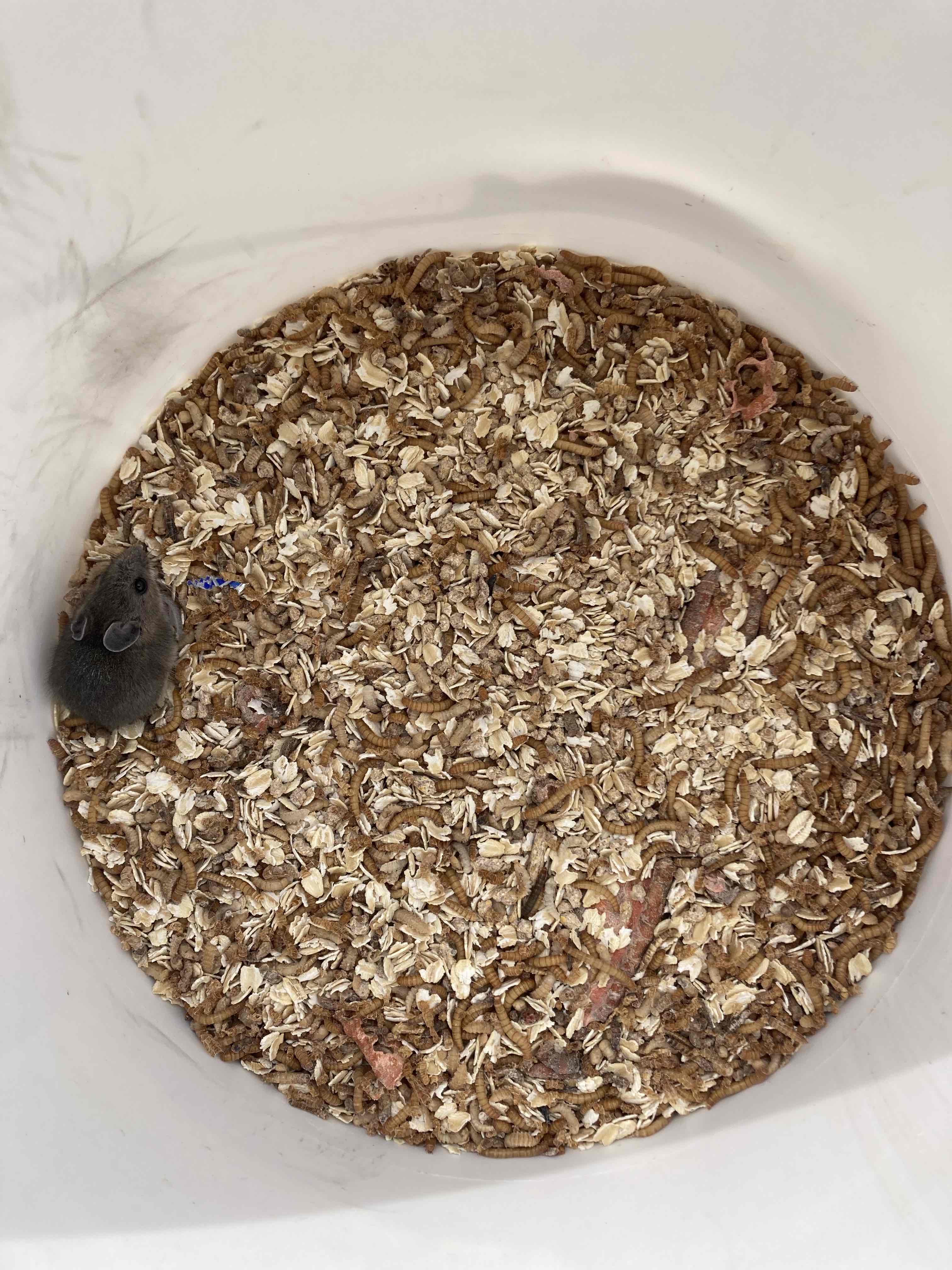
Since I've had to keep mealworms to feed my bat clients over the winter, I've discovered the perfect mouse trap. Mice love to eat mealworms, and with a stack of unused critter keepers, I'd inadvertently made a ramp up to top of my joint compound bucket full of mealworms. Mouse climbs ramp, sees feast, jumps in, can't jump back out. It started with one...


and then came a mama mouse with four babies (how did this happen?? Were they hanging off her teats when she jumped down into the bucket?? Or did each one climb up behind her, see her, and jump in to join the others?) I need a trailcam in my basement. 


All told, I've now caught ten mice (two mamas with broods) in this gentle trap. I am SO glad to get them out of my basement!


I release them in a place where they can have shelter but won't annoy anyone, with a pile of seed to feed from until they find their way.

With the latest white-footed mouse family as impetus, I decided to make a trek up to an old farmstead I used to visit with Chet. I knew the trees and shrubs would be in full bloom around the swiftly decaying house, my favorite combo of weathered wood and colored petals. 


It did not disappoint.

I'd heard toads trilling in the puddles at home, and here in a road puddle was the coiled evidence of their work in the night. 


I must revisit and see if these peaches are any good! The tree is enormous.


It hurts to see the lath fall and expose the old house's bones. One by one the buildings I love have fallen or been torn down, so I photograph them while I can.


Beautiful spirea, weathered lath.


The first tiger of the year in a riot of peach blossoms. I'd see one back at home too, flirting with daffodils...there's not a lilac flower (their usual first food) to be found this early. 


Birdseye speedwell has such a sweet true blue, the first of early spring.

I turned for home, hearing the first yellow-throated warbler of the spring singing his sweet descending  notes from the tall pines along the farm road. 

There was a pair of courting falcate orangetip butterflies at my last daffodils!
Click on the photo, please, to see the orange tips of the male fluttering above the female, who has her abdomen sticking straight up--a butterfly's way of saying "I have a headache."


A chipping sparrow sorted through seed hulls beneath the feeder. They've arrived and are singing, adding their somewhat tuneless trill to the mix of nearly identical trills in my yard.


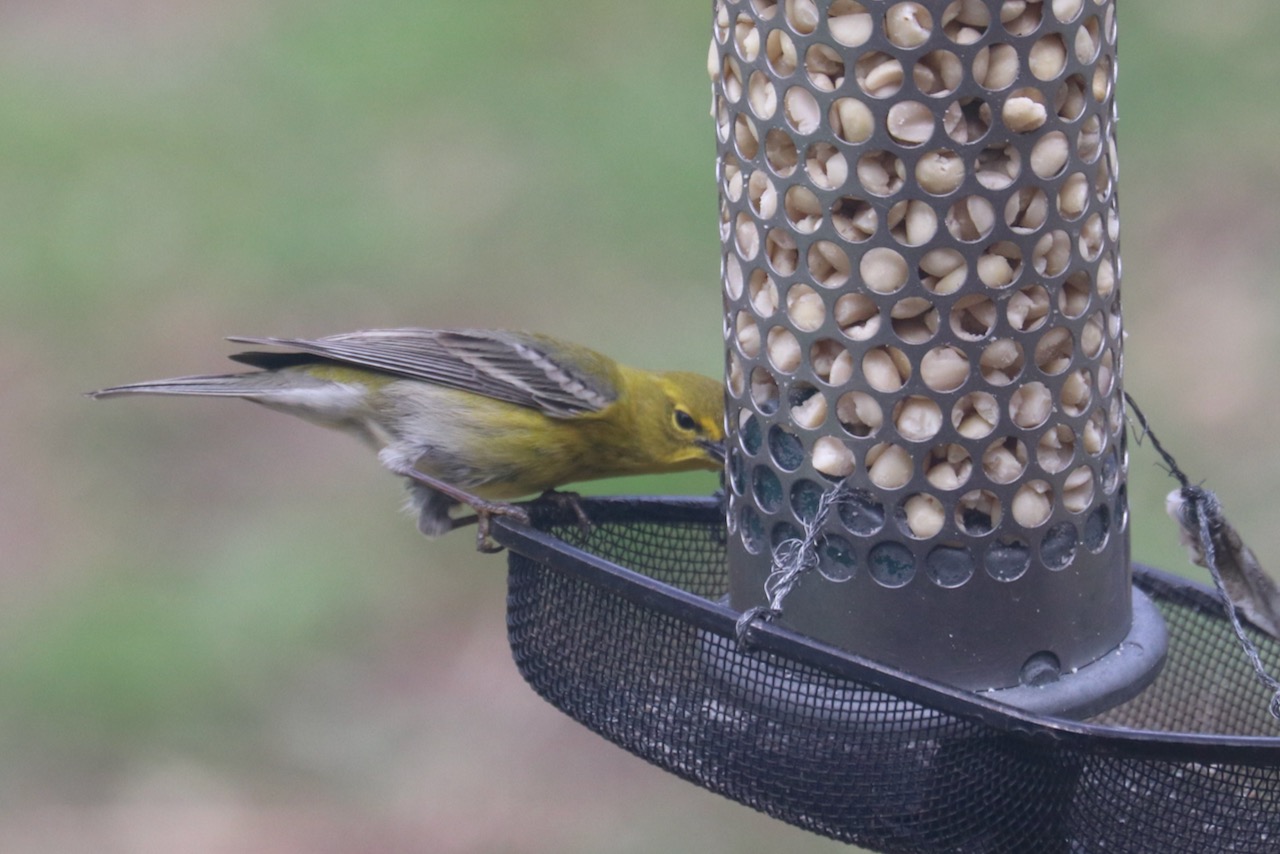
The pine warbler pair is still around; the male expertly extricating bits of peanut


and gagging them down before my delighted eyes.


He sings constantly, his trill softer and more melodious than the more percussive chipping sparrow's...
and more constant in pulse than the looser trills of dark-eyed juncos. It's a lot to sort out for the ear birder!

All this warbler action and the 85 degree temperature on this fifth of April finally moved me to get the WarblerFall going! I've never put it out this early, but like Steven Tyler, I don't want to miss a thing!

I made a presoak bucket of cold water, another big bucket of hot soapy water and a rinse bucket as well, and I commenced scrubbing clean all the flat rocks that had been lying unused all winter. Finally I was ready to construct the WarblerFall.

I plugged it in, got the water music just right and popped into the studio to watch and shoot through the window. First clients were a cardinal and a house finch!

The Carolina chickadee slaked its thirst


and finches gold and house descended again and again. 


A house sparrow took a drink, and then two male brown-headed cowbirds took the first baths,


Maybe you don't like cowbirds. But remember: These are native birds with a very, very interesting life history. And LOOK at them!


 and within minutes, six species of birds had joyfully broken the champagne bottle on the prow of my 2023 WarblerFall. It was so clear to me that they all remembered the setup from last season, and were delighted to welcome it back.

And so was I. I cranked open the studio window so I could hear the sound of fluttering wings and water droplets flying, and together the birds and I welcomed spring with water music. 
I washed the heated pet dish and put it aside, knowing I'll have to watch night temperatures for at least the next month. But it's worth it to see this cavalcade of happy drinkers and bathers again. What a treat, what a delight--the gift that gives and gives.

If you've been meaning to order your WarblerFall plans, don't let me stop you! :) 


THANK YOU for your continuing support!

JZ
 

[Back to Top]