Background Switcher (Hidden)

Goodbye, Clarence

Friday, May 24, 2013

17 comments

Running. Running every moment, trying to keep up with the gardens and the lawn, to plant what needs to be planted exactly when it needs to be planted; to avoid having things die. I can't sit down. Something might die. 

When I'm not planting and mowing and weeding, I'm on the road, always unloading from the last trip and packing for the next. I got in at 11:30 pm last night from a speaking engagement two and a half hours away in Pike County, Ohio. Showed them a good time, met some truly lovely people, had a beer and an impossibly tough ribeye at a roadhouse and hit the road again. Manager gave me $10 off and a bag of peanuts for the road, probably because I was nice about it. It all tasted wonderful. Just a textural thing. I turned around and gave it to the waitress. Not their fault somebody ran that poor steer ragged.


Good thing I enjoy seeing new scenery, new skyscapes, meeting new people, because there's a lot of that going on this spring. Watching the light play on the road, that does it for me.


I've finally unloaded the greenhouse, emptied that sucker all the way out, only to load it up again with tender things just now, because they're calling for upper 30's tonight. I believe it. This morning I shivered in 45 degrees. Walked out the door in a tank top and shorts, turned on my heel and got out the long pants and sleeves again. 45/37 on May 24? Really? I'll have to pile straw on the tomatoes and peppers tonight. It's a familiar drill. I covered and uncovered the peas almost daily through late April and mid-May.

The good news is that the sugar snap peas I so boldly planted in mid-April almost all survived multiple mid-20's freezes, and they're a yard tall and blooming now. This cold snap won't faze them. That was an experiment that succeeded. I've never had yard-tall peas bloom in May before. Whee!

I continue to run every morning, my 2.8 mile route, and I've been taking a small pair of compact binoculars with me so I can watch the yellow-breasted chats do their flight displays; see the last few migrating warblers slip through the leaves. It's enhanced my experience immensely. As much as I love to run unencumbered, some encumbrances are worth it. I'm looking for a nice pair of compacts now that I've thoroughly spoiled myself for naked-eye birding.


This landscape continues to bewitch me, as the haymeadows grow up and new flowers open each day and new birds set up and shuffle territories. I never tire of this road, this sky, these sounds and scents, never tire of watching everything change hour by hour, day by day.


Chet is always by my side, unless he's routing a deer, a squirtle, or that new stray cat we keep seeing. A dog has his work to do.  At eight, he's still solid muscle. No flab on him!

It's a bittersweet time for me. This morning, I bade goodbye to Clarence, who drives the bus Liam and Phoebe used to ride. Each morning, we had 20 minutes to chat (well, chat doesn't really encompass it) as he waited by the little cemetery I frequent until it was time for him to pick up the kids who live at the end of my road. I'd had a nodding, joking acquaintance with Clarence for several years, but when we had regular time for conversation, it got interesting fast. This former Marine was a jungle sniper in Viet Nam, able to go into the forest with nothing but his gun, ammunition and water purifying tablets, and emerge six weeks later, having not only survived it, but done a job too dark to tell. Clarence has stories, and I listened, usually only speaking to ask another question. He's one of the most fascinating people I've met, and I treasured those minutes. 


It's probably my writer's ear and the fact that I just like him that made me want to hear Clarence out. He often complained that I knew everything about him, but he knew nothing about me. I'd laugh then, and tell him he doesn't need to know about me. Nothing to know anyway. Compared to him, I'm nothing; I've never suffered real privation or had to do anything terrible. I'm like a sapling. He's a weathered oak, growing on rock.

It's not often you meet someone who has done things and survived ordeals that you cannot even imagine, and will tell the stories that go along with that. He saved one of the best stories for last. Yes, I've written them down, but I don't know what I'll do with them. They're his.

Now he's retiring, and the world being the way it is, I know I won't get to see him any more. I'll miss him terribly. I know he'll miss me. And I wonder how much of my desire to run every morning, rain or shine, ice or snow, was tied up in getting a new story each day. In giving an ear to someone who would otherwise not be lent one.


Full many a flower is born to blush unseen, and waste its sweetness on the desert air....Some mute inglorious Milton here may rest, some Cromwell, guiltless of his country’s blood.

Thomas Gray’s “Elegy Written in a Country Churchyard” (1751)

I think about what led me to listen for so many hours to a man who'd otherwise be sweeping out and cleaning his bus in those idle minutes each morning, lost in his own thoughts as I'd have been lost in mine. To peel back the layers, to try to understand what has made him who he is, to make a connection, build an enduring friendship. John Burroughs came close to describing it.


The lesson which life repeats and constantly enforces is 'look underfoot.' You are always nearer the divine and the true sources of your power than you think. The lure of the distant and difficult is deceptive. The great opportunity is where you are. Do not despise your own place and hour. Every place is under the stars, every place is of the world. 

And somehow, this one works best of all.

Even after all this time, 
The sun never says to the earth,  "You owe me." 
...Look what happens with 
A love like that. 
It lights the whole sky.

Hafiz of Persia 


Thanks to Tim Ryan for the Burroughs quote, and to Dirk Coburn for Hafiz.  And to Clarence, for all the stories.

Watercolor's so HARD!

Thursday, May 16, 2013

7 comments
The most oft-repeated and least true thing that gets said about watercolor.

"Oh. You paint in watercolor?? Watercolor's so HARD!"
Always makes me scratch my head. It's this thing that people who've never even tried watercolor say. It's this thing that people who've tried watercolor say. And I think they repeat it because everybody else says it. But...harder than what? Acrylic? Oil? Pastel? A rock? Diamond drill bits?

It may have something to do with the fable that you can't correct anything in watercolor after it's dried. Not so. I'm here to show you how.


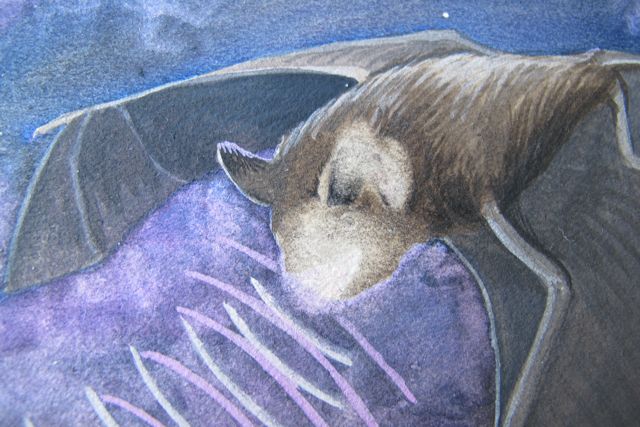
As an illustrator, you do a lot of stuff. You get asked to illustrate things about which you may know next to nothing. Before the Age of The Google, you were stuck with what reference in books and magazines that you could get your physical gloms on.  And it was in this Age of Innocence that I painted a big brown bat using echolocation, for a Bird Watcher's Digest booklet by Rob and Kim Mies titled, "Understanding Bats."

I did my best, and my best pretty much sucked. I didn't know anything about bats, and I kind of made up the face. Maybe there's a bat somewhere on the planet that looks like this, but it sure isn't a big brown. Some kind of weird African mastiff bat, maybe. And those teeth? From hunger.

So Bill asked if BWD could re-use this and a couple of other paintings for  a new, revised edition of the "Understanding Bats" booklet. Sure, I said, and miraculously, and after four passes through a 12-drawer oaken flatfile, I finally found the originals. 

And was aghast. I couldn't let THAT fugly face go to print, with all I've learned and all I've loved about bats between 1996 and now! I remember it was 1996 because I was pregnant with Phoebe when I painted it, and Rob and Kim (then of the Organization for Bat Conservation) let me watch them feed their bats in their camper trailer in the parking lot of BWD. And I was all uncharacteristically spooky about contact with the bats and being pregnant and disease and stuff. Being pregnant will do that to you. Fortunately it was a correctible condition.


As was the mastiff-like face of the bat. Eminently correctible, even 17 years later. What you do is


you dip your brush in clear water, pool it on the offending area, and scrub. 


You suck up the pigment and the bad juju in the brush, rinse and repeat. If the ear's bad, you scrub that out, too.


And then when it's all dry, you paint a big brown bat face what am a big brown bat face over the scrubby part. Better. Far from perfect, but not fugly.


And the whole thing looks a lot better for it.


Ryan Amos, Big Brown Bat. Note blunt-tipped tragus. If he were a little brown bat, it'd be pointed and narrower.

Speaking of bat faces, I've been doing some retro-research on the True Identity of Ryan Amos and Drusilla, the two purported big brown bats I took through this past winter. I finally knuckled down and consulted some field guides. Couldn't make hide nor hair of the differences using photos in the Kaufman Focus Guide, because they didn't show the tragus (the little process in the front of the ear); nor did they show the back feet of big brown or little brown bats.

So I consulted Fiona Reid's Peterson Field Guide to Mammals of North America, which uses her careful watercolor paintings. And then it was clear. Both my kids were big browns, with a wide, blunt (not pointed) tragus, and short hairs (not long hairs) on their hind toes. Yes, these are the distinctions we use to differentiate bats. It's subtle stuff, and I'm always questioning myself. Do I even know what I'm looking at?? They looked like big browns; they acted like big browns (feisty as all get out, and bitey too), but they were small (15 gm for Ryan, and 17 for Dru). And I wondered. Now I know.

Yahoo. Here's to watercolor painting, here's to paintings in field guides, and here's to the search for truth and somewhat improved beauty.

And making your mistakes into birds. Yeah, they're birds now.

Painting Imperial Woodpeckers-Part II

Tuesday, May 14, 2013

6 comments

Why do I mask all those nitty pine needles, and cuss for hours trying to clean up the boo boo's that masking fluid always leaves?

Because, with enough cussing, it winds up looking cool. Realistic. Ooh! Almost time to paint the birds!! It's been a long day, and I've got more to do on the habitat first. I go into the second day of painting, still cleaning up pine needles.

Those rough scumbled edges on the trunk shadow are deliberate. I want to make sure it still looks like a painting, not a photograph. I want the paint and the process to show around the edges.


I'm excited to start the birds. I always start on the feet. They're non-threatening, fun, hard to mess up, a good place to start. I have to get in the mood to switch from habitat to birds.


Huge claws, and from what I can tell from skins, they were pale--horn-colored, perhaps-- as were the scutes on the legs and feet. I recall Nancy Tanner, widow of ivory-bill authority James Tanner, telling me that ivory-billed woodpeckers had very pale, whitish feet and claws, so I go with her advice and my hunch. 


Here she comes, emerging from the clouds. The strongly recurved crest is typical of a female imperial woodpecker. Female ivory-bills showed it too, to a lesser extent.


I try to convey how bouncy it looks in the video. I decide to paint all the blacks on the male, too. I'm guessing on eye color. I have always thought their eyes would be more white than yellow, though most artists depict them as strong golden-yellow. I tend to follow George Sutton's lead, because he painted ivory-bills from life. That's as close as I'll come to knowing the eye color of the imperial.


See how, in painting the sky wash, I've swept a little blue in where I know the white wing patch of the climbing bird will be? I knew I wanted that white patch against blue. These decisions must be made quickly. Wet washes won't wait.


Here comes the red of the male's crest.


That's why I've made him emerging from the hole--so I can put that red against the tree trunk.


Shadows on the birds, highlights in Chinese white stroked across their foreheads and shoulders...I think I'm done. Never mind the pinkish sky here--snapped late at night under incandescent and flourescent light.

The next morning, when the sun finally breaks through, I take the piece outside to photograph it with my Canon 7D. It does such a good job, handheld, that I can see the texture of the watercolor paper (140 lb. cold press Winsor-Newton) in the jpeg. And it nails the colors. Amazing color shifts occur under flourescent and incandescent light.  Pardon the progress photos--they were snapped in varying light conditions (mostly poor) and some with my iPhone. I was working so fast I could hardly stop to photograph it. When it's going well I don't stop even to eat. I keep a jar of almonds on the table and keep going.


That's how I work best--with a wicked deadline. See the painting and my review for The Wall Street Journal here.

Or, if you click on this image, you can probably read it right now.


Photo by Myra Owens, kindly scanned and sent to me. Couldn't find a Weekend WSJ in Marietta...but some hard copies are on their way as we speak. 


[Back to Top]