Background Switcher (Hidden)

From the Heights: Vultures, Deer, and Remembering Bill

Friday, February 14, 2020

4 comments
We’re back in Extremadura, Spain, because vultures and deer. Big birds like griffon vultures were easier to capture than the little birds. Do click on these; they're quite nice if you can see them at size.


I loved the griffons. We watched them for much of the day. This one is building its nest in a likely cranny.


This one may have been feeding on a bloody carcass, as its head was stained red. I wondered how so many huge vultures found enough to eat. I understand there are feeding stations where cattle are laid out for them. Knowing how vultures are suffering and declining worldwide, it’s comforting to see them being subsidized here in Extremadura.

I was grateful to see so many griffon vultures sailing by with comfortably full crops and bloodied heads.


Phoebe, Liam and I climbed to the top of a tower to see the countryside. We did a lot of that, climbing cathedral towers and castle towers, always looking for the eagle's vantage point. 


Ah my beautiful babies. How I reveled in being with them for two weeks. We never got sick of each other. That alone makes my heart sing. To see their enduring love for each other...I can paint and write for the rest of my life, but these two and that love they share is the most beautiful thing I've somehow, inexplicably produced. Had a lot of help from their big sweet crazy dad.


He would have loved showing us Extremadura. We laughed about how goal-oriented he'd have been, searching for the golden eagle, the gigantic black vulture that we somehow spotted the second we entered the park. We looked, too, but we didn't find eagles, and that was OK with us. It wouldn't have been OK with him! He was a goaly guy.

They’re somewhere out there, and that was enough for us. We didn’t have to go chasing over hill and dale to find one. We felt him with us. How could he be anywhere else? If you could see him at 20...he looked an awful lot like this beautiful boy.


You'd have to love wind to live here. Wind sculpted our hair every second.


Me, lugging all necessary optics, all the time, up hill and down dale. 
I was thoroughly encumbered. Once in awhile I'd give Liam my camera to carry, and think how lovely it would be to have a personal porter.


Gliding down, flaps lowered...I imagined my great wings carrying me like a hang-glider, my legs dangling down.


It looks like such fun to dip and dive over this landscape, to ride on the wind instead of standing around fighting it.


And then we rest...

Some of the vultures were carrying twigs and greenery for their nests, before Christmas! Seeing such a majestic and mysterious bird carrying a little sprig of greenery moved me. You could see its goal, there in its bill. It had a thought in its mind and was carrying it out.


After having seen the stag swim the river, we were thrilled to see an Iberian hind and her fawns feeding amongst scattered boulders on a hillside. This is Cervus elaphus hispanicus, the Iberian red deer.


These creatures are much larger and longer legged and lankier than our whitetail; they're very much like the Scottish red deer, which is built more on an elkish body plan. Both European red deer and American elk are in the genus Cervus. Interestingly, Cervus is a primarily Eurasian genus, and our wapiti is the only representative in North America, and certainly the largest of any Cervus worldwide. Our elk are just hyooooge compared to Iberian deer, but this is still a whole lot of animal!


I was most delighted with this shot of three running amongst the rocks; the way they're in focus but the rocks aren't. Please click on it! It looks like a diorama if you embiggen it.


That evening, an Iberian stag cut right in front of our car, and Liam grabbed the moment. December 21, the Winter Solstice, was a charmed day with my sweet family, and it wasn't over yet!


This post is a little Valentine to my Liam and Phoebe. Your mama is very far away at the moment, but I hope you can feel my love hurtling on clumsy wings through an Ecuadorean rainstorm, up over the Andes, over the Gulf of Mexico, up through the Appalachian chain, and dropping down into Morgantown. Then it’s picking up again, crossing the winter Atlantic, and zeroing in on a certain girl in mainland Spain right now. You can close the windows and bar the doors, but it’s coming in.


Birds and Hogs, Cranes and Dogs!

Sunday, February 9, 2020

12 comments
These photos were taken Dec. 21,  2019, on Liam's and my epic trip to mainland Spain to be with Phoebe and, later, Oscar and his family way out in the Canary Islands. Despite my life's barrelling on apace, I am dogged about getting this Spain stuff posted, so my kids and I will have something semi-coherent to remember the trip by. I can see by the numbers that you really prefer the day-to-day Indigo Hill reportage, and I get that. It's more accessible and personal.  I thank those of you who stick with me here on the blog as I travel a bit.  

Monfragüe National Park in Extremadura, south central Spain, is a wild and windy place. Being winter, it was also cold, though I understand it can be broiling hot in summer. We carried on despite the howling wind, and managed to see some sights and some wildlife.  
This is a very distant blue rock thrush. I'm sure in proper light it's lovely, its blue being more of a slate color. There are similar birds in South Africa.


The cork oaks in the dehesa forest are laid out so regularly you wonder if they were planted like this, or if they somehow assert their space and keep all other oaks away with root poisons. I don't know the answer to this. I've been rooting around to try to understand more about this strange oak savannah ecosystem. Suffice it to say it's probably anthropogenic in origin, and dates back thousands of years, yet it provides both for livestock and wildlife in myriad ways.


 It's an acorn-based economy! Sheep and pigs and cattle graze the grass beneath the oaks and wild olives; shepherds take the sheep, especially, to the highlands in summer, which prevents overgrazing of the dehesa plain, in a process called transhumancia. It's much like the cattle drives of the old American west, but it's still going on.


I was beyond thrilled to get a close look at a Mastin de Extremadura, and a brindle one to boot! This Spanish mastiff, a specialty of the region, was wandering out by the road, with no humans in sight, but his job is to guard the sheep. These dogs are raised with sheep from the time they're tiny; they seem to think they're sheep, and want only to be with sheep. But let someone approach their herd, and their protective nature comes out. They'll follow you with the evil eye until you give up the pursuit. And they can back it up with massive jaws and great speed.


I just couldn't get over the beauty of this dog, with a tail like a tiger's, and brindle stripes running through its long fur. I will admit to a new fascination with brindling. Not sure where that came from.


It wanted nothing at all to do with us, and retreated to the top of the bank.


There, I got a shot of its kind and gentle face. Still, not a dog to be challenged or trifled with. It's got a job to do!


I will sit here until you drive away. Please go away. I have sheep to guard.


Meanwhile, nicely rounded Iberian hogs and sheep, cattle and goats, kept in by wire and impossibly ancient mortar-free stone fences, all eat the acorns that fall from the oaks, and that  diet gives the hogs' hams their unique flavor. But they're not the only ones who eat the acorns. 


Cranes (which look like nothing unless you click on the photo) do too!


Click on the photo to see a juenile crane, with its featureless head. This was as close as we ever got to them, and they were in a hurry to right that wrong, walking off immediately.


I managed to catch a few in transit.


The hogs were pretty wild, too, come to think of it.


Cattle were more approachable.


A couple of the famous fighting bulls for which the region is known. Oscar is a born Spaniard, but he detests bullfighting, as do many of his peers. One hopes we are entering a different age, one a bit more advanced than that of the Roman emperors and their bloodlust.


There was so much to take in here that my mind was whirling the whole time. The interconnectedness of the dehesa oaks and olives; the livestock living cheek to jowl with cranes and vultures and azure-winged magpies


You may be quite sure I bemoaned my craptastic shots of these beautiful magpies. You can only see their azure if you click. Oh how I wanted to be closer, but they were too wild.


A crested lark amongst the cowpies. We loved his up-do. 

A beautiful linnet in winter plumage!

Linnet reprise.

A pair of siskins with Moorish architecture behind.


And a wood pigeon. Man, I was under-equipped in the camera realm. An 800 mm lens might have gotten something; my 300 was smoking and still I got so little. No wonder European birders flip all the way out when they come to America and especially the Neotropics. It's like a dang petting zoo compared to Extremadura. 

A confiding great tit. It was wonderful to have any bird confide in us, so skittish were they all. There aren't many bird families whose European representatives are prettier than the American species, but man, the tits in Europe are really beautiful. Insert whatever middle-school level joke you wish here _____________.  I saw long-tailed tits flying over Caceres this same evening, but getting photos of them would have been an impossible dream.


All right. I've gone on long enough. Until next time!! Olé!


In a February Mood

Saturday, February 1, 2020

18 comments
There comes a point, after weeks of ungodly dark and dreary days, unbroken by any hint of sun or warmth, when one's own company wears thin.

It takes a lot to break me down, probably because I now have something concrete against which to measure any sadness, especially the slight, niggling sadness brought by dismal weather. So what. It's gray for months on end. My friend Hank said that bad weather looks worse when you're looking out the window. Get out in it. It takes a surprising amount of fortitude to go out, looking for adventure, when the light is as flat and dull as a mall parking lot.

But we do go out. We have to put some miles on the dog, and on me. I decided to follow my nose and pick a road I'd never been down (or, in this case, up). 
It's not hard to find those around here. 


To get there, we walked past this old jewel, moldering in an overgrown field. I've paid several visits to this house, but they've been in summer. I like to poke around abandoned places to see what denizens of their gardens have survived the neglect.


You can't kill a ditch lily, even if you try. Ah, this was a beautiful day at the old place, a not-February day. I had fun snooping around the foundation and outbuildings. Just the reflection of a blue sky in the window cheers me.

But now we are here in February, in the weeks before the woodcocks get back, and this is what we get: gray and brown and wet and not much else. Living here, I realized as I gazed at it this evening, would have been problematic even when the place was tended. Whipple Run lies between the house and the road, so you have to ford it to get out, and ford it again to get home. Not a big deal now, but let it rain torrents for a few days, and you've got a situation on your hands. 


Water will do what it will. It seeks the lowest point. Thus, what was once a driveway is now a streambed. We have a way of inviting water down our paths. We grade them until they're lower than the surrounding land, and water will always oblige us,  running in to take the low road. 


My boots were not up to the fording, so we walked on. 

Mood:


Ah, February, you old, cold, wet blanket. Are you trying to outdo your nasty sister January? 

I wonder what's up this road? 


First there was a pool with a nice sandbar, a little oxbow backwater. I scanned the muddy trunk of the drowning tree and found what I was looking for: mustelid tracks.
Hoping for otter, I settled for mink. Mink will do.

A light rain pattered on the surface of the water. We pressed on anyway.


Turns out there wasn't much up this road but woods, which was fine with us.


When I got to the top of the hill some messages came in on my phone. 
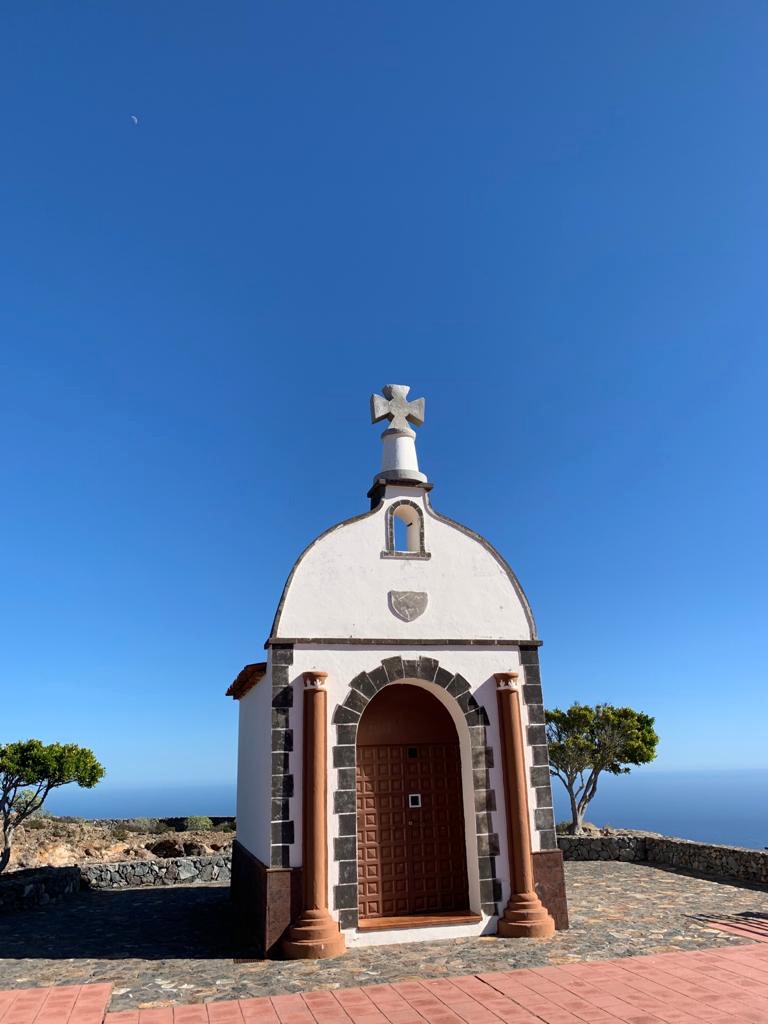
 Phoebe had rented a little smart car on La Gomera for the weekend and done some exploring. While I trudged down a muddy road in Appalachia, gazing at a house bound only for rot and ruin, she had made a pilgrimage to find a wee chapel she'd once spotted from far below. 

She was not disappointed. There it stood, sharp as an amethyst in the clear Atlantic sunshine.


And the climb up there had looked like this. Oh, what I'd have given to take that hike with her!


And she and Oscar had ended the day like this:


Oh, to be young and in love. 

I'll take middle-aged and still alive, with everything more or less still functional, because it's what I've got.

What is it that keeps us in place? Why do I choose to live in a place that weeps all winter long? Why does my daughter choose to live in the sunstruck glow of a rocky island, the sea all around her? That second question needs no answer.

Why does it not occur to me to leave, to strike out for someplace new?
I search for answers, and find I don't want to leave here. I'm scratching and clawing away at my house, throwing out what I don't need (nearly everything); trying to get it back in repair, so I can stop worrying about the rot and malfunction of it all, and enjoy it instead. It's a goal. The old furnace seems to need about a grand a year just to keep running; I've replaced everything you could replace on that damn thing.  I'm having new siding put on the tower, rooting out the wall rot on the north side (and wherever else it comes up.) Braced for the worst.

 I love working in my studio, starting new projects, watching for my old jay friends, and dreaming of seedlings coming up in only a couple more months. And then it will be garden time, and there's no place I'd rather be in garden time. And just as it's garden time, I'll take off on a book tour (see left sidebar of this blog). So there are things to look forward to, and boy do I look forward to them.

I'm choosing to vary my life with travel, to give myself enough outings to counter the sameness of remaining in place. I feel the press of time, the impermanence of my stay on this earth.  I have become one of those women who travel more, because they suddenly can. But I also travel more because I need to. I get so much more out of it than ever before. 

I'm trying to be kinder to myself, knowing that I'm still grieving. Something like this doesn't go away in a year. It becomes part of you, and it colors your outlook, not necessarily in a bad way all the time. It makes you grateful to be here. It makes you so happy to feel joy again, when it happens. It makes you expect less of life, having seen how easily it can be grabbed away. So when something good happens, you're just bowled over that it was so good. And when bad things happen, you measure them against the mother of all bad things, and they don't look that bad to you. Still, you're always looking over your shoulder, and I don't expect that to change. You have to keep an eye on something that big.

As the anniversaries, big and small, portentious and life-changing and merely depressing, parade by in my psyche, I find myself walking over to gaze at the house where Bill lived for a short time, where he grilled and laughed and played music, then suffered and died, finally leaving the suffering, and us, behind.

 I don't know what I expect to find by going over there. There's nothing I'll get from it but little  shards of memories, the sharp ones that dig in. There's no one to tell me I should stay away, so when I'm drawn there, I go. The place seems so much smaller, so diminished, without him in it. And he's not there. I sense nothing of him there. 


But I keep going. I guess I'm looking for a connection, the same one I'm looking for when I walk to his grave each morning. What doesn't seem right to me is that there should be nothing of him left here. The kids struggle with that, too, that feeling of being left alone. He had such a big soul, such a huge appetite for life, that it seems there should be a trace of that still around. Seems like he should be tossing the treetops on a still, wet day.

 Nothing moves, and not a bird sings. 


[Back to Top]